
NVPH materials · Thane district, Maharashtra
Naturally ventilated polyhouse material for Navi Mumbai
By Editorial Team, Kryzen Biotech · Updated 13 November 2026
A naturally ventilated polyhouse can work in Navi Mumbai, but it needs active curtain and shade management through the hot April period and especially the wet, humid monsoon. For a crop that needs reliable summer temperature control, fan-and-pad cooling is the stronger option; for capsicum, cucumber, tomato and flowers with practical seasonal planning, an NVPH is a lower-running-cost route.
- Hottest month
- April, ~38°C
- Humid (75%+)
- 5 months
- NVPH material, 1 acre
- ₹734/m²
- Delivery
- Next day
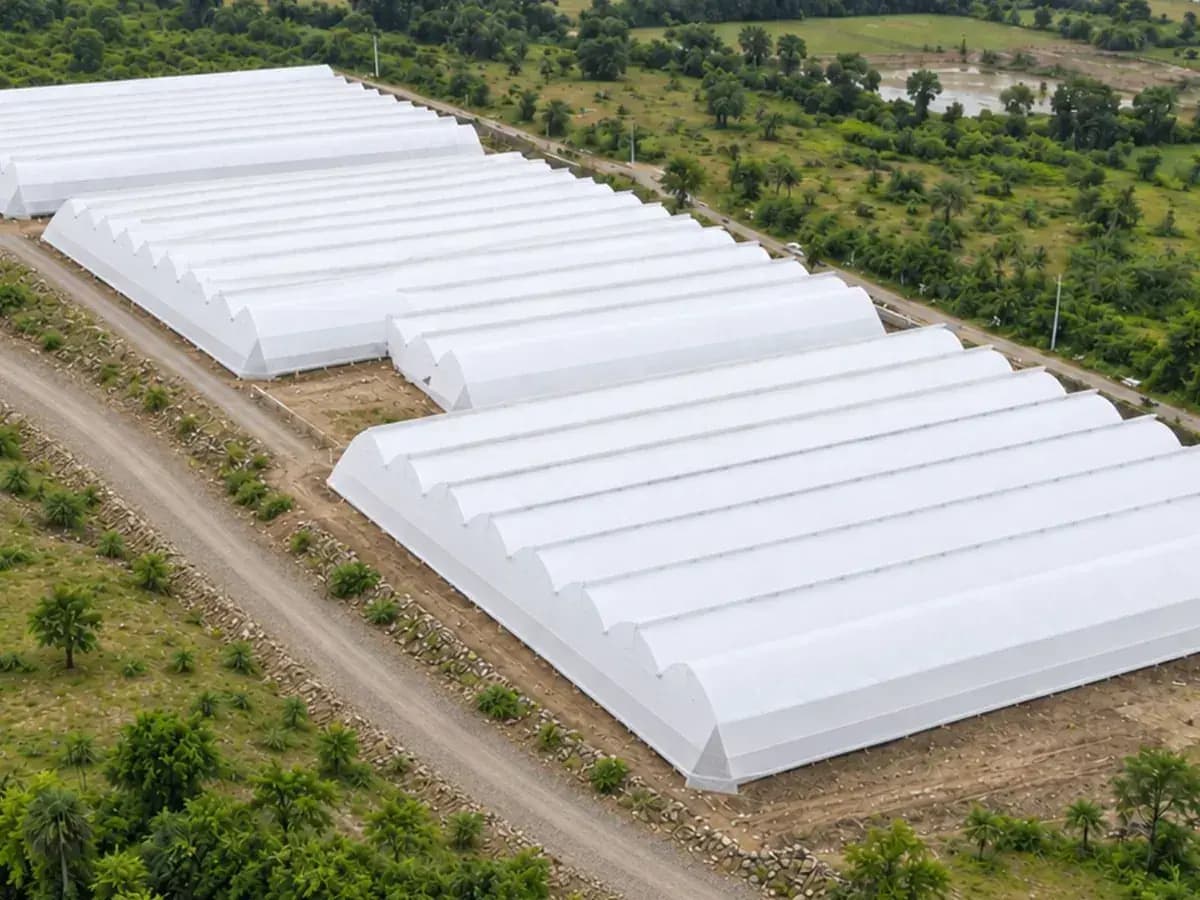
Operate vents, curtains and shade by season
In January and February, open the side curtains after conditions warm and keep the crop exposed to maximum useful light. These are also the months to inspect ropes, pulleys, springs, insect net and the roof vent before the heat and rains. The listed nethouse season is November–February, which reflects the relatively mild period, but an NVPH still gives a protected environment for planned crops.
From March through May, raise side curtains fully during the hot part of the day and keep the roof vent working freely. In April, close the shade net or second shade layer above the crop during peak heat, then manage it to avoid unnecessary loss of light. Irrigate early in the day. April has only 3 mm average rain, so heat is the main issue rather than rain protection.
During June–October, close curtains when rain blows in, then reopen them whenever rainfall stops and conditions allow. Do not keep the house sealed for long: humidity is 80% in June, 90% in July and August, 89% in September, and 78% in October. Run air-circulation fans in the morning, keep crop spacing practical for airflow, and remove plant debris promptly. Before June, clear every gutter and funnel, check film tears and tighten GI springs. The table and calendar below set out the key seasonal checks.
- April: curtains fully up, shade layer closed over the crop in peak heat, early irrigation.
- June–October: use curtains to block rain, but reopen between showers; prioritise air movement.
- Before July: clear gutters and funnels because July averages about 834 mm rain.
- November–February: schedule structural maintenance and main planting in the dry, milder period.
| Month | Jan | Feb | Mar | Apr | May | Jun | Jul | Aug | Sep | Oct | Nov | Dec | Detail |
|---|---|---|---|---|---|---|---|---|---|---|---|---|---|
| Peak heat | ~38°C highs | ||||||||||||
| Strongest sun | 7.2 kWh/m²/day | ||||||||||||
| Wettest month | ~834 mm | ||||||||||||
| Humid (75%+) | June–October | ||||||||||||
| Nethouse season | November–February |
- 1
Before July
Clear gutters and funnels, check the film for tears and tighten the GI springs. July brings about 834 mm, the heaviest rain of the year.
- 2
June to October
Humidity stays at 75% or more. Keep side curtains open whenever it is not raining and run air circulation fans in the mornings; space plants a little wider to cut fungal disease.
- 3
April
Peak heat, about 38°C. Roll the curtains fully up, close the shade net or second layer over the crop, and irrigate early in the day.
- 4
November to February
The dry, mild stretch. Open the house for maximum light, plan the main planting and do structural maintenance.
Material choices suited to the rain and humidity
The base roof covering should remain 250-micron white diffused, UV-stabilised polyfilm. It spreads the strong April light more evenly. For shading, an aluminium reflective shade net is the recommended change over the standard white 50% shade net because it reflects heat outward at around 38°C conditions. Add a second net layer operated with ropes and pulleys, so it can be opened or closed with the season rather than remaining fixed.
The essential climate upgrade is an air-circulation fan. Roof vents and curtains exchange air with the outside; the circulation fan moves air through the crop during the five humid months, helping leaves dry after humid mornings. It is not a substitute for fan-and-pad cooling, but it is a practical addition for humidity management in an NVPH.
Keep the GI gutter sheet and funnels, but make gutter cleaning a pre-monsoon job. An aluminium door is preferable here because heavy rain does not make it warp or swell. Include an entry cabin with double doors where pest exclusion is important: it helps limit whitefly and thrips entering when people go in and out. Side insect net and the skirting apron remain important parts of the sidewall system.
- Keep: 250-micron white diffused roof film and GI gutters.
- Use: aluminium reflective shade net and a second, adjustable net layer.
- Add: air-circulation fans for June–October and an aluminium door for wet conditions.
- Include: an entry cabin where controlling insect entry is a priority.
| Part | Standard kit | For Navi Mumbai | Why |
|---|---|---|---|
| Roof film | 250-micron white diffused polyfilm | Keep | Spreads April's 7.2 kWh/m²/day of sunlight evenly |
| Shade net | White 50% | Aluminium Shade Net (4 m) | Reflects heat back out at 38°C |
| Second net layer | None | Add (double layer) | Open or close it by the season with ropes and pulleys |
| Air circulation | Roof vent + curtains | Air Circulation Fan | 5 humid months: moving air keeps leaves dry |
| Doors | FRP (fibre) doors | Aluminium Door | Heavy rain: aluminium does not warp or swell |
| Gutters | GI gutter sheet + funnels | Keep | July brings ~834 mm; clean before June |
| Entry cabin | Optional | Include | A double door keeps whitefly and thrips out when people walk in |
The material kit and current ex-factory price
Polyhouse Constructions, a venture of Kryzen Biotech Pvt Ltd, manufactures complete NVPH material kits at Degaon on the Pune–Bangalore Highway, Tal. Wai, Satara. We supply material to Navi Mumbai from the Satara factory; we do not have an office in Navi Mumbai. Delivery is listed as 1 day after dispatch. Erection, where required, is done by Kryzen Biotech’s construction team.
A complete kit combines the GI structure, polyfilm, side insect net, shade net, gutters, profiles, brackets, springs, rope and fasteners. The largest listed 52 × 76 m kit has 68 items and about 16.8 tonnes of steel and fittings. The live kit list below shows examples such as the Big Bottom, columns, gutter purlins, arcs, white diffused film, side insect net, white shade net, aluminium profile, F brackets and nylon rope. Build online for the exact span and bay to see each line, quantity, weight and current rate.
This week’s material-only, ex-factory prices including GST are ₹4,68,814 for 20 × 24 m (480 m²), ₹8,59,963 for 28 × 36 m (1,008 m²), and ₹28,99,897 for 52 × 76 m (3,952 m²). Freight to Navi Mumbai and erection are extra. Rates follow weekly GI and plastic pricing and are updated every Friday; booking is with 5% advance and 95% before dispatch.
- 20 × 24 m, 480 m²: ₹4,68,814, or ₹977/m².
- 28 × 36 m, 1,008 m²: ₹8,59,963, or ₹853/m².
- 52 × 76 m, 3,952 m²: ₹28,99,897, or ₹734/m².
- GI structure warranty: 15 years; polyfilm: 2.5 years; nets: 3 years.
| Size | Span × bay | Area | Material incl. GST | Per m² |
|---|---|---|---|---|
| Small | 20 × 24 m | 480 m² | ₹4,68,814 | ₹977 |
| Medium | 28 × 36 m | 1,008 m² | ₹8,59,963 | ₹853 |
| About 1 acre | 52 × 76 m | 3,952 m² | ₹28,99,897 | ₹734 |
Price your own size for Navi Mumbai
Choose span and bay and get the full list with quantities, weights and rates in a minute.
Crop planning around Thane mandi price seasons
Choose a crop for the structure and crop calendar first, then use market price seasons as one input rather than a guarantee. The Thane district data covers APMC Kalyan, Kalyan, Murbad and Shahapur markets and related listed market names. For an NVPH in Navi Mumbai, cucumbers, capsicum, tomato and flowers are the crop categories identified as suitable; cucumber is a fast 3–4 month crop, while capsicum can be managed under shade in the hot period.
Cucumber has an average modal price of ₹2,202/q across five markets, a high of ₹2,732 in December and a low of ₹1,686 in February. This makes harvest scheduling toward the clearer November–December window worth considering, while the crop must still be planned around its actual growing duration. Capsicum averages ₹3,893/q across seven markets, with its listed high of ₹6,111 in July and low of ₹2,614 in February. A July price high should be weighed against the production challenge of 90% humidity and 834 mm July rain.
Other options depend on your crop experience and pest/disease management. Green peas show the highest listed average among these crops at ₹9,410/q, with ₹12,125 in November and ₹6,785 in March. Okra peaks at ₹4,479 in December, while beans, ridge gourd, brinjal and green chilli all show listed highs in July. Those monsoon-price patterns do not remove the need for airflow, disease control and careful rain management inside an NVPH.
- Cucumber: highest listed price in December, ₹2,732/q; lowest in February, ₹1,686/q.
- Capsicum: highest listed price in July, ₹6,111/q; lowest in February, ₹2,614/q.
- Green peas: highest listed price in November, ₹12,125/q.
- Use the market table as historical price information, not as an assured future rate.
| Crop | Markets | Average modal price | Highest month | Lowest month |
|---|---|---|---|---|
| Okra (bhindi) | 8 | ₹3,376/q | Dec (₹4,479) | May (₹2,446) |
| Green peas | 3 | ₹9,410/q | Nov (₹12,125) | Mar (₹6,785) |
| Beans | 6 | ₹4,475/q | Jul (₹6,932) | Jan (₹2,290) |
| Bitter gourd | 8 | ₹3,310/q | Jun (₹4,667) | Oct (₹2,336) |
| Cucumber | 5 | ₹2,202/q | Dec (₹2,732) | Feb (₹1,686) |
| Ridge gourd | 5 | ₹3,636/q | Jul (₹5,548) | Oct (₹2,513) |
| Capsicum | 7 | ₹3,893/q | Jul (₹6,111) | Feb (₹2,614) |
| Green chilli | 4 | ₹4,056/q | Jul (₹5,774) | Sep (₹2,734) |
| Brinjal | 7 | ₹2,949/q | Jul (₹4,493) | Feb (₹2,087) |
| Bottle gourd | 6 | ₹1,689/q | Jul (₹2,732) | Apr (₹1,276) |
When fan and pad is the better decision
For many crops, an NVPH is appropriate because roof vents and side curtains provide cooling without power consumption. Its listed material price for about 1 acre is ₹28,99,897, or ₹734/m². This is suited to capsicum, cucumber, tomato and flowers in Navi Mumbai when the crop programme accepts seasonal variation and the operator manages shade, curtains and humidity well.
Fan and pad should be considered where a crop needs tighter summer control, particularly leafy greens and crops that cannot tolerate high internal temperature variation. In April, fan-and-pad cooling is listed at about 32°C inside, versus an outside average high of 38.4°C. It has electricity use for exhaust fans and a pump, but it offers more active cooling when natural airflow is not enough.
The listed fan-and-pad material price for about 1 acre is ₹32,48,775, or ₹822/m², compared with ₹28,99,897 for NVPH. The decision is not simply the price difference: choose NVPH where ventilation, shade and crop timing fit the crop; choose fan and pad where dependable April cooling is central to the production plan.
- NVPH cooling: roof vent and side curtains, with no cooling power cost.
- Fan and pad: exhaust fans and wet pads, about 32°C inside in April.
- NVPH material price, about 1 acre: ₹28,99,897.
- Fan-and-pad material price, about 1 acre: ₹32,48,775.
| Naturally ventilated | Fan & pad | |
|---|---|---|
| Cooling | Roof vent and side curtains (no power) | Exhaust fans and wet pads, ~32°C inside in April |
| Running cost | None for cooling | Electricity for fans and a pump |
| Material price, 1 acre | ₹28,99,897 (₹734/m²) | ₹32,48,775 (₹822/m²) |
| Suits in Navi Mumbai | Capsicum, cucumber, tomato, flowers | Leafy greens and crops needing tight control in summer |
Ordering a structure built for the site
A kit should be planned for the crop, chosen span and bay, ventilation arrangement, shade system and entry requirements before ordering. Our GI pipes are ISI-marked branded steel from Tata, Jindal and JSW. In-house engineering and manufacturing, a 32-point QA checklist, a lab test certificate with dispatch and a technical data sheet for every product are part of the material process.
For a subsidy-linked project, confirm the current position with the state horticulture department before work begins. MIDH/NHM is stated as 50% of the cost norm up to 4,000 m² per beneficiary. NHB commercial projects above 2,500 m² need In-Principle Approval before starting and have a credit-linked back-ended subsidy framework. The attached guide explains the applicable process for a Navi Mumbai project.
- Start with crop and cooling choice, then finalise the structure and kit quantities.
- Check gutters, airflow and entry control carefully for the June–October climate.
- For construction, Kryzen Biotech’s team carries out erection.
Subsidy for a project in Navi Mumbai
Which scheme fits your size, a worked example and the steps to apply.
Buy from India's biggest CEA manufacturing company
Choose your structure and size and get the complete material list, priced this week.
FAQs
Can a naturally ventilated polyhouse handle Navi Mumbai’s April heat?
It can be operated through April, but it needs full side-curtain opening, a working roof vent and shade management. April averages 38.4°C with 7.2 kWh/m²/day sun; fan and pad is preferable if the crop needs tighter summer temperature control.
How should I manage an NVPH in the Navi Mumbai monsoon?
July averages 834 mm rain and 90% humidity, while June–October are the humid months. Clean gutters before June, close curtains during rain, reopen whenever rain stops, and use air-circulation fans in the morning to help keep foliage dry.
What material upgrades are useful for this climate?
Use an aluminium reflective shade net, add a second adjustable net layer and include air-circulation fans. An aluminium door and entry cabin are also recommended for wet conditions and pest exclusion.
What is the current material price for an NVPH near Navi Mumbai?
This week, material including GST is ₹4,68,814 for 480 m², ₹8,59,963 for 1,008 m² and ₹28,99,897 for 3,952 m². These are ex-factory material prices; freight to Navi Mumbai and erection are extra.
Which crops have useful mandi price windows in Thane district?
Cucumber’s listed high is ₹2,732/q in December, capsicum’s is ₹6,111/q in July, and green peas reach ₹12,125/q in November. These are historical district-market modal prices and should be used with crop duration and monsoon production risk, not treated as assured returns.
NVPH materials near Navi Mumbai
Neighbouring towns on the same delivery route, and how their summers compare.
| Town | From Navi Mumbai | Hottest month | Humid months | Suits |
|---|---|---|---|---|
| NVPH materials in Panvel | ~10 km | Apr, 38°C | 5 | NVPH + fan & pad |
| NVPH materials in Mumbai | ~20 km | Apr, 38°C | 5 | NVPH + fan & pad |
| NVPH materials in Thane | ~20 km | Apr, 38°C | 5 | NVPH + fan & pad |
| NVPH materials in Ambernath | ~30 km | Apr, 38°C | 5 | NVPH + fan & pad |
| NVPH materials in Kalyan-Dombivli | ~30 km | Apr, 38°C | 5 | NVPH + fan & pad |
| NVPH materials in Ulhasnagar | ~30 km | Apr, 38°C | 5 | NVPH + fan & pad |