
NVPH materials · Mumbai City district, Maharashtra
Naturally Ventilated Polyhouse Material for Mumbai
By Editorial Team, Kryzen Biotech · Updated 13 November 2026
A naturally ventilated polyhouse can work in Mumbai, but it must be operated chiefly as a rain-and-humidity-managed house from June to October, not simply as a heat-control structure. April needs full ventilation and reflective shade; the monsoon needs clean gutters, rain management and moving air to limit wet foliage.
- Hottest month
- April, ~38°C
- Humid (75%+)
- 5 months
- NVPH material, 1 acre
- ₹734/m²
- Delivery
- Next day
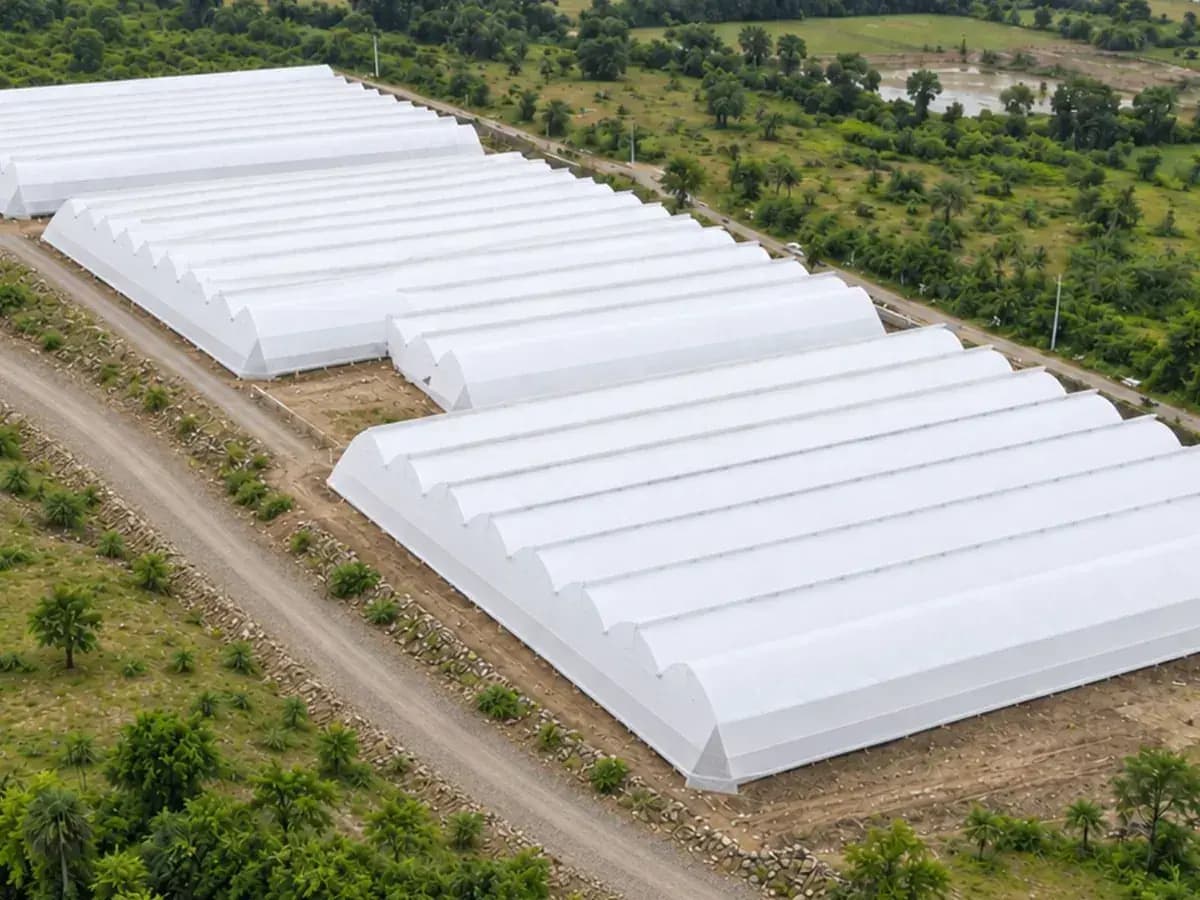
What Mumbai’s weather means for an NVPH
Mumbai’s April high is 38.4°C, with the strongest sun at 7.1 kWh/m²/day. Natural ventilation can release warm air through the roof vent while cooler air enters through open side curtains, but shade management matters in this month. May remains hot at 37°C and becomes more humid at 60%.
The more difficult operating period is June to October. Humidity is 80% in June, 90% in July and August, 89% in September and 78% in October. Annual rain is 2,509 mm—well above the Maharashtra average of 1,176 mm—and July alone receives about 834 mm. An NVPH keeps direct rain off the crop, but it cannot dehumidify air like a controlled system; prompt vent and curtain decisions are essential.
January nights can fall to 15.4°C, while January afternoons average 31°C. These are not severe cold conditions, but curtains should not be left needlessly wide open overnight when the crop needs protection.
- April: 38.4°C high; use maximum natural airflow and shade.
- June–October: humid months; prioritise dry leaves and rain exclusion.
- July: 834 mm rain; inspect drainage before the monsoon.
- November–February: the identified nethouse season, with a drier and milder window.
| Measure | Mumbai | Maharashtra average (130 towns) | What it means for the NVPH |
|---|---|---|---|
| Hottest-month high | 38°C (April) | 40.7°C | 2.7°C cooler than the state average |
| Humidity in that month | 53% | 35% | Dry in April, but humid from June to October |
| Rain a year | 2,509 mm | 1,176 mm | 1,333 mm more than the state average |
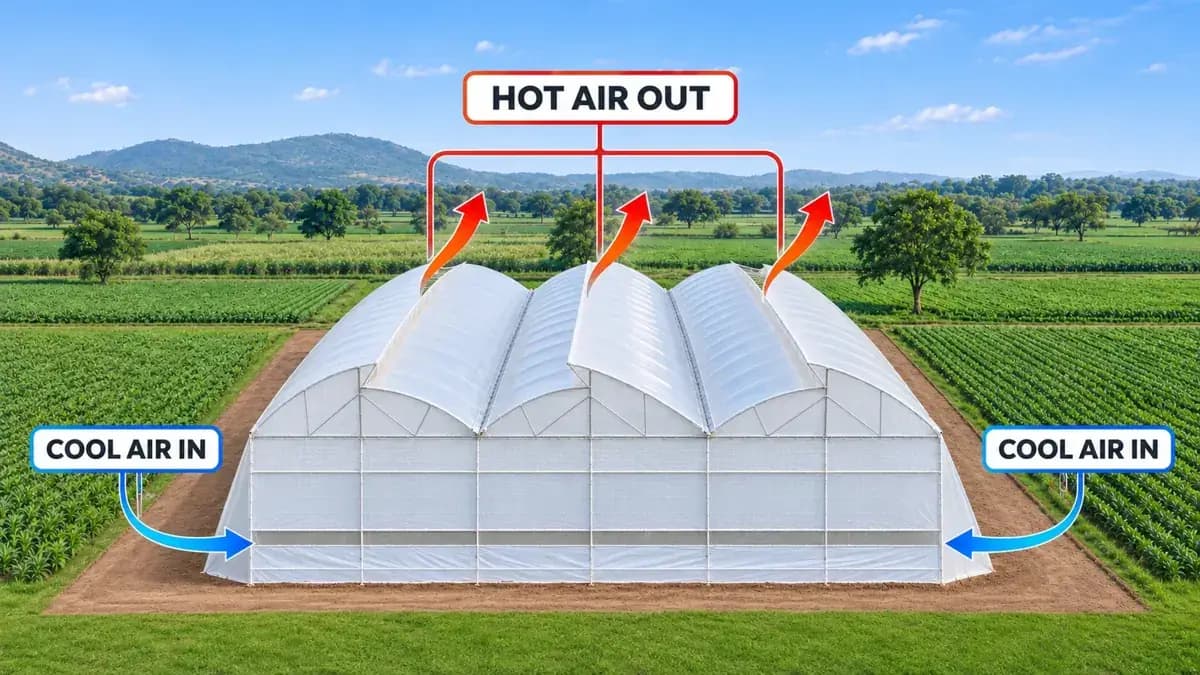
A month-by-month way to run vents, curtains and shade
From January through February, use the dry period to plan planting, open the house for maximum available light and carry out structural maintenance. January has no average rainfall and February only 2 mm. In March, days rise to 36.8°C and sunshine reaches 6.6 kWh/m²/day, so start opening side curtains early enough to avoid heat building under the roof.
April is the peak-heat month. Roll side curtains fully up, keep the roof vent working freely, close the shade net or second shade layer over the crop, and irrigate early in the day. Keep this approach through hot May, adjusting shade only when light is reduced by cloud. Do not close a humid house tightly simply because rain is expected: use the curtains to stop direct rain while preserving as much airflow as conditions allow.
Before June, clear every gutter and funnel, check the roof film for tears and tighten GI springs. During June to October, keep side curtains open whenever it is not raining and run air-circulation fans in the mornings. Space plants a little wider to reduce fungal disease pressure. July and August combine 90% humidity with 834 mm and 606 mm rain respectively, so routine inspection is more important than trying to retain heat.
In November and December, rainfall drops to 17 mm and 5 mm. Open the house for light and reset the crop plan for the dry season. The table below gives the monthly high, night low, humidity, rain, sun and wind values behind these operating choices.
| Month | Jan | Feb | Mar | Apr | May | Jun | Jul | Aug | Sep | Oct | Nov | Dec | Detail |
|---|---|---|---|---|---|---|---|---|---|---|---|---|---|
| Peak heat | ~38°C highs | ||||||||||||
| Strongest sun | 7.1 kWh/m²/day | ||||||||||||
| Wettest month | ~834 mm | ||||||||||||
| Humid (75%+) | June–October | ||||||||||||
| Nethouse season | November–February |
- 1
Before July
Clear gutters and funnels, check the film for tears and tighten the GI springs. July brings about 834 mm, the heaviest rain of the year.
- 2
June to October
Humidity stays at 75% or more. Keep side curtains open whenever it is not raining and run air circulation fans in the mornings; space plants a little wider to cut fungal disease.
- 3
April
Peak heat, about 38°C. Roll the curtains fully up, close the shade net or second layer over the crop, and irrigate early in the day.
- 4
November to February
The dry, mild stretch. Open the house for maximum light, plan the main planting and do structural maintenance.
Material changes worth making for Mumbai rain and humidity
The base roof cover can remain 250-micron white diffused polyfilm. It spreads April’s strong sunlight more evenly. For shade, an aluminium shade net is the more suitable Mumbai change: it reflects heat back out when April reaches 38°C. Add a second net layer operated by ropes and pulleys so it can be opened or closed with the season rather than left in one position throughout the year.
Keep the roof vent, side curtains and GI gutter sheet with funnels. Gutters are particularly important before the July rainfall peak. Add air-circulation fans because natural airflow alone may not keep foliage dry during Mumbai’s five humid months. A fan is an air-movement aid; it does not turn the house into a fan-and-pad system.
Choose aluminium doors instead of FRP fibre doors for heavy-rain conditions, and include an entry cabin where insect exclusion is important. The double-door entry helps limit whitefly and thrips entering as people walk in. Side insect net, well-operated curtains and a clean entry routine need to work together.
- Keep: 250-micron white diffused roof film and GI gutters with funnels.
- Upgrade: aluminium reflective shade net and a second adjustable net layer.
- Add: air-circulation fans, aluminium doors and an entry cabin for stronger insect-entry control.
| Part | Standard kit | For Mumbai | Why |
|---|---|---|---|
| Roof film | 250-micron white diffused polyfilm | Keep | Spreads April's 7.1 kWh/m²/day of sunlight evenly |
| Shade net | White 50% | Aluminium Shade Net (4 m) | Reflects heat back out at 38°C |
| Second net layer | None | Add (double layer) | Open or close it by the season with ropes and pulleys |
| Air circulation | Roof vent + curtains | Air Circulation Fan | 5 humid months: moving air keeps leaves dry |
| Doors | FRP (fibre) doors | Aluminium Door | Heavy rain: aluminium does not warp or swell |
| Gutters | GI gutter sheet + funnels | Keep | July brings ~834 mm; clean before June |
| Entry cabin | Optional | Include | A double door keeps whitefly and thrips out when people walk in |
What comes in a complete 20 × 24 m material kit
Polyhouse Constructions supplies complete NVPH material kits from its Degaon, Pune–Bangalore Highway factory at Wai, Satara. For Mumbai, dispatch delivery is listed as 1 day after dispatch. The kit is material supply; erection is done by Kryzen Biotech’s construction team.
The table below shows the largest lines in a 20 × 24 m kit, which has 67 items in all and about 2.5 tonnes of steel and fittings. It includes GI structure members, 250-micron white diffused polyfilm, side insect net, skirting apron, 50% white shade net, aluminium profile, GI spring, four manual gear roll-up curtain units, two fibre doors and brackets. The online kit builder provides every line, quantity, weight and current rate for the selected size.
GI structure material uses ISI-marked branded steel from Tata, Jindal and JSW. Polyhouse Constructions provides a 15-year manufacturing warranty on the GI structure, 2.5 years on polyfilm and 3 years on nets. Every dispatch includes lab test certificates, and each product has a technical data sheet.
| Group | Item | Quantity | Weight |
|---|---|---|---|
| GI structure | Side Hockey (60X2.0X5500) | 22 nos | 378 kg |
| GI structure | Small Column (76X2.0X4500) | 18 nos | 305 kg |
| GI structure | Big Bottom (60X2.0X8000) | 8 nos | 200 kg |
| GI structure | Hockey Runner (42X2.0X4000) | 18 nos | 150 kg |
| GI structure | Big Arc (42X2.0X5200) | 12 nos | 130 kg |
| Film & nets | Polyfilm White Diffused 250 Micron (4.5 m) | 158 mtr | — |
| Film & nets | Polyfilm White Diffused 250 Micron (5.5 m) | 73 mtr | — |
| Film & nets | Side Insect Net (5.2 m) | 90 mtr | — |
| Film & nets | Side Skirting Apron (1.5 m) | 90 mtr | — |
| Film & nets | White Shade Net 50% | 80 mtr | — |
| Fittings & accessories | Aluminium Profile | 500 mtr | — |
| Fittings & accessories | GI Spring | 900 mtr | — |
| Fittings & accessories | Manual Gear Roll Up Curtain Unit | 4 nos | — |
| Fittings & accessories | Fibre Door | 2 nos | — |
| Fittings & accessories | F Bracket | 24 nos | — |
This week’s NVPH material prices for Mumbai
The live prices below are material-only, ex-factory figures including GST. Freight to Mumbai and erection are extra. The small 20 × 24 m kit covers 480 m² and is ₹4,68,814, or ₹977/m². A 28 × 36 m, 1,008 m² kit is ₹8,59,963, or ₹853/m².
For 3,952 m², described as about 1 acre, material is ₹28,99,897 at ₹734/m². The lower per-m² rate at larger sizes comes from sharing gutters, end frames and doors across more area. Rates follow weekly GI and plastic prices and are updated every Friday, so use the kit builder for the current line-by-line rate.
Booking requires 5% advance and 95% before dispatch. A 5% bulk discount applies on 10+ units of an item. The Mumbai-specific additions discussed above—such as aluminium shade net, fans or aluminium doors—should be selected and priced within the final kit rather than assumed to be included in the base price.
| Size | Span × bay | Area | Material incl. GST | Per m² |
|---|---|---|---|---|
| Small | 20 × 24 m | 480 m² | ₹4,68,814 | ₹977 |
| Medium | 28 × 36 m | 1,008 m² | ₹8,59,963 | ₹853 |
| About 1 acre | 52 × 76 m | 3,952 m² | ₹28,99,897 | ₹734 |
Price your own size for Mumbai
Choose span and bay and get the full list with quantities, weights and rates in a minute.
Crop choices and Mumbai market timing
Crop selection should match both the house climate and the selling season in Mumbai markets. Cucumber is a fast 3–4 month NVPH crop, and its Mumbai district average modal price is ₹2,149/q across three markets. Its recorded high is ₹2,758 in June and low is ₹1,530 in March. June is also the start of very high humidity, so crop health and airflow need to be planned alongside the sales opportunity.
For crops listed in the district data, green peas have the highest stated average modal price at ₹7,941/q, with a May high of ₹9,992 and January low of ₹5,150. Beans average ₹4,301/q and peak at ₹7,289 in June. Green chilli averages ₹4,888/q and reaches ₹6,211 in January; okra averages ₹4,406/q and has its recorded high of ₹5,685 in December.
Tomato averages ₹2,005/q, peaking at ₹2,966 in December, while brinjal averages ₹2,446/q and peaks at ₹3,415 in November. These are historical market observations, not a promise of future prices. For the specific crop programme, consider the house’s April heat and June–October humidity as seriously as the peak-price month.
- Cucumber: ₹2,149/q average modal price; highest ₹2,758 in June.
- Green chilli: ₹4,888/q average; highest ₹6,211 in January.
- Okra: ₹4,406/q average; highest ₹5,685 in December.
- Tomato and brinjal recorded highest months: December and November respectively.
| Crop | Markets | Average modal price | Highest month | Lowest month |
|---|---|---|---|---|
| Green peas | 3 | ₹7,941/q | May (₹9,992) | Jan (₹5,150) |
| Beans | 3 | ₹4,301/q | Jun (₹7,289) | Feb (₹2,080) |
| Bottle gourd | 3 | ₹1,944/q | Jun (₹2,629) | Mar (₹1,403) |
| Okra (bhindi) | 3 | ₹4,406/q | Dec (₹5,685) | Apr (₹3,685) |
| Cucumber | 3 | ₹2,149/q | Jun (₹2,758) | Mar (₹1,530) |
| Green chilli | 3 | ₹4,888/q | Jan (₹6,211) | Sep (₹3,440) |
| Coriander (leaves) | 3 | ₹1,102/q | Oct (₹1,741) | Jan (₹701) |
| Papaya | 4 | ₹1,938/q | Sep (₹2,395) | Jul (₹1,647) |
| Tomato | 3 | ₹2,005/q | Dec (₹2,966) | Mar (₹1,382) |
| Brinjal | 3 | ₹2,446/q | Nov (₹3,415) | Mar (₹1,744) |
NVPH or fan and pad for a Mumbai project?
An NVPH cools through roof vents and side curtains and has no cooling power cost. It is suited here for capsicum, cucumber, tomato and flowers. Its practical limitation is the monsoon: with humidity at 75% or more from June to October, opening vents moves air but does not remove moisture from already humid outside air.
A fan-and-pad polyhouse uses exhaust fans and wet pads. In April it can achieve about 32°C inside, compared with the outdoor high of 38.4°C. This tighter summer control may suit leafy greens and crops needing closer control, but fans and a pump require electricity. The attachment below compares the stated material rates for about 1 acre: ₹28,99,897 for NVPH versus ₹32,48,775 for fan and pad.
For a farmer whose main requirement is rain protection, insect exclusion, crop support and passive ventilation, the Mumbai-specific NVPH upgrades are a sensible base. Where summer temperature control is central to the crop plan, assess fan and pad before fixing the structure type.
| Naturally ventilated | Fan & pad | |
|---|---|---|
| Cooling | Roof vent and side curtains (no power) | Exhaust fans and wet pads, ~32°C inside in April |
| Running cost | None for cooling | Electricity for fans and a pump |
| Material price, 1 acre | ₹28,99,897 (₹734/m²) | ₹32,48,775 (₹822/m²) |
| Suits in Mumbai | Capsicum, cucumber, tomato, flowers | Leafy greens and crops needing tight control in summer |
How Polyhouse Constructions supplies the project
Polyhouse Constructions is a venture of Kryzen Biotech Pvt Ltd and a manufacturer of protected-cultivation structures and material in India. In-house engineering and manufacturing are supported by a 32-point QA checklist for every part. Material is cut and drilled to drawing, rather than requiring pipes to be cut on site.
Build the NVPH kit online at polyhouseconstructions.com to see the selected structure, film, nets, fittings, quantities and this week’s rates. Individual materials are also available. For construction after material selection, Kryzen Biotech’s construction team handles erection; Polyhouse Constructions does not claim an office in Mumbai.
If subsidy is part of the project decision, confirm current norms and eligibility with the state horticulture department before starting work. MIDH/NHM and NHB routes have different project-size and approval conditions, and norms can change.
- Factory: Degaon, Pune–Bangalore Highway, Tal. Wai, Satara, Maharashtra.
- Mumbai delivery: 1 day after dispatch.
- Experience Center: Mahalunge, Pune.
| What you get | Polyhouse Construction | Typical local fabricator |
|---|---|---|
| Experience | 30 years of collective experience in greenhouse engineering | Often a small crew learning on the job |
| Technical know-how | Strong technical understanding: structure planned for your climate and crop | Usually repeats one standard design |
| Warranty | 15-year manufacturing warranty | Rarely a written warranty |
| Engineering | In-house engineering team | No design or load checks |
| Manufacturing | In-house manufacturing, cut and drilled to drawing | Buys pipes from traders, cuts on site |
| Quality checks | 32-point QA checklist for every part | Visual check at best |
| Lab certificate | Lab test certificate with every dispatch | Not provided |
| Technical sheet | Technical data sheet for every product | Not available |
| Material match | Zero material mismatch: every part counted per design | Short or excess material is common |
| Raw material | Branded steel from Tata, Jindal and JSW | Unbranded or mixed sources |
| Price | Lowest cost across India, with real-time price benefits from weekly rates | Fixed quote; rate drops are not passed on |
| Backing | Backed by industry leader Kryzen Biotech | Single-owner workshop |
Buy from India's biggest CEA manufacturing company
Choose your structure and size and get the complete material list, priced this week.
FAQs
Will natural ventilation be enough in Mumbai’s April heat?
It can provide passive airflow through roof vents and side curtains, but April reaches 38.4°C with 7.1 kWh/m²/day of sun. Use fully raised curtains, a clear roof vent and aluminium reflective shade net; fan and pad offers tighter control at about 32°C inside in April.
What is the main NVPH risk during the Mumbai monsoon?
Humidity and rain are the main constraints, not heat. July has 90% humidity and about 834 mm rain, so clear gutters before June, prevent direct rain entry, keep curtains open whenever rain allows and use air-circulation fans in the mornings.
What does a 20 × 24 m Mumbai NVPH material kit cost?
This week’s material-only, ex-factory price including GST is ₹4,68,814 for 480 m², or ₹977/m². Freight to Mumbai and erection are extra, and climate-specific upgrades should be added to the selected kit.
Which crops have useful Mumbai mandi price seasons for an NVPH?
Cucumber recorded ₹2,149/q average modal price and a June high of ₹2,758, while green chilli recorded ₹4,888/q average and a January high of ₹6,211. Okra’s recorded high was ₹5,685 in December; use these past observations with crop-climate planning, not as assured prices.
Does Polyhouse Constructions construct the polyhouse in Mumbai?
Polyhouse Constructions manufactures and supplies the complete material kit from its Satara factory; Mumbai delivery is listed as 1 day after dispatch. Construction and erection are done by Kryzen Biotech’s construction team, and there is no stated Mumbai office.
NVPH materials near Mumbai
Neighbouring towns on the same delivery route, and how their summers compare.
| Town | From Mumbai | Hottest month | Humid months | Suits |
|---|---|---|---|---|
| NVPH materials in Navi Mumbai | ~20 km | Apr, 38°C | 5 | NVPH + fan & pad |
| NVPH materials in Thane | ~20 km | Apr, 38°C | 5 | NVPH + fan & pad |
| NVPH materials in Kalyan-Dombivli | ~30 km | Apr, 38°C | 5 | NVPH + fan & pad |
| NVPH materials in Mira-Bhayandar | ~30 km | Apr, 39°C | 5 | NVPH + fan & pad |
| NVPH materials in Panvel | ~30 km | Apr, 38°C | 5 | NVPH + fan & pad |
| NVPH materials in Uran | ~30 km | Apr, 38°C | 5 | NVPH + fan & pad |