
Naturally Ventilated Polyhouse guide
What is an NVPH (naturally ventilated polyhouse)?
By Editorial Team, Kryzen Biotech · Updated 12 November 2026
An NVPH is a GI steel greenhouse covered with UV-stabilised film that cools itself with moving air instead of fans. Hot air escapes through open vents at the roof ridge, and fresh air comes in through roll-up curtains on the sides. Because nothing needs to run except irrigation, it is the cheapest polyhouse to operate and the one most Indian growers start with.
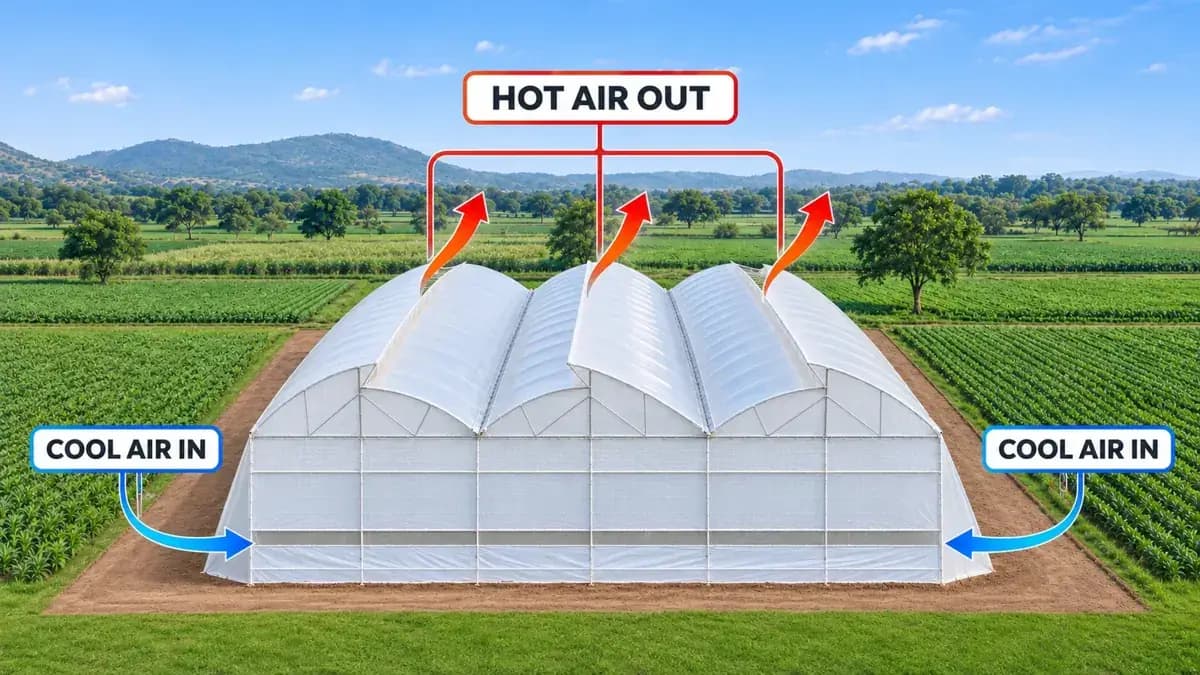
How an NVPH controls its own climate
Ridge vent
Hot air rises and leaves through a fixed opening along the top of every 8 m span. Kryzen builds a butterfly roof, so the vent stays open all day without motors.
Side curtains
Roll them up on hot days for cross-flow; roll them down on cold nights or in heavy rain.
Insect net
A 40-mesh UV net sits behind every vent and curtain, so air passes but most insects do not.
Shade net
A 50% shade screen inside, pulled open or closed by hand, takes the edge off summer sun.
Add-ons
Foggers raise humidity on dry days; retractable aluminet reflects heat and can keep the inside about 5 °C cooler.
Typical NVPH specification
| Part | What to expect |
|---|---|
| Grid | 8 m spans × 4 m bays |
| Height | Ridge 6.8–7.5 m; gutter 4.2 m on one side and 4.5 m on the other |
| Steel | GI pipe, 2 mm wall in every member, 375–400 GSM zinc |
| Columns and foundation | 76 mm columns on 60 mm foundation pipes, 75 cm or deeper in 1:2:4 concrete |
| Film | 200 micron, 5-layer, UV-stabilised |
| Design load | 120 km/h wind and 25 kg/m², checked for your site |
What this means when you buy material
An NVPH kit is mostly GI pipe by weight, so the GI rate of the week decides most of the price. Ask every supplier for the wall thickness of each member, not only the columns, and the zinc coating in g/m²: these two numbers decide how long the frame lasts.
The rest of the list is covering and fixing: roof film, curtain film, insect net, shade net, aluminium or GI profiles with zig-zag spring wire, gutters and the gear units that roll the curtains. On our kit builder you can see every one of these lines, with quantity and weight, before you pay.
Material you will order
Terms used on this page
- NVPH
- A polyhouse that is cooled by air moving through roof vents and roll-up side curtains, without fans. It has the lowest running cost and suits most crops and climates.
- GI (galvanised iron)
- Steel that has been coated with zinc so it does not rust. Almost every pipe, clamp and gutter in a polyhouse is GI. The steel carries the load; the zinc layer protects it from rain, fertiliser and humid air.
- Zinc coating (g/m²)
- How much zinc covers each square metre of steel, measured in grams. More zinc means longer protection against rust. Pre-galvanised pipes usually carry 40–120 g/m²; hot-dip galvanised steel carries 200–500 g/m².
- Roll-up curtain
- Side film that can be rolled up with a gear unit to let air in, and rolled down to close the polyhouse on cold, rainy or windy days.
- Span
- The width of one arch of the polyhouse, from gutter to gutter. Our polyhouses are built in 8 m spans, so a 24 m wide polyhouse has three spans.
- Bay
- The distance between two rows of arches along the length of the polyhouse. Our bays are 4 m.
Get NVPH material from India's biggest CEA manufacturing company
Choose your size and see every item, quantity and weekly rate before you pay.
FAQs
Does an NVPH need electricity?
Only for irrigation and optional foggers. Ventilation is natural, which is why running cost is low.
What size is one NVPH bay?
The standard grid is 8 m across (one span) by 4 m along (one bay). Polyhouse sizes are built up in these steps.
How long does the structure last?
The GI structure is designed for about 15 years; film is usually changed every 2.5–3 years depending on sun and sprays.