
Nethouse material · New Delhi district, Delhi
Nethouse Material Wholesale Rate in New Delhi
By Editorial Team, Kryzen Biotech · Updated 13 November 2026
For a New Delhi nethouse, the immediate material choice is shaped by May heat of 42.8°C, strong sun of 6.7 kWh/m²/day and a July rainfall peak of 217 mm. Polyhouse Constructions supplies complete nethouse kits and individual nets, GI structure and fittings from its Satara factory; the current weekly material rates and the right layout are set out below.
- Nethouse season
- Most of the year
- Strongest sun
- May, 6.7 kWh/m²
- Net we suggest
- Aluminium or 50% white
- Square nethouse, 1 acre
- ₹291/m²
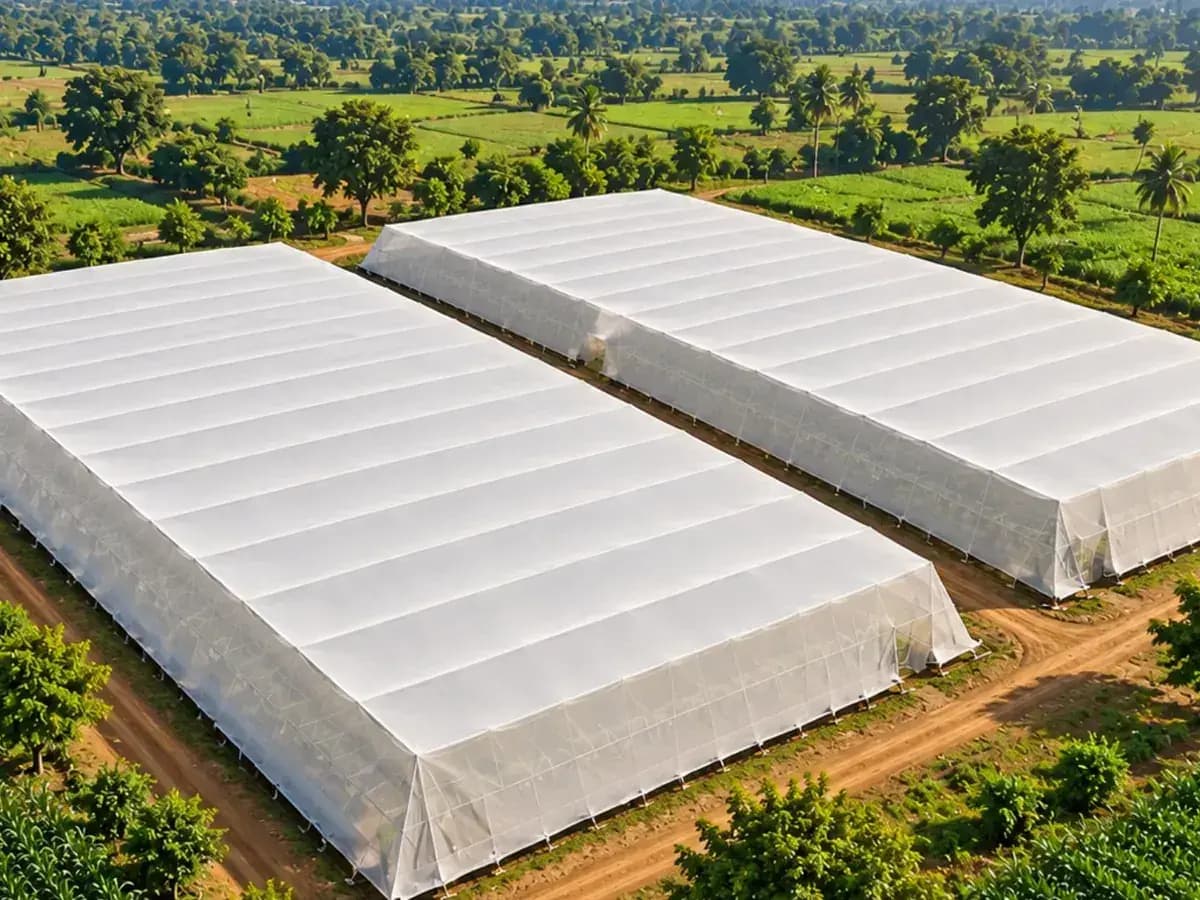
This week’s net and GI material rates
The factory GI rate this week is ₹94.50/kg. Net prices are quoted ex-factory and excluding GST, so use the rate table below for the material value before freight and taxes. Rates change every Friday because the frame follows GI prices while nets follow plastic prices.
For roof shade net, white, green and black 50% net are each ₹6.75 per m² before the bulk discount. A 4 m wide roll is ₹27.00 per running metre and an 8 m wide roll is ₹54.00 per running metre. White shade net is generally the better starting point for New Delhi’s hot, high-sun period; aluminium shade net is priced at ₹78.75 per m² and has a reflective surface for heat management.
Side insect net is ₹42.50 per m²: ₹191.25 per running metre at 4.5 m width or ₹221.00 per running metre at 5.2 m width. It is a wall material rather than a roof-shade substitute, and is intended to keep whitefly and thrips off vegetable crops.
- Weekly rates are ex-factory, excluding GST.
- A 5% discount applies on 10 or more units of any one item.
- Book with 5% advance; the remaining 95% is payable before dispatch.
- New Delhi is about 1,600 km from our Satara factory; delivery is typically 5 days after dispatch.
| Net | Roll width | Per running metre | Per m² | 10+ units (5% off) |
|---|---|---|---|---|
| Aluminium Shade Net (4 m) | 4 m | ₹315.00 | ₹78.75 | ₹299.25 |
| Black Shade Net 50% | 4 m | ₹27.00 | ₹6.75 | ₹25.65 |
| Black Shade Net 50% (8 m) | 8 m | ₹54.00 | ₹6.75 | ₹51.30 |
| Green Shade Net 50% | 4 m | ₹27.00 | ₹6.75 | ₹25.65 |
| Green Shade Net 50% (8 m) | 8 m | ₹54.00 | ₹6.75 | ₹51.30 |
| Side Insect Net (4.5 m) | 4.5 m | ₹191.25 | ₹42.50 | ₹181.69 |
| Side Insect Net (5.2 m) | 5.2 m | ₹221.00 | ₹42.50 | ₹209.95 |
| White Shade Net 50% | 4 m | ₹27.00 | ₹6.75 | ₹25.65 |
| White Shade Net 50% (8 m) | 8 m | ₹54.00 | ₹6.75 | ₹51.30 |
- GI rate this week
- ₹94.50/kg
- Bulk discount
- 5% on 10+ units
- Distance to New Delhi
- ~1,600 km
What “wholesale” means when buying from the factory
Wholesale does not require an acre-size order. One weekly factory rate applies whether a farmer buys one roll or material for a full structure, with no dealer margin in between. The extra 5% reduction begins when the cart contains 10 or more units of an item; it is not a discount on a mixed collection that does not reach 10 units for an individual product.
For a complete structure, build the kit online at polyhouseconstructions.com rather than relying on a single lump-sum estimate. The kit shows the item list, quantities and this week’s rate. This is useful when comparing a smaller nursery house against an acre-sized structure, or when purchasing roof net, insect net and fittings separately.
Every dispatch includes a GST invoice with HSN codes, suitable for accounts and subsidy documentation. Polyhouse Constructions is a manufacturer and a venture of Kryzen Biotech Pvt Ltd; material is supplied from Degaon, on the Pune–Bangalore Highway at Wai, Satara. There is no New Delhi office. If erection is required, it is carried out by Kryzen Biotech’s construction team.
- 1
One rate, any quantity
Weekly factory rate whether you buy one roll or a whole acre. No dealer margin in between.
- 2
5% bulk discount
Buy 10 or more of any item and the discount is applied automatically in the cart.
- 3
Rates every Friday
Nets and film follow the plastic rate, the frame follows the GI rate; both are updated weekly and shown on every page.
- 4
Quotation and invoice
GST invoice with HSN codes, ready for subsidy files and accounts.
Buy nets and fittings on their own
Every net, wire, ring and pulley is in the individual items shop at the weekly rate.
Square or curved: choose the structure for the crop and heat
A square, flat-roof nethouse uses an NHB 4 × 4 m grid and a flat net roof on GI wire. It is the lower-cost-per-m² option, is straightforward to extend and suits New Delhi’s annual rainfall of 750 mm. It is a practical format for nursery work, coriander, spinach and other leafy greens where maximum internal height is not the main requirement.
A curved nethouse has an arched GI frame, giving more height and air movement. That matters in the May–June heat, when average afternoon highs reach 42.8°C in May and 42.1°C in June. For taller capsicum and tomato crops, the curved option is the stronger choice where budget permits.
This week’s material-only square medium kit is 32 × 32 m, or 1,024 m², at ₹3,30,900 including GST. The square approximately one-acre kit measures 64 × 64 m, covers 4,096 m² and is ₹11,91,523 including GST. The curved approximately one-acre kit is 52 × 76 m, covers 3,952 m² and is ₹16,81,233 including GST. These are material-kit figures, not construction charges.
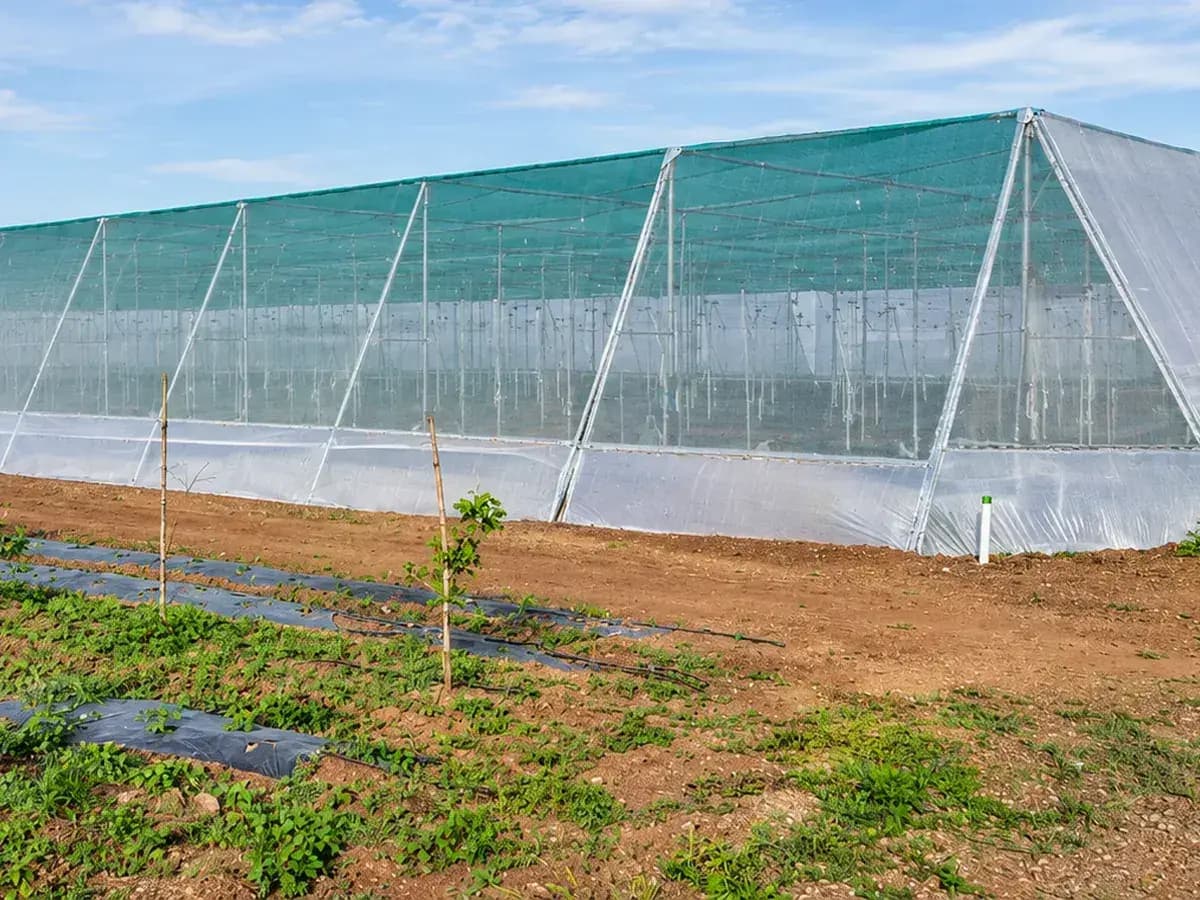
Square (flat-roof) nethouse
Good fitThe NHB 4 × 4 m grid with a flat net roof on GI wire. Lowest cost per m² and easy to extend; it suits New Delhi's 750 mm of rain well.
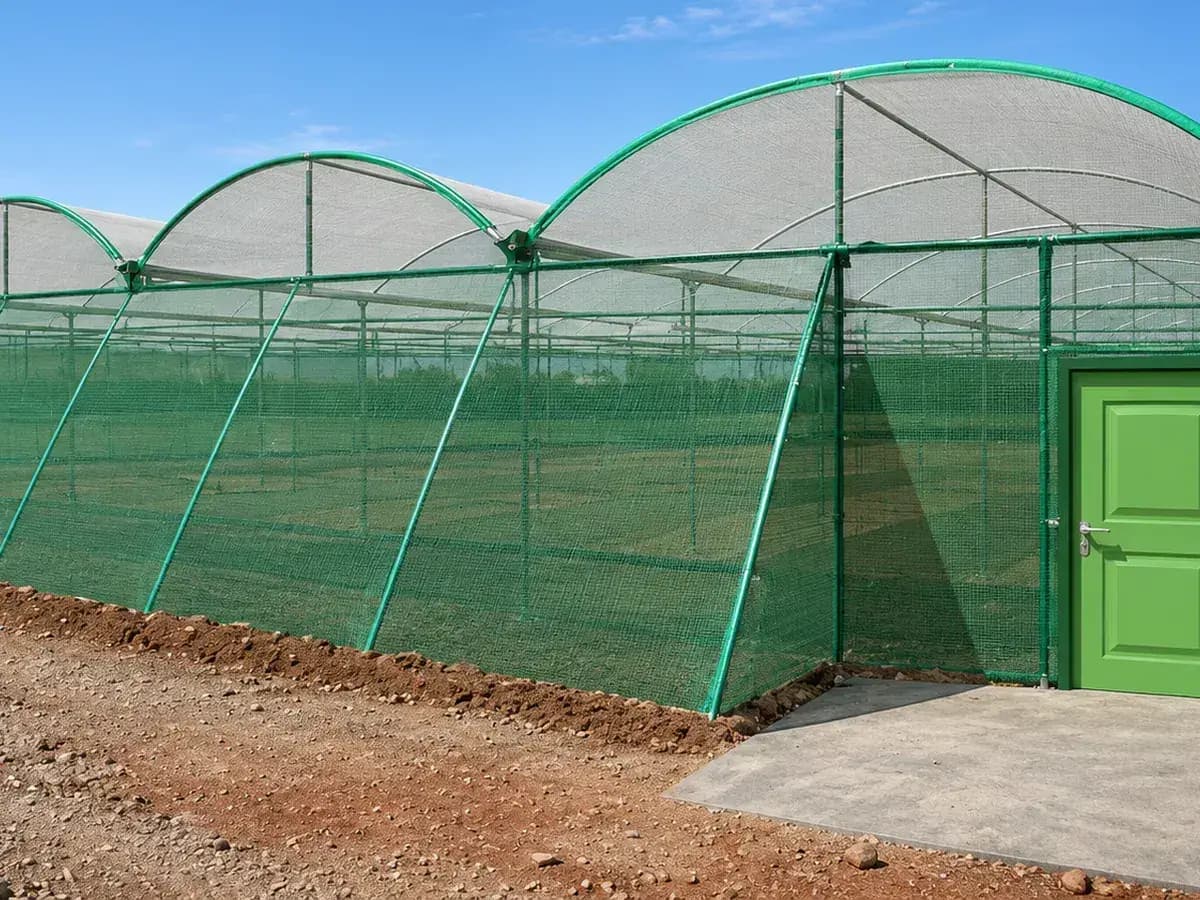
Curved (dome) nethouse
Best for heatArched GI frame covered in net: more height and air movement, better for tall crops like capsicum and tomato, and for 43°C summers.
| Kit | Span × bay | Area | Material incl. GST | Per m² |
|---|---|---|---|---|
| Square nethouse, medium | 32 × 32 m | 1,024 m² | ₹3,30,900 | ₹323 |
| Square nethouse, ~1 acre | 64 × 64 m | 4,096 m² | ₹11,91,523 | ₹291 |
| Curved nethouse, ~1 acre | 52 × 76 m | 3,952 m² | ₹16,81,233 | ₹425 |
Roof net and side net for New Delhi sun
May is both the hottest and strongest-sun month, with a 42.8°C average afternoon high and 6.7 kWh/m²/day of sun. A white 50% shade net diffuses light and cuts glare without making the crop space as dim as heavier shade would. It is the standard roof-net choice here for a general vegetable nethouse.
Aluminium shade net is worth considering where the crop is exposed through the harshest summer period. Its reflective surface sends heat upwards, a useful property during the 43°C season. Green 50% net can suit nurseries and leafy greens. Although black 50% net gives the same nominal shade, it holds some heat in this climate, so white or aluminium is preferable in peak summer.
Use side insect net on walls for pest exclusion. Roof shade net controls light and heat, while the fine-mesh side net is for reducing entry of whitefly and thrips. These are separate roles; specify both where the crop and pest pressure call for them.
| Net | What it does | In New Delhi |
|---|---|---|
| White shade net 50% | Diffuses light; the standard roof net | Our pick for New Delhi: cuts the May glare without dimming the crop |
| Green shade net 50% | Same shade, green colour | Nurseries and leafy greens; a cooler look in the field |
| Black shade net 50% | Same shade, black colour | Holds some heat at 43°C; prefer white or aluminium |
| Aluminium shade net | Reflective; sends heat back up | Worth it here: 43°C highs and 6.7 kWh/m² |
| Side insect net | Fine mesh for the walls | Keeps whitefly and thrips off vegetables |

Plan around May heat, July rain and winter nights
There is no single nethouse season in New Delhi because a protected structure can support nursery and vegetable activity through the year. The management pressure changes sharply by month. April reaches 39°C, May peaks at 42.8°C and June is still 42.1°C, so ventilation, shade choice and irrigation discipline are most important before the monsoon.
July is the wettest month at 217 mm, followed by August at 203 mm. Rain protection is not the purpose of a shade-net roof, but a sound structure, properly tensioned nets and clean drainage around the house matter in these months. Humidity rises to 75% in August and remains 69% in September, so avoid allowing dense crop growth to reduce airflow.
Winter has a different limitation: January nights average 5.9°C and December 7.7°C. A nethouse will not provide the temperature control of a fan-and-pad polyhouse. For crops that need cooling in the hottest period, fan-and-pad cooling works in New Delhi and can bring the inside temperature to 31°C, but that is a different protected-cultivation system from a basic nethouse.
| Month | Jan | Feb | Mar | Apr | May | Jun | Jul | Aug | Sep | Oct | Nov | Dec | Detail |
|---|---|---|---|---|---|---|---|---|---|---|---|---|---|
| Peak heat | ~43°C highs | ||||||||||||
| Strongest sun | 6.7 kWh/m²/day | ||||||||||||
| Wettest month | ~217 mm |
Crops that fit a nethouse and the stronger mandi months
For a square house, vegetable seedlings are a sensible use throughout the year, while leafy greens such as coriander can remain tender under 50% shade. A curved house is better aligned with summer chilli and capsicum because of its height and air movement; roof shading also helps protect fruit from sunscald in May.
The local price pattern should influence sowing and harvest planning, but it is not a promise of future price. Across New Delhi district markets, capsicum has an average modal price of ₹3,324/q and its recorded high month is July at ₹5,397/q; May is its low month at ₹1,621/q. Coriander leaves average ₹3,535/q and peak in July at ₹7,522/q, while their low month is February at ₹1,328/q.
For winter-oriented harvest timing, tomato recorded its high month in November at ₹3,137/q, compared with ₹1,027/q in May. Bottle gourd is highest in December at ₹2,276/q, and okra is highest in December at ₹6,192/q. Bitter gourd recorded its strongest month in February at ₹4,533/q. Check current arrivals and grades before fixing a cropping calendar.
- The district data covers markets including APMC Azadpur, APMC Keshopur, APMC Shahdara and Gazipur APMC.
- All figures in the table are modal prices in ₹ per quintal from the last two years of market observations.
| Crop | Markets | Average modal price | Highest month | Lowest month |
|---|---|---|---|---|
| Cucumber | 10 | ₹2,098/q | Jan (₹2,616) | May (₹1,348) |
| Brinjal | 10 | ₹1,912/q | Jul (₹2,266) | May (₹1,609) |
| Cabbage | 10 | ₹1,175/q | Nov (₹1,765) | May (₹680) |
| Tomato | 10 | ₹2,073/q | Nov (₹3,137) | May (₹1,027) |
| Cauliflower | 10 | ₹2,654/q | Jul (₹5,027) | Feb (₹854) |
| Capsicum | 9 | ₹3,324/q | Jul (₹5,397) | May (₹1,621) |
| Bottle gourd | 10 | ₹1,765/q | Dec (₹2,276) | May (₹1,141) |
| Bitter gourd | 9 | ₹2,921/q | Feb (₹4,533) | May (₹1,529) |
| Coriander (leaves) | 10 | ₹3,535/q | Jul (₹7,522) | Feb (₹1,328) |
| Okra (bhindi) | 9 | ₹3,574/q | Dec (₹6,192) | May (₹1,839) |
What is in the square acre kit
The 64 × 64 m square kit covers 4,096 m², close to one acre. Its largest listed components show why comparing only pipe weight or roof-net area can be misleading: the full kit has 25 items and about 8.6 tonnes of steel and fittings. The detailed list below is for this size; an exact-size kit builder gives the line-by-line requirement for another layout.
Among the principal structure components are 480 purlins, 256 columns, 256 foundation pipes, 64 side hockey pipes and 196 five-way pipe couplers. The listed net and enclosure items include 900 m of white 50% shade net, 258 m of 5.2 m side insect net and 258 m of side skirting apron. It also includes aluminium profile, GI spring, self-drilling screws and two fibre doors.
The GI structure uses ISI-marked branded steel from Tata, Jindal and JSW. Polyhouse Constructions provides a 15-year manufacturing warranty on the GI structure and a 3-year warranty on nets. In-house engineering, a 32-point QA process, lab test certificates with dispatch and a technical data sheet for each product provide documentation beyond the material count.
| Group | Item | Quantity | Weight |
|---|---|---|---|
| GI structure | Purlin - NH (42X2.0X4000) | 480 nos | 3,994 kg |
| GI structure | Column - NH (60X2.0X4000) | 256 nos | 2,918 kg |
| GI structure | Foundation Pipe (48X2.0X1200) | 256 nos | 707 kg |
| GI structure | Side Hockey - NH (33X2.0X4200) | 64 nos | 430 kg |
| GI structure | Five Way Pipe Coupler (48 OD) | 196 nos | 338 kg |
| Film & nets | Side Insect Net (5.2 m) | 258 mtr | — |
| Film & nets | White Shade Net 50% | 900 mtr | — |
| Film & nets | Side Skirting Apron (1.5 m) | 258 mtr | — |
| Fittings & accessories | Aluminium Profile | 1,224 mtr | — |
| Fittings & accessories | Self Drilling Screw | 6,900 nos | — |
| Fittings & accessories | GI Spring | 1,224 mtr | — |
| Fittings & accessories | Fibre Door Big | 1 nos | — |
| Fittings & accessories | Fibre Door | 1 nos | — |
Before you place a nethouse material order
First decide the crop and structure: square for lower-cost nursery or leafy-green space, or curved for more air movement around tall summer crops. Then decide whether white 50% roof net is adequate or whether aluminium roof net is justified for the May heat. Add side insect net where pest exclusion is needed, rather than treating it as an optional decorative side covering.
Measure the usable plot and select the span and bay layout before ordering. For subsidy planning, MIDH/NHM support is 50% of the cost norm up to 4,000 m² per beneficiary; the shade-net-house norm cited is ₹710/m². NHB commercial projects above 2,500 m² require In-Principle Approval before starting and have separate credit-linked provisions. Norms can change, so confirm the current position with the state horticulture department.
Request the exact online kit and invoice details before paying the advance. This lets the material list reflect the chosen size rather than a generic acre estimate, and keeps the weekly GI and net pricing visible at the point of purchase.
Buy from India's biggest CEA manufacturing company
Choose your structure and size and get the complete material list, priced this week.
FAQs
What is the wholesale rate of 50% shade net in New Delhi this week?
White, green and black 50% shade net are each ₹6.75 per m² before GST, ex-factory. A 4 m roll is ₹27.00 per running metre and an 8 m roll is ₹54.00 per running metre; rates change every Friday.
Is there a wholesale discount for an acre nethouse order?
A 5% discount applies when you buy 10 or more units of any individual item. The same weekly factory rate applies to smaller purchases too, without a dealer margin.
Should I choose square or curved nethouse in New Delhi?
Choose square for a lower-cost, extendable layout for seedlings and leafy greens. Choose curved for tall tomato or capsicum where more height and air movement help during May–June heat above 42°C.
Which net is best for New Delhi summer?
White 50% shade net is the general roof-net pick because it diffuses the strong May light. Aluminium shade net is worth considering for crops exposed through the 42.8°C May heat; use side insect net separately on the walls for whitefly and thrips exclusion.
How long does delivery to New Delhi take, and who constructs it?
New Delhi is about 1,600 km from the Satara factory, and delivery is typically 5 days after dispatch. Polyhouse Constructions supplies the material; construction or erection is done by Kryzen Biotech’s construction team.
Nethouse material near New Delhi
Nearby towns on the same route, with their nethouse season and sunlight.
| Town | From New Delhi | Nethouse season | Strongest sun | Rain a year |
|---|---|---|---|---|
| Nethouse material in Bhalswa Jahangir Pur | ~10 km | Most of the year | 6.7 kWh/m² | 648 mm |
| Nethouse material in Delhi | ~10 km | Most of the year | 6.7 kWh/m² | 750 mm |
| Nethouse material in Karawal Nagar | ~10 km | Most of the year | 6.7 kWh/m² | 750 mm |
| Nethouse material in Nangloi Jat | ~20 km | Most of the year | 6.7 kWh/m² | 648 mm |
| Nethouse material in Sultan Pur Majra | ~20 km | Most of the year | 6.7 kWh/m² | 648 mm |
| Nethouse material in Loni | ~20 km | Most of the year | 6.7 kWh/m² | 833 mm |