
NVPH materials · New Delhi district, Delhi
Naturally ventilated polyhouse material for New Delhi
By Editorial Team, Kryzen Biotech · Updated 13 November 2026
A naturally ventilated polyhouse (NVPH) can work in New Delhi, but May and June need disciplined curtain, roof-vent and shade-net operation. The dry peak heat reaches 42.8°C in May, while July to September bring rain and higher humidity; the material specification and crop calendar must address both periods.
- Hottest month
- May, ~43°C
- Humid (75%+)
- Rarely
- NVPH material, 1 acre
- ₹734/m²
- Delivery
- ~5 days
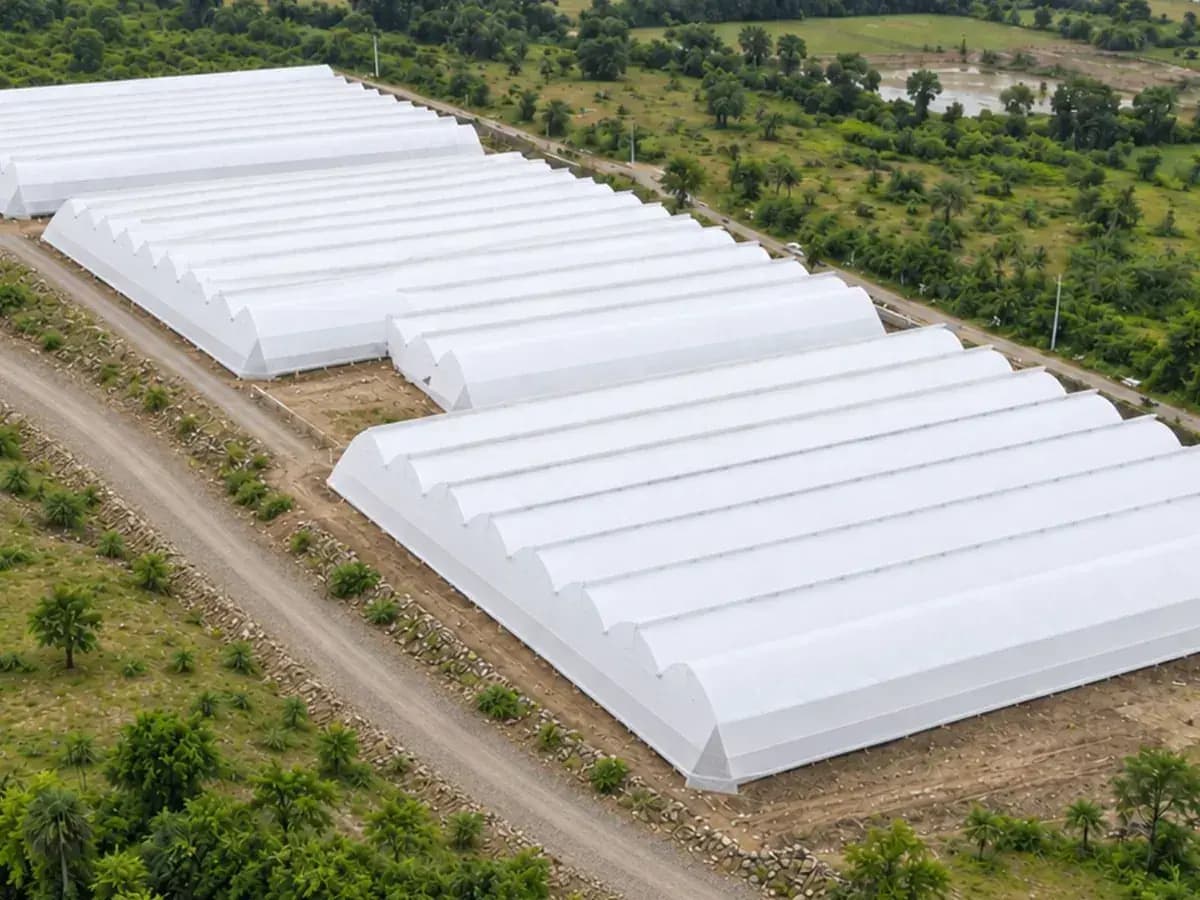
What New Delhi weather means for an NVPH
New Delhi has a sharply changing protected-cultivation climate. January nights average 5.9°C, then the afternoon high rises from 32.4°C in March to 39°C in April and 42.8°C in May. May also has the strongest sun, at 6.7 kWh/m²/day, and only 23% humidity. In this dry heat, roof vents and fully raised side curtains can exchange air, but an NVPH will not provide the close summer temperature control of fan and pad cooling.
June remains very hot at 42.1°C, with a warmer average night of 29.7°C. The monsoon changes the operating problem rather than ending it: July has about 217 mm rain, August 203 mm and September 121 mm. Humidity rises to 63% in July, 75% in August and 69% in September. Rain exclusion, clear drainage and air movement become especially important in those months.
Conditions become easier from October. The average high is 32.2°C in October, 27.6°C in November and 22.8°C in December, although nights cool to 12.6°C in November and 7.7°C in December. The 12-month table below is useful for choosing planting dates and planning daily curtain settings rather than treating the house as one fixed environment.
- May: 42.8°C average high, 23% humidity and 6.7 kWh/m²/day sun.
- July: wettest month at 217 mm rain.
- January: coolest average night at 5.9°C.
| Month | Afternoon high | Night low | Humidity | Rain | Sun (kWh/m²/day) | Wind (m/s) |
|---|---|---|---|---|---|---|
| Jan | 21.4°C | 5.9°C | 44% | 16 mm | 3.1 | 1.7 |
| Feb | 25.7°C | 9.1°C | 41% | 22 mm | 4.3 | 1.9 |
| Mar | 32.4°C | 14.9°C | 33% | 18 mm | 5.6 | 2 |
| Apr | 39°C | 21.8°C | 24% | 15 mm | 6.6 | 2.2 |
| May | 42.8°C | 27.3°C | 23% | 33 mm | 6.7 | 2.4 |
| Jun | 42.1°C | 29.7°C | 36% | 80 mm | 6.1 | 2.5 |
| Jul | 36.7°C | 27.8°C | 63% | 217 mm | 5 | 2.1 |
| Aug | 33.7°C | 25.9°C | 75% | 203 mm | 4.9 | 1.8 |
| Sep | 33.4°C | 23.2°C | 69% | 121 mm | 5.1 | 1.7 |
| Oct | 32.2°C | 18.2°C | 51% | 13 mm | 4.7 | 1.4 |
| Nov | 27.6°C | 12.6°C | 43% | 4 mm | 3.6 | 1.6 |
| Dec | 22.8°C | 7.7°C | 42% | 8 mm | 3 | 1.7 |
Run the vents, curtains and shade by season
In January and February, use the side curtains carefully around the cool nights of 5.9°C and 9.1°C, while opening them when daytime conditions allow. March is a transition month: its 32.4°C high and 14.9°C low call for progressively more daytime ventilation. By April, begin treating heat exclusion as a daily task because the average high reaches 39°C.
In May, roll the curtains fully up and keep the roof vent open. Close the shade net or the second shade layer over the crop, and irrigate early in the day. June needs the same heat response, alongside a check that drainage is ready before rain increases. This is the period in which an operator should not expect a naturally ventilated house to hold fan-and-pad temperatures.
Before July, clear gutters and funnels, inspect the film for tears and tighten the GI springs. Through July, August and September, use the roof vent and side-curtain openings to remove humid air whenever rain conditions permit; do not leave gutters blocked during the wettest spell. In October, reduce shading as the high falls to 32.2°C. In November and December, manage curtains for daytime ventilation but protect the crop during the cooler evenings and nights.
- Keep the roof vent and side curtains as the core natural-airflow system.
- Use the second shade layer seasonally with ropes and pulleys.
- Clear gutters and funnels before July, not after the monsoon has begun.
| Month | Jan | Feb | Mar | Apr | May | Jun | Jul | Aug | Sep | Oct | Nov | Dec | Detail |
|---|---|---|---|---|---|---|---|---|---|---|---|---|---|
| Peak heat | ~43°C highs | ||||||||||||
| Strongest sun | 6.7 kWh/m²/day | ||||||||||||
| Wettest month | ~217 mm |
- 1
Before July
Clear gutters and funnels, check the film for tears and tighten the GI springs. July brings about 217 mm, the heaviest rain of the year.
- 2
May
Peak heat, about 43°C. Roll the curtains fully up, close the shade net or second layer over the crop, and irrigate early in the day.
Material changes that suit the Delhi heat and monsoon
The standard 250-micron white diffused polyfilm should be retained. It spreads May’s 6.7 kWh/m²/day sunlight evenly. For the shade layer, use aluminium shade net rather than the standard white 50% net: its reflective surface is specified to reflect heat back out at the 43°C May condition. Add a second net layer so it can be opened or closed by season with ropes and pulleys.
Keep the roof vent plus curtains: natural airflow is listed as enough for this climate. Retain FRP fibre doors, which last well in these conditions, and retain the GI gutter sheet and funnels. The latter are not optional in practice when July alone averages about 217 mm of rain. An entry cabin remains optional, but a double door can help keep whitefly and thrips out as people enter.
The supplied GI structure uses ISI-marked branded steel from Tata, Jindal and JSW. Polyhouse Constructions provides a 15-year manufacturing warranty on the GI structure, 2.5 years on polyfilm and 3 years on nets. Each dispatch includes a lab test certificate and technical data sheet; the parts are made through in-house engineering and manufacturing with a 32-point QA checklist.
- Keep: white diffused 250-micron roof film, roof vent, curtains, FRP doors and gutters.
- Change: aluminium shade net and an added second net layer.
- Check: gutter cleanliness, funnels, film condition and GI springs before July.
| Part | Standard kit | For New Delhi | Why |
|---|---|---|---|
| Roof film | 250-micron white diffused polyfilm | Keep | Spreads May's 6.7 kWh/m²/day of sunlight evenly |
| Shade net | White 50% | Aluminium Shade Net (4 m) | Reflects heat back out at 43°C |
| Second net layer | None | Add (double layer) | Open or close it by the season with ropes and pulleys |
| Air circulation | Roof vent + curtains | Keep | Natural airflow is enough |
| Doors | FRP (fibre) doors | Keep FRP | FRP lasts well in this climate |
| Gutters | GI gutter sheet + funnels | Keep | July brings ~217 mm; clean before June |
| Entry cabin | Optional | Optional | A double door keeps whitefly and thrips out when people walk in |
What is in a live NVPH kit
A complete kit combines the GI structure, polyfilm, nets and fittings rather than leaving the farmer to match site-cut materials. For a 20 × 24 m kit, the largest listed structure parts include 22 side hockey pieces, 18 small columns, 8 big bottom pieces, 18 hockey runners and 12 big arcs. This size has 67 items in all and about 2.5 tonnes of steel and fittings.
The same kit list includes 158 m of 4.5 m white diffused 250-micron polyfilm and 73 m of 5.5 m film, 90 m of side insect net, 90 m of side skirting apron, 80 m of white 50% shade net, aluminium profile, GI spring, four manual gear roll-up curtain units and two fibre doors. For New Delhi, the aluminium shade-net and second-layer changes described above should be selected for the final build.
Polyhouse Constructions is a manufacturer supplying from its Degaon, Pune–Bangalore Highway, Tal. Wai, Satara factory, not an office in New Delhi. The online kit builder shows each item, quantity, weight and current rate for the selected size. Construction or erection is done by Kryzen Biotech’s construction team. Delivery to New Delhi is stated as 5 days after dispatch.
- Build the exact span and bay online to see the complete line-by-line material list.
- Material is supplied from the Satara factory; freight and erection are separate from material pricing.
- Booking is 5% advance and 95% before dispatch.
| Group | Item | Quantity | Weight |
|---|---|---|---|
| GI structure | Side Hockey (60X2.0X5500) | 22 nos | 378 kg |
| GI structure | Small Column (76X2.0X4500) | 18 nos | 305 kg |
| GI structure | Big Bottom (60X2.0X8000) | 8 nos | 200 kg |
| GI structure | Hockey Runner (42X2.0X4000) | 18 nos | 150 kg |
| GI structure | Big Arc (42X2.0X5200) | 12 nos | 130 kg |
| Film & nets | Polyfilm White Diffused 250 Micron (4.5 m) | 158 mtr | — |
| Film & nets | Polyfilm White Diffused 250 Micron (5.5 m) | 73 mtr | — |
| Film & nets | Side Insect Net (5.2 m) | 90 mtr | — |
| Film & nets | Side Skirting Apron (1.5 m) | 90 mtr | — |
| Film & nets | White Shade Net 50% | 80 mtr | — |
| Fittings & accessories | Aluminium Profile | 500 mtr | — |
| Fittings & accessories | GI Spring | 900 mtr | — |
| Fittings & accessories | Manual Gear Roll Up Curtain Unit | 4 nos | — |
| Fittings & accessories | Fibre Door | 2 nos | — |
| Fittings & accessories | F Bracket | 24 nos | — |
This week’s ex-factory material price
The table below gives this week’s material-only NVPH rates, including GST and excluding freight to New Delhi and erection. A 480 m², 20 × 24 m small kit is ₹4,68,814, or ₹977/m². A 1,008 m², 28 × 36 m medium kit is ₹8,59,963, or ₹853/m².
For about one acre, the 52 × 76 m, 3,952 m² material kit is ₹28,99,897, or ₹734/m². The lower rate per m² at larger size occurs because gutters, end frames and doors are shared. Rates follow weekly GI and plastic rates and are updated every Friday, so use the kit builder for the current size-specific list. A 5% bulk discount applies on 10 or more units of an item.
- Small, 480 m²: ₹4,68,814 including GST.
- Medium, 1,008 m²: ₹8,59,963 including GST.
- About 1 acre, 3,952 m²: ₹28,99,897 including GST.
| Size | Span × bay | Area | Material incl. GST | Per m² |
|---|---|---|---|---|
| Small | 20 × 24 m | 480 m² | ₹4,68,814 | ₹977 |
| Medium | 28 × 36 m | 1,008 m² | ₹8,59,963 | ₹853 |
| About 1 acre | 52 × 76 m | 3,952 m² | ₹28,99,897 | ₹734 |
Price your own size for New Delhi
Choose span and bay and get the full list with quantities, weights and rates in a minute.
Crops to assess against New Delhi mandi seasons
Do not choose an NVPH crop only because it can be grown under cover; match its harvest window to the district’s mandi pattern. Capsicum is a relevant protected-cultivation crop, with an average modal price of ₹3,324/q across 9 markets and its reported high of ₹5,397/q in July. May is its reported low month at ₹1,621/q, which is also New Delhi’s hottest period. Cucumber is a fast 3–4 month NVPH crop, but its price high is ₹2,616/q in January and low is ₹1,348/q in May.
Tomato deserves a separate market plan: its average modal price is ₹2,073/q, highest reported in November at ₹3,137/q and lowest in May at ₹1,027/q. Bitter gourd has an average of ₹2,921/q, with February at ₹4,533/q and May at ₹1,529/q. Okra averages ₹3,574/q and reaches its reported high of ₹6,192/q in December. These are district-market historical observations, not assured future prices.
The district data covers markets including APMC Keshopur, APMC Azadpur and the Fruit and Vegetable Market at Gazipur. Capsicum, cucumber and tomato are the clearest NVPH crop options in the supplied comparison; city florists and events are also identified as year-round demand for gerbera and rose. Check the intended harvest month against the price table before committing crop area.
- Capsicum: ₹3,324/q average; July high ₹5,397/q.
- Cucumber: January high ₹2,616/q; May low ₹1,348/q.
- Tomato: November high ₹3,137/q; May low ₹1,027/q.
| Crop | Markets | Average modal price | Highest month | Lowest month |
|---|---|---|---|---|
| Cucumber | 10 | ₹2,098/q | Jan (₹2,616) | May (₹1,348) |
| Brinjal | 10 | ₹1,912/q | Jul (₹2,266) | May (₹1,609) |
| Cabbage | 10 | ₹1,175/q | Nov (₹1,765) | May (₹680) |
| Tomato | 10 | ₹2,073/q | Nov (₹3,137) | May (₹1,027) |
| Cauliflower | 10 | ₹2,654/q | Jul (₹5,027) | Feb (₹854) |
| Capsicum | 9 | ₹3,324/q | Jul (₹5,397) | May (₹1,621) |
| Bottle gourd | 10 | ₹1,765/q | Dec (₹2,276) | May (₹1,141) |
| Bitter gourd | 9 | ₹2,921/q | Feb (₹4,533) | May (₹1,529) |
| Coriander (leaves) | 10 | ₹3,535/q | Jul (₹7,522) | Feb (₹1,328) |
| Okra (bhindi) | 9 | ₹3,574/q | Dec (₹6,192) | May (₹1,839) |
NVPH or fan and pad for a New Delhi project?
Choose an NVPH when the crop and selling plan can work with natural variation, and when avoiding power use for cooling matters. Its roof vent and side curtains have no cooling power requirement. The supplied comparison identifies capsicum, cucumber, tomato and flowers as suitable crops in New Delhi. However, the May high is about 43°C, so the house needs full ventilation, reflective shade and active irrigation management; it will not match controlled cooling.
Fan and pad is the alternative for leafy greens and crops needing tighter summer control. In May, the comparison gives an inside temperature of about 31°C with exhaust fans and wet pads. That improvement comes with electricity for fans and a pump. At the about-one-acre size shown, fan and pad material is ₹32,48,775 (₹822/m²), compared with NVPH material at ₹28,99,897 (₹734/m²).
For either route, project eligibility and subsidy should be checked before starting. MIDH/NHM support is stated as 50% of the cost norm up to 4,000 m² per beneficiary. For NHB commercial projects above 2,500 m², In-Principle Approval is needed before starting.
- NVPH: no power for cooling; roof vent and curtain cooling.
- Fan and pad: about 31°C inside in May, with fan and pump electricity.
- At 3,952 m²: NVPH ₹28,99,897 versus fan and pad ₹32,48,775, material including GST.
| Naturally ventilated | Fan & pad | |
|---|---|---|
| Cooling | Roof vent and side curtains (no power) | Exhaust fans and wet pads, ~31°C inside in May |
| Running cost | None for cooling | Electricity for fans and a pump |
| Material price, 1 acre | ₹28,99,897 (₹734/m²) | ₹32,48,775 (₹822/m²) |
| Suits in New Delhi | Capsicum, cucumber, tomato, flowers | Leafy greens and crops needing tight control in summer |
Buy from India's biggest CEA manufacturing company
Choose your structure and size and get the complete material list, priced this week.
FAQs
Can natural ventilation cope with New Delhi’s May heat?
It can provide airflow through roof vents and fully raised side curtains, particularly because May humidity averages 23%. But with a 42.8°C average high, use aluminium shade net and a second shade layer; fan and pad is the option when tighter summer cooling is required.
What should I do in the New Delhi monsoon?
Clear gutters and funnels, inspect film for tears and tighten GI springs before July. July averages 217 mm rain, followed by 203 mm in August, so drainage and ventilation to remove humid air need regular attention.
What does a 20 × 24 m NVPH material kit cost?
This week’s 480 m² material kit is ₹4,68,814 including GST, or ₹977/m². It is ex-factory; freight to New Delhi and erection are extra.
Which crop has a useful protected-cultivation price season here?
Capsicum has a reported district-market average modal price of ₹3,324/q and a July high of ₹5,397/q. Cucumber’s reported high is ₹2,616/q in January, while tomato reaches ₹3,137/q in November; historical prices are not a future-price guarantee.
Who erects the polyhouse in New Delhi?
Polyhouse Constructions supplies the material from its Satara factory and does not have a New Delhi office. Construction and erection are done by Kryzen Biotech’s construction team.
NVPH materials near New Delhi
Neighbouring towns on the same delivery route, and how their summers compare.
| Town | From New Delhi | Hottest month | Humid months | Suits |
|---|---|---|---|---|
| NVPH materials in Bhalswa Jahangir Pur | ~10 km | May, 43°C | 0 | NVPH + fan & pad |
| NVPH materials in Delhi | ~10 km | May, 43°C | 0 | NVPH + fan & pad |
| NVPH materials in Karawal Nagar | ~10 km | May, 43°C | 0 | NVPH + fan & pad |
| NVPH materials in Nangloi Jat | ~20 km | May, 43°C | 0 | NVPH + fan & pad |
| NVPH materials in Sultan Pur Majra | ~20 km | May, 43°C | 0 | NVPH + fan & pad |
| NVPH materials in Loni | ~20 km | May, 43°C | 0 | NVPH + fan & pad |