
NVPH materials · Vadodara district, Gujarat
Naturally ventilated polyhouse material for Vadodara
By Editorial Team, Kryzen Biotech · Updated 13 November 2026
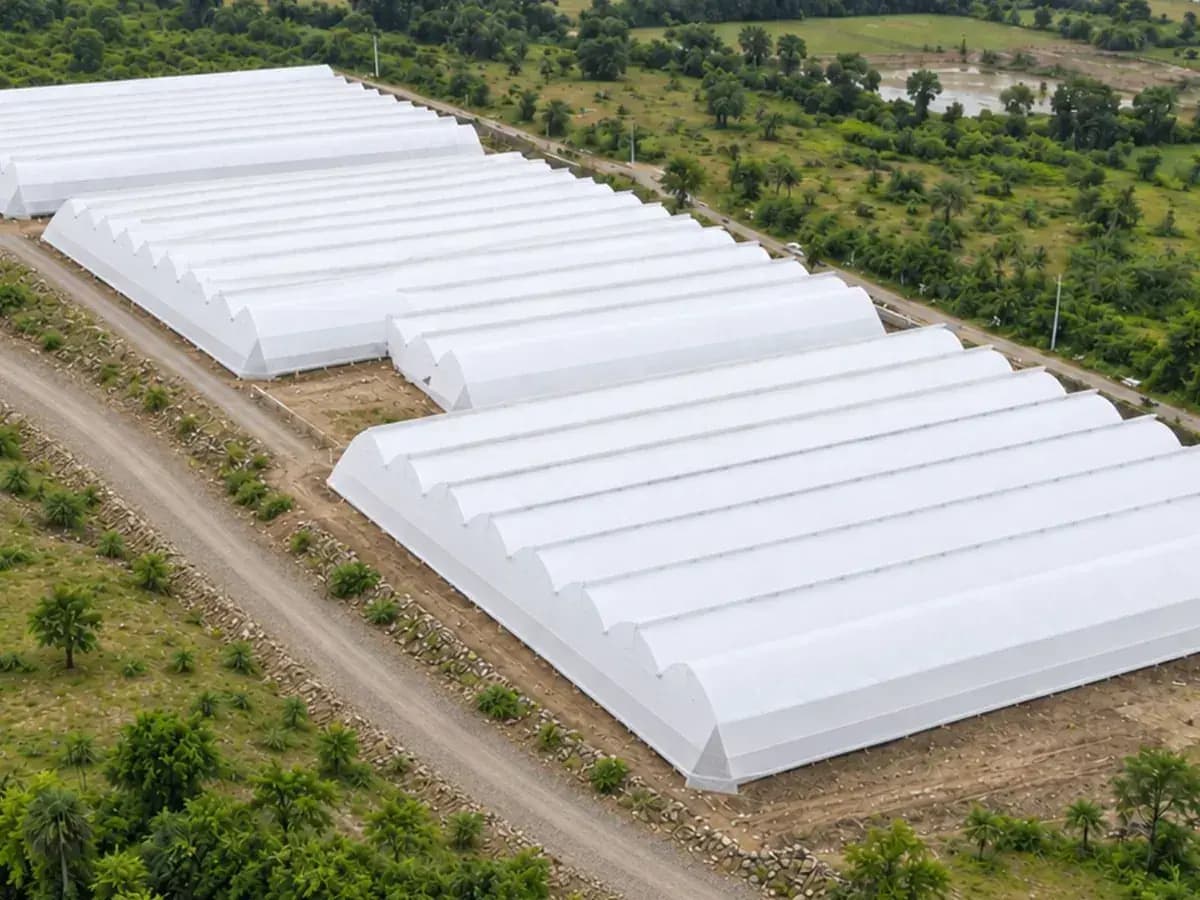
A naturally ventilated polyhouse can work well in Vadodara when its roof vents, side curtains and shade are managed for the very different May heat and July–September humidity. The key limitation is peak summer: May averages 43.1°C outside, so an NVPH reduces heat through airflow and shade but cannot give the tighter cooling of a fan-and-pad house.
- Hottest month
- May, ~43°C
- Humid (75%+)
- 3 months
- NVPH material, 1 acre
- ₹734/m²
- Delivery
- ~3 days
What Vadodara weather means for an NVPH
Vadodara has a demanding hot period before the monsoon. Afternoon highs rise from 37.8°C in March to 41.8°C in April and 43.1°C in May; May also has the strongest sun at 7.5 kWh/m²/day. The useful factor is that May humidity is only 37%, so air can move readily through open side curtains and the roof vent. Use reflective shade and do not expect a closed polyhouse to remain comfortable at midday without proper vent operation.
The monsoon changes the management problem from heat to moisture. July receives 331 mm rain and August 306 mm, while humidity averages 80% in July, 86% in August and 83% in September. Rain protection remains valuable, but stagnant humid air raises crop-disease risk. In the drier October–February period, the house is easier to run: January averages 29.4°C by day but falls to 11.7°C at night, so avoid leaving curtains unnecessarily open late at night.
The month-by-month table below is a practical planning reference for crop timing, irrigation and curtain decisions rather than a promise of conditions on a particular day.
- Peak heat: May, 43.1°C average afternoon high.
- Wettest month: July, 331 mm average rain.
- Most humid stretch: July to September.
- Coolest average night: January, 11.7°C.
| Month | Afternoon high | Night low | Humidity | Rain | Sun (kWh/m²/day) | Wind (m/s) |
|---|---|---|---|---|---|---|
| Jan | 29.4°C | 11.7°C | 34% | 1 mm | 4.7 | 2 |
| Feb | 33.2°C | 14.6°C | 28% | 2 mm | 5.6 | 2 |
| Mar | 37.8°C | 19.2°C | 25% | 4 mm | 6.6 | 2 |
| Apr | 41.8°C | 23.7°C | 28% | 3 mm | 7.3 | 2.4 |
| May | 43.1°C | 27°C | 37% | 4 mm | 7.5 | 3.6 |
| Jun | 37.8°C | 27.6°C | 59% | 143 mm | 5.9 | 4.2 |
| Jul | 32.3°C | 25.5°C | 80% | 331 mm | 4.2 | 3.8 |
| Aug | 30.5°C | 24.4°C | 86% | 306 mm | 3.9 | 3.1 |
| Sep | 31.2°C | 23.8°C | 83% | 152 mm | 4.8 | 2 |
| Oct | 32.8°C | 20.5°C | 66% | 15 mm | 5.5 | 1.3 |
| Nov | 31.8°C | 16.4°C | 52% | 4 mm | 4.7 | 1.5 |
| Dec | 29.7°C | 12.9°C | 42% | 2 mm | 4.3 | 1.8 |
Run the vents, curtains and shade by season
From March through May, keep roof vents functional and roll side curtains fully up during the hot part of the day. Use the aluminium shade net and the added second shade layer over the crop when heat and sun are strongest. Irrigate early in the day, as the seasonal guide recommends, rather than treating shade as a substitute for water management.
Before the rains begin in June, clear gutters and funnels, inspect the roof film for tears, and tighten GI springs. During rain, protect the crop by closing curtains as needed; once rain stops, open the sides whenever conditions permit to move humid air out. From July to September, wider plant spacing is a practical step to reduce fungal pressure when relative humidity is 75% or more.
October to February is the period to open the house for maximum available light, plan principal planting and complete structural maintenance. In November to January, watch the cooler nights: day ventilation may still be needed, but the curtains should not simply remain fully open into the coldest night hours.
- March–May: maximum ventilation, shade deployed during severe heat.
- June: clean drainage and check cover tension before heavy rain.
- July–September: ventilate after rain whenever possible; manage humidity and spacing.
- October–February: prioritise light, planned planting and maintenance.
| Month | Jan | Feb | Mar | Apr | May | Jun | Jul | Aug | Sep | Oct | Nov | Dec | Detail |
|---|---|---|---|---|---|---|---|---|---|---|---|---|---|
| Peak heat | ~43°C highs | ||||||||||||
| Strongest sun | 7.5 kWh/m²/day | ||||||||||||
| Wettest month | ~331 mm | ||||||||||||
| Humid (75%+) | July–September | ||||||||||||
| Nethouse season | October–February |
- 1
Before July
Clear gutters and funnels, check the film for tears and tighten the GI springs. July brings about 331 mm, the heaviest rain of the year.
- 2
July to September
Humidity stays at 75% or more. Keep side curtains open whenever it is not raining; space plants a little wider to cut fungal disease.
- 3
May
Peak heat, about 43°C. Roll the curtains fully up, close the shade net or second layer over the crop, and irrigate early in the day.
- 4
October to February
The dry, mild stretch. Open the house for maximum light, plan the main planting and do structural maintenance.
Material choices that suit this site
For Vadodara, retain the 250-micron white diffused polyfilm. It spreads the strong May sunlight more evenly. The standard roof vent and side curtains are retained for natural airflow, while white 50% shade is changed to Aluminium Shade Net (4 m), which reflects heat back out in the 43°C period.
Specify a second net layer operated with ropes and pulleys. This gives the grower the option to open or close the extra layer by season instead of keeping one shade level all year. Keep FRP doors, and include an entry cabin: its double-door arrangement helps keep whitefly and thrips out when people enter. GI gutter sheet and funnels should also remain in the kit because of the monsoon rainfall.
The structure uses ISI-marked, branded Tata, Jindal and JSW steel. Polyhouse Constructions supplies 250-micron UV-stabilised white diffused film, side insect net, shade net and fittings as part of a complete kit. The GI structure carries a 15-year manufacturing warranty, polyfilm 2.5 years and nets 3 years.
- Keep: white diffused roof film, roof vent, side curtains, FRP doors and GI gutters.
- Add: aluminium shade net, a second net layer and an entry cabin.
- Use the second layer as a seasonal control, not as a permanently closed cover.
| Part | Standard kit | For Vadodara | Why |
|---|---|---|---|
| Roof film | 250-micron white diffused polyfilm | Keep | Spreads May's 7.5 kWh/m²/day of sunlight evenly |
| Shade net | White 50% | Aluminium Shade Net (4 m) | Reflects heat back out at 43°C |
| Second net layer | None | Add (double layer) | Open or close it by the season with ropes and pulleys |
| Air circulation | Roof vent + curtains | Keep | Natural airflow is enough |
| Doors | FRP (fibre) doors | Keep FRP | FRP lasts well in this climate |
| Gutters | GI gutter sheet + funnels | Keep | July brings ~331 mm; clean before June |
| Entry cabin | Optional | Include | A double door keeps whitefly and thrips out when people walk in |
Current material kit rates and what is included
The table below gives this week’s material-only, ex-factory NVPH rates including GST. A 20 × 24 m house of 480 m² is ₹4,68,814, a 28 × 36 m house of 1,008 m² is ₹8,59,963, and a 52 × 76 m house of 3,952 m² is ₹28,99,897. The lower per-m² rate on a larger house comes from sharing gutters, end frames and doors across more growing area.
Freight to Vadodara and erection are extra. Material is supplied from the Degaon factory on the Pune–Bangalore Highway at Wai, Satara; delivery is 3 days after dispatch. Rates follow weekly GI and plastic prices and are updated every Friday, so build the exact kit online before booking. Booking is with 5% advance and the remaining 95% before dispatch.
For a 52 × 76 m kit, the largest listed components include 102 Big Bottom members, 133 Small Columns, 375 m of GI gutter sheet, 722 m of 4.5 m white diffused film and 864 m of white 50% shade net. It is a 68-item kit with about 16.8 tonnes of steel and fittings; the online kit builder gives every line for the selected size.
- Small: 480 m² — ₹4,68,814 — ₹977/m².
- Medium: 1,008 m² — ₹8,59,963 — ₹853/m².
- About 1 acre: 3,952 m² — ₹28,99,897 — ₹734/m².
| Size | Span × bay | Area | Material incl. GST | Per m² |
|---|---|---|---|---|
| Small | 20 × 24 m | 480 m² | ₹4,68,814 | ₹977 |
| Medium | 28 × 36 m | 1,008 m² | ₹8,59,963 | ₹853 |
| About 1 acre | 52 × 76 m | 3,952 m² | ₹28,99,897 | ₹734 |
Price your own size for Vadodara
Choose span and bay and get the full list with quantities, weights and rates in a minute.
Crops to match the house and local price seasons
Choose a crop around both climate tolerance and the sale month, not only its average mandi price. Cucumber is a logical NVPH crop to assess because its district average modal price is ₹2,216/q and its highest recorded month is June at ₹2,736/q. It needs careful airflow through the humid monsoon transition. Tomato recorded its high in August at ₹2,953/q, but August’s 86% average humidity makes disease management and ventilation especially important.
For the comparatively mild post-monsoon period, cabbage, cauliflower, bottle gourd and brinjal all have their highest recorded district prices in November: ₹1,717/q, ₹2,624/q, ₹1,829/q and ₹2,572/q respectively. Their recorded low month is March for cabbage, cauliflower and brinjal, when the dry heat begins to build. Okra’s recorded high is December at ₹4,192/q, against a low of ₹2,054/q in May.
Green chilli and coriander leaves have strong recorded July price peaks, ₹4,626/q and ₹5,754/q, but this is also the most humid season. Such crops need a deliberate disease and market plan, not planting only because a past price peak looks attractive. These figures are district-market observations from Padra APMC and Vadodara(Sayajipura) APMC and should be checked again near harvest.
- Cucumber: average ₹2,216/q; high in June at ₹2,736/q.
- Cauliflower: high in November at ₹2,624/q.
- Green chilli: high in July at ₹4,626/q, but September low is ₹1,947/q.
- Okra: high in December at ₹4,192/q.
| Crop | Markets | Average modal price | Highest month | Lowest month |
|---|---|---|---|---|
| Cabbage | 4 | ₹1,124/q | Nov (₹1,717) | Mar (₹394) |
| Green chilli | 4 | ₹3,171/q | Jul (₹4,626) | Sep (₹1,947) |
| Tomato | 4 | ₹1,876/q | Aug (₹2,953) | Mar (₹659) |
| Cauliflower | 4 | ₹1,998/q | Nov (₹2,624) | Mar (₹1,140) |
| Bottle gourd | 4 | ₹1,437/q | Nov (₹1,829) | May (₹1,014) |
| Brinjal | 4 | ₹1,685/q | Nov (₹2,572) | Mar (₹809) |
| Spinach | 4 | ₹1,578/q | Jul (₹2,434) | Jan (₹659) |
| Cucumber | 4 | ₹2,216/q | Jun (₹2,736) | Mar (₹1,545) |
| Coriander (leaves) | 4 | ₹3,142/q | Jul (₹5,754) | Jan (₹1,181) |
| Okra (bhindi) | 4 | ₹3,113/q | Dec (₹4,192) | May (₹2,054) |
NVPH or fan and pad for a Vadodara project?
An NVPH is the lower-cost, no-cooling-power option for crops that can be managed with roof vents, side curtains and shade. Its listed material price for about 1 acre is ₹28,99,897, or ₹734/m². It suits capsicum, cucumber, tomato and flowers in Vadodara, provided summer crop scheduling and shade operation are realistic.
Fan and pad provides exhaust fans and wet pads and is shown at about 33°C inside in May. That tighter summer control is relevant when a crop needs steadier conditions through Vadodara’s 43.1°C month. Its listed material price for about 1 acre is ₹32,48,775, or ₹822/m², and it requires electricity for fans and a pump.
Therefore, use an NVPH where the crop calendar can lean on the October–February mild period and where active shade and curtain management are acceptable. Consider fan and pad for leafy greens or crops needing tighter summer control; it is not simply an upgrade in structure, but an operating system with power and water requirements.
- NVPH cooling: roof vent and side curtains, with no power for cooling.
- Fan-and-pad cooling: fans and wet pads; about 33°C inside in May.
- Material-price comparison is for the listed about-one-acre sizes only.
| Naturally ventilated | Fan & pad | |
|---|---|---|
| Cooling | Roof vent and side curtains (no power) | Exhaust fans and wet pads, ~33°C inside in May |
| Running cost | None for cooling | Electricity for fans and a pump |
| Material price, 1 acre | ₹28,99,897 (₹734/m²) | ₹32,48,775 (₹822/m²) |
| Suits in Vadodara | Capsicum, cucumber, tomato, flowers | Leafy greens and crops needing tight control in summer |
Buying material and arranging construction
Polyhouse Constructions is a manufacturer and a venture of Kryzen Biotech Pvt Ltd, not a Vadodara office. We supply complete material kits or individual parts from Satara. Every dispatch is supported by in-house engineering and manufacturing, a 32-point QA checklist, lab test certificates and a technical data sheet for every product.
For erection, Kryzen Biotech’s construction team carries out construction. Before finalising a layout, use the kit builder to select span and bay, review each item, quantity, weight and the week’s rate, then confirm the site-specific crop and ventilation requirements. Farmers considering support should also confirm current norms with the Gujarat state horticulture department before beginning work.
- Material manufacturing and supply: Polyhouse Constructions.
- Construction/erection: Kryzen Biotech’s construction team.
- No Vadodara office is represented; kits are supplied from the Satara factory.
| What you get | Polyhouse Construction | Typical local fabricator |
|---|---|---|
| Experience | 30 years of collective experience in greenhouse engineering | Often a small crew learning on the job |
| Technical know-how | Strong technical understanding: structure planned for your climate and crop | Usually repeats one standard design |
| Warranty | 15-year manufacturing warranty | Rarely a written warranty |
| Engineering | In-house engineering team | No design or load checks |
| Manufacturing | In-house manufacturing, cut and drilled to drawing | Buys pipes from traders, cuts on site |
| Quality checks | 32-point QA checklist for every part | Visual check at best |
| Lab certificate | Lab test certificate with every dispatch | Not provided |
| Technical sheet | Technical data sheet for every product | Not available |
| Material match | Zero material mismatch: every part counted per design | Short or excess material is common |
| Raw material | Branded steel from Tata, Jindal and JSW | Unbranded or mixed sources |
| Price | Lowest cost across India, with real-time price benefits from weekly rates | Fixed quote; rate drops are not passed on |
| Backing | Backed by industry leader Kryzen Biotech | Single-owner workshop |
Buy from India's biggest CEA manufacturing company
Choose your structure and size and get the complete material list, priced this week.
FAQs
Will a naturally ventilated polyhouse handle Vadodara’s May heat?
It can reduce heat through fully opened side curtains, roof vents, aluminium shade net and a second shade layer, but May averages 43.1°C outside. For tighter summer control, fan and pad is shown at about 33°C inside in May.
How should I manage the house in the July to September monsoon?
July averages 331 mm rain, while humidity is 80% in July, 86% in August and 83% in September. Clear gutters before the rains, close curtains during rain as required, and reopen them whenever possible after rain to move humid air out.
What is the current NVPH material price for Vadodara?
The listed material-only, GST-included ex-factory prices are ₹4,68,814 for 480 m², ₹8,59,963 for 1,008 m² and ₹28,99,897 for 3,952 m². Freight to Vadodara and erection are extra, and rates update every Friday.
Which crops should I consider for an NVPH here?
Cucumber, capsicum, tomato and flowers suit the NVPH comparison for Vadodara, while crop selection should also follow the intended selling month. District records show cucumber’s highest month in June and cauliflower, cabbage, bottle gourd and brinjal highs in November.
Does Polyhouse Constructions construct the polyhouse in Vadodara?
Polyhouse Constructions manufactures and supplies the material kit from Satara; it does not have a Vadodara office. Construction and erection are carried out by Kryzen Biotech’s construction team.
NVPH materials near Vadodara
Neighbouring towns on the same delivery route, and how their summers compare.
| Town | From Vadodara | Hottest month | Humid months | Suits |
|---|---|---|---|---|
| NVPH materials in Padra | ~20 km | May, 42°C | 3 | NVPH + fan & pad |
| NVPH materials in Anand | ~50 km | May, 43°C | 3 | NVPH + fan & pad |
| NVPH materials in Petlad | ~60 km | May, 43°C | 3 | NVPH + fan & pad |
| NVPH materials in Umreth | ~60 km | May, 43°C | 3 | NVPH + fan & pad |
| NVPH materials in Nadiad | ~70 km | May, 43°C | 3 | NVPH + fan & pad |
| NVPH materials in Rajpipla | ~70 km | May, 42°C | 3 | NVPH + fan & pad |