
NVPH materials · New Delhi district, Delhi
Naturally ventilated polyhouse material for Delhi
By Editorial Team, Kryzen Biotech · Updated 13 November 2026
A naturally ventilated polyhouse can work well for much of Delhi’s crop calendar, but it needs disciplined curtain and shade management through the dry April–June heat. May is the deciding month: average afternoon highs reach 42.8°C, so growers wanting reliable tight summer temperature control should compare fan & pad cooling before finalising the structure.
- Hottest month
- May, ~43°C
- Humid (75%+)
- Rarely
- NVPH material, 1 acre
- ₹734/m²
- Delivery
- ~5 days
What natural ventilation can handle in Delhi
An NVPH cools by bringing air in through raised side curtains and releasing warmer air through the roof vent. This is useful in Delhi’s dry summer air: May has an average humidity of 23%, and June 36%, so ventilation can move heat out effectively. It does not, however, make the house independent of outside temperature. With average highs of 39°C in April, 42.8°C in May and 42.1°C in June, a naturally ventilated house will still be hot in the afternoon.
From July to September, the challenge changes from extreme dry heat to rain and moisture. July is the wettest month at 217 mm, followed by August at 203 mm and September at 121 mm; humidity is 63%, 75% and 69% respectively. Keep air moving whenever rain is not entering the crop area, avoid leaving curtains shut for long after a shower, and inspect the roof cover, gutters and drainage before the monsoon.
Winter is a favourable working period for ventilation, but nights are cool. January averages 21.4°C in the afternoon and 5.9°C at night. Curtains that are useful for daytime airflow should be lowered in the evening and overnight when conditions demand crop protection. March and October are useful transition months, with highs around 32°C and cooler nights than the peak-summer period.
- Natural ventilation is a practical choice for crops that tolerate some summer variation and can be scheduled around Delhi’s hottest weeks.
- It is not the same as mechanical cooling: at May’s 42.8°C average high, shade and open vents reduce heat stress but do not provide a fixed inside temperature.
- The month-by-month table below should guide crop timing, irrigation and daily curtain decisions.
| Month | Afternoon high | Night low | Humidity | Rain | Sun (kWh/m²/day) | Wind (m/s) |
|---|---|---|---|---|---|---|
| Jan | 21.4°C | 5.9°C | 44% | 16 mm | 3.1 | 1.7 |
| Feb | 25.7°C | 9.1°C | 41% | 22 mm | 4.3 | 1.9 |
| Mar | 32.4°C | 14.9°C | 33% | 18 mm | 5.6 | 2 |
| Apr | 39°C | 21.8°C | 24% | 15 mm | 6.6 | 2.2 |
| May | 42.8°C | 27.3°C | 23% | 33 mm | 6.7 | 2.4 |
| Jun | 42.1°C | 29.7°C | 36% | 80 mm | 6.1 | 2.5 |
| Jul | 36.7°C | 27.8°C | 63% | 217 mm | 5 | 2.1 |
| Aug | 33.7°C | 25.9°C | 75% | 203 mm | 4.9 | 1.8 |
| Sep | 33.4°C | 23.2°C | 69% | 121 mm | 5.1 | 1.7 |
| Oct | 32.2°C | 18.2°C | 51% | 13 mm | 4.7 | 1.4 |
| Nov | 27.6°C | 12.6°C | 43% | 4 mm | 3.6 | 1.6 |
| Dec | 22.8°C | 7.7°C | 42% | 8 mm | 3 | 1.7 |
A working calendar for vents, curtains and shade
From January to February, open side curtains during suitable daytime conditions to refresh the crop, then reduce openings toward evening as nights fall to 5.9°C in January and 9.1°C in February. Do not treat a clear winter afternoon as a reason to leave the house fully open overnight. March brings stronger sun at 5.6 kWh/m²/day and a 32.4°C average high, so increase daytime ventilation gradually.
In April, May and June, roll the side curtains fully up during the hottest part of the day and keep the roof vent functioning freely. May has both the strongest sun, 6.7 kWh/m²/day, and the highest average afternoon temperature. Close the shade layer over the crop during peak heat. Irrigate early in the day, as specified in the seasonal steps below, rather than relying on afternoon cooling alone.
Before July, clear all gutters and funnels, check film for tears and tighten GI springs. During July–September, use openings to release moisture whenever weather permits, while preventing direct rain entry. October allows a gradual reduction of shade as sun falls to 4.7 kWh/m²/day. In November and December, use the curtain primarily for daytime exchange and close it earlier in the evening; December nights average 7.7°C.
- May: curtains fully up, roof vent open, shade layer closed over the crop during peak heat.
- Monsoon: prioritise rain exclusion, drainage and moisture release rather than keeping every opening permanently shut.
- Winter: manage openings by time of day, especially where the crop is affected by cool nights.
| Month | Jan | Feb | Mar | Apr | May | Jun | Jul | Aug | Sep | Oct | Nov | Dec | Detail |
|---|---|---|---|---|---|---|---|---|---|---|---|---|---|
| Peak heat | ~43°C highs | ||||||||||||
| Strongest sun | 6.7 kWh/m²/day | ||||||||||||
| Wettest month | ~217 mm |
- 1
Before July
Clear gutters and funnels, check the film for tears and tighten the GI springs. July brings about 217 mm, the heaviest rain of the year.
- 2
May
Peak heat, about 43°C. Roll the curtains fully up, close the shade net or second layer over the crop, and irrigate early in the day.
Material changes worth specifying for this climate
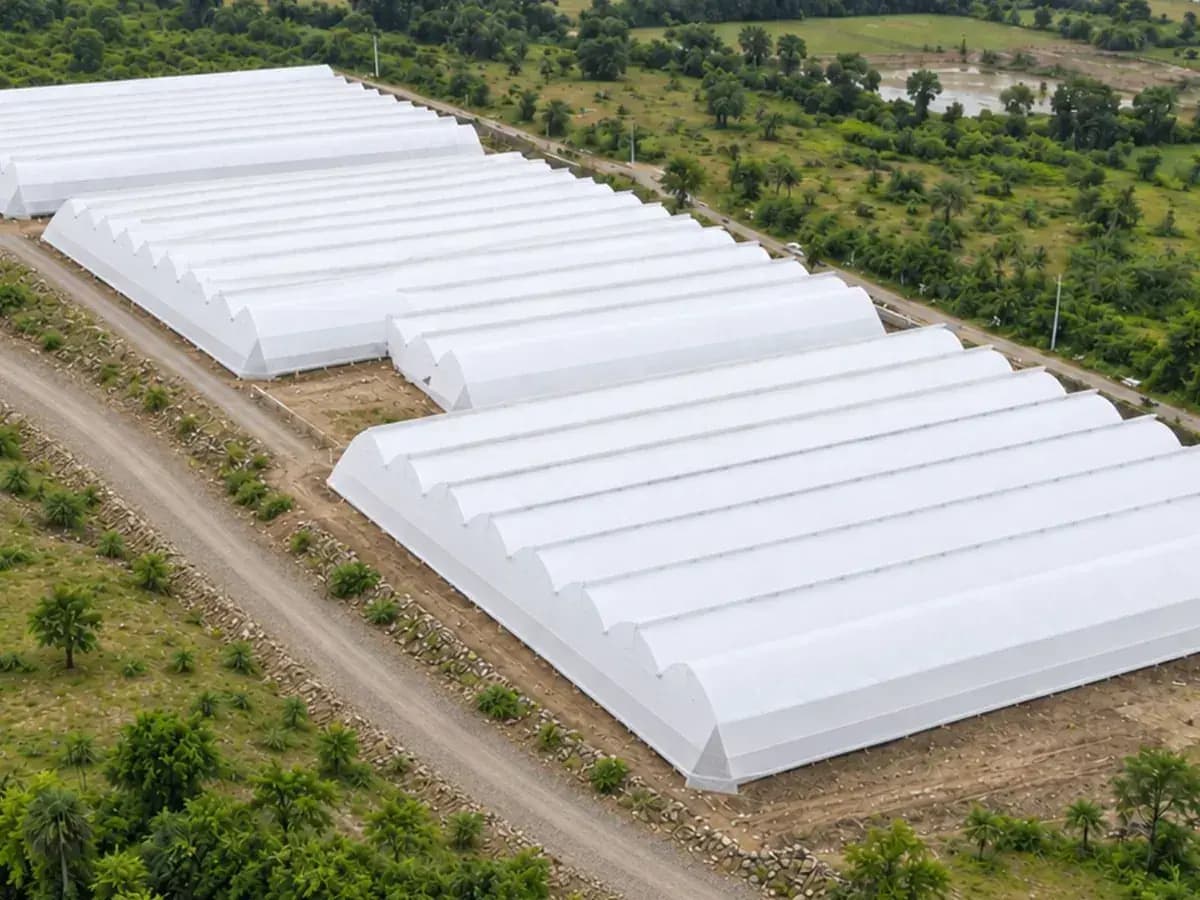
The core Delhi kit should retain the 250-micron white diffused polyfilm, roof vent and side-curtain ventilation. The white diffused film spreads the strong May light more evenly, while the standard insect-net side system supports ventilation with crop separation. FRP doors and GI gutter sheet with funnels are also appropriate components for this climate.
For the April–June period, choose an aluminium reflective shade net rather than relying only on the standard white 50% shade net. It is recommended here because it reflects heat outward during the 43°C May conditions. Add a second shade-net layer with ropes and pulleys. That gives the operator a practical choice to open or close the layer with the season rather than carrying the same shading level all year.
A double-door entry cabin remains optional, but it can help reduce whitefly and thrips entering while people move in and out. It is an access-control choice, not a substitute for crop scouting or correct curtain use.
- Keep: 250-micron white diffused roof film, roof vent, side curtains, FRP doors and GI gutters.
- Upgrade: aluminium shade net and a rope-and-pulley operated second shade layer.
- Prepare gutters before June because July alone averages about 217 mm rain.
| Part | Standard kit | For Delhi | Why |
|---|---|---|---|
| Roof film | 250-micron white diffused polyfilm | Keep | Spreads May's 6.7 kWh/m²/day of sunlight evenly |
| Shade net | White 50% | Aluminium Shade Net (4 m) | Reflects heat back out at 43°C |
| Second net layer | None | Add (double layer) | Open or close it by the season with ropes and pulleys |
| Air circulation | Roof vent + curtains | Keep | Natural airflow is enough |
| Doors | FRP (fibre) doors | Keep FRP | FRP lasts well in this climate |
| Gutters | GI gutter sheet + funnels | Keep | July brings ~217 mm; clean before June |
| Entry cabin | Optional | Optional | A double door keeps whitefly and thrips out when people walk in |
What comes in a complete NVPH material kit
Polyhouse Constructions is a manufacturer supplying complete material kits from its Degaon, Pune–Bangalore Highway factory at Wai, Satara. Delhi is 1,600 km from the factory, and delivery is 5 days after dispatch. This is material supply, not a Delhi office: erection and construction are carried out by Kryzen Biotech’s construction team.
A kit combines the GI structure, white diffused polyfilm, side insect net, skirting apron, shade net and the fittings needed to assemble the design. For example, the 28 × 36 m kit has 67 items in all and about 4.8 tonnes of steel and fittings. Its larger listed lines include 36 small columns, 32 side hockey members, 21 big-bottom members, 27 big arcs, 70 m of GI gutter sheet, film in two widths, and the listed profiles, springs, brackets, clamps and screws.
The table below shows the major components and quantities for that 1,008 m² example. The online kit builder provides the full line-by-line list, weights and rates for the selected span and bay. GI pipes are ISI-marked branded steel from Tata, Jindal and JSW; the GI structure has a 15-year manufacturing warranty, polyfilm 2.5 years and nets 3 years.
- Every dispatch includes lab test certificates and a technical data sheet for every product.
- In-house engineering and manufacturing are supported by a 32-point QA check.
- Individual materials as well as complete kits are available.
| Group | Item | Quantity | Weight |
|---|---|---|---|
| GI structure | Small Column (76X2.0X4500) | 36 nos | 609 kg |
| GI structure | Side Hockey (60X2.0X5500) | 32 nos | 549 kg |
| GI structure | Big Bottom (60X2.0X8000) | 21 nos | 524 kg |
| GI structure | Big Arc (42X2.0X5200) | 27 nos | 292 kg |
| GI structure | GI Gutter Sheet | 70 mtr | — |
| Film & nets | Polyfilm White Diffused 250 Micron (4.5 m) | 255 mtr | — |
| Film & nets | Polyfilm White Diffused 250 Micron (5.5 m) | 138 mtr | — |
| Film & nets | Side Insect Net (5.2 m) | 130 mtr | — |
| Film & nets | Side Skirting Apron (1.5 m) | 130 mtr | — |
| Film & nets | White Shade Net 50% | 192 mtr | — |
| Fittings & accessories | Aluminium Profile | 836 mtr | — |
| Fittings & accessories | GI Spring | 1,425 mtr | — |
| Fittings & accessories | F Bracket | 54 nos | — |
| Fittings & accessories | Clamps 60 mm Half | 358 nos | — |
| Fittings & accessories | Self Drilling Screw | 1,881 nos | — |
This week’s material-only price for Delhi projects
The current table below is for NVPH material including GST, ex-factory. Freight to Delhi and erection are extra, so these figures should be read as kit-material prices rather than an installed-project quote. Prices follow weekly GI and plastic rates and are updated every Friday.
A 480 m², 20 × 24 m small kit is ₹4,68,814, or ₹977/m². The 1,008 m², 28 × 36 m medium kit is ₹8,59,963, or ₹853/m². A 3,952 m², 52 × 76 m kit—about 1 acre—is ₹28,99,897, or ₹734/m². The lower per-m² rate at larger size reflects shared gutters, end frames and doors.
A booking requires 5% advance and the remaining 95% before dispatch. A 5% bulk discount applies when 10 or more units of an item are purchased. Build the intended Delhi size online to see the exact current material quantities and weekly rate before planning freight and erection.
- Small: 480 m² at ₹4,68,814.
- Medium: 1,008 m² at ₹8,59,963.
- About 1 acre: 3,952 m² at ₹28,99,897.
| Size | Span × bay | Area | Material incl. GST | Per m² |
|---|---|---|---|---|
| Small | 20 × 24 m | 480 m² | ₹4,68,814 | ₹977 |
| Medium | 28 × 36 m | 1,008 m² | ₹8,59,963 | ₹853 |
| About 1 acre | 52 × 76 m | 3,952 m² | ₹28,99,897 | ₹734 |
Price your own size for Delhi
Choose span and bay and get the full list with quantities, weights and rates in a minute.
Crop choices: match planting and harvest to Delhi markets
For an NVPH, coloured capsicum and parthenocarpic cucumber are the clearest protected-cultivation options in the available crop guidance. Capsicum needs the May shade strategy particularly carefully, while cucumber is described as a fast 3–4 month crop supported by drip irrigation in dry spells. Tomato is another market-led option, but choose crop and planting date based on a realistic heat-management plan rather than a price peak alone.
Market records across 10 district markets show cucumber averaging ₹2,098/q, with the highest listed month January at ₹2,616/q and the lowest May at ₹1,348/q. Tomato averages ₹2,073/q and peaks in November at ₹3,137/q, compared with ₹1,027/q in May. These May lows coincide with the toughest natural-ventilation month, which is a useful warning against assuming high summer risk will automatically bring a higher price.
Capsicum has the strongest listed average among these main NVPH vegetables at ₹3,324/q across 9 markets, and its highest listed month is July at ₹5,397/q; its low is May at ₹1,621/q. Use the price table as a season indicator, not a promise: prices are historical modal prices from district markets and production, grade and timing still matter. Growers selling flowers can also consider gerbera and rose, which the crop guide identifies for year-round city florist and event demand.
- Markets listed for the district include APMC Azadpur, APMC Keshopur, APMC Shahdara and Fruit & Vegetable Market, Gazipur APMC.
- Cucumber: January is the listed high-price month; May is the listed low-price month.
- Capsicum: July is the listed high-price month, but the monsoon requires active humidity and rain management.
| Crop | Markets | Average modal price | Highest month | Lowest month |
|---|---|---|---|---|
| Cucumber | 10 | ₹2,098/q | Jan (₹2,616) | May (₹1,348) |
| Brinjal | 10 | ₹1,912/q | Jul (₹2,266) | May (₹1,609) |
| Cabbage | 10 | ₹1,175/q | Nov (₹1,765) | May (₹680) |
| Tomato | 10 | ₹2,073/q | Nov (₹3,137) | May (₹1,027) |
| Cauliflower | 10 | ₹2,654/q | Jul (₹5,027) | Feb (₹854) |
| Capsicum | 9 | ₹3,324/q | Jul (₹5,397) | May (₹1,621) |
| Bottle gourd | 10 | ₹1,765/q | Dec (₹2,276) | May (₹1,141) |
| Bitter gourd | 9 | ₹2,921/q | Feb (₹4,533) | May (₹1,529) |
| Coriander (leaves) | 10 | ₹3,535/q | Jul (₹7,522) | Feb (₹1,328) |
| Okra (bhindi) | 9 | ₹3,574/q | Dec (₹6,192) | May (₹1,839) |
NVPH or fan & pad for a Delhi site?
Choose NVPH where the aim is lower cooling running cost and the crop can accept conditions that track Delhi weather. Its roof vent and side curtains need no power for cooling. It suits capsicum, cucumber, tomato and flowers, provided the grower is ready to manage shade, ventilation and crop schedule through the April–June heat.
Choose fan & pad when the crop plan depends on more dependable summer cooling. In May, fan & pad can achieve about 31°C inside, compared with the exposure an NVPH has to outside average highs of 42.8°C. That improvement comes with exhaust fans, wet pads, a pump and electricity use.
For the about-1-acre comparison shown below, NVPH material is ₹28,99,897 or ₹734/m², while fan & pad material is ₹32,48,775 or ₹822/m². The purchase-price gap is only one part of the decision: account for the power and water requirements of mechanical cooling, and decide whether the crop’s summer temperature requirement justifies them.
- NVPH: no cooling power cost, but afternoon summer conditions remain linked to outside heat.
- Fan & pad: tighter May cooling, with electricity for fans and pump.
- Delhi’s dry May air is favourable for pad cooling, and pad cooling works here.
| Naturally ventilated | Fan & pad | |
|---|---|---|
| Cooling | Roof vent and side curtains (no power) | Exhaust fans and wet pads, ~31°C inside in May |
| Running cost | None for cooling | Electricity for fans and a pump |
| Material price, 1 acre | ₹28,99,897 (₹734/m²) | ₹32,48,775 (₹822/m²) |
| Suits in Delhi | Capsicum, cucumber, tomato, flowers | Leafy greens and crops needing tight control in summer |
Ordering, engineering and project support
The practical first step is to choose the required span and bay in the online builder, then check every material line, quantity, weight and current rate. Polyhouse Constructions is a venture of Kryzen Biotech Pvt Ltd and manufactures protected-cultivation structures and material in India. Its factory is at Degaon, Pune–Bangalore Highway, Tal. Wai, Satara, Maharashtra; the Experience Center is at Mahalunge, Pune.
For a Delhi NVPH, confirm the crop, planned crop months, shade-net upgrade, second-layer operation, door preference and drainage preparation before material is packed. The engineering team can plan the structure for the climate and crop, while Kryzen Biotech’s team handles construction rather than an unconnected local crew. This distinction matters when the project has to operate through May heat and the July monsoon.
Delhi growers considering assistance should verify the applicable programme and current norms with the state horticulture department before beginning work. MIDH/NHM is stated as 50% of the cost norm up to 4,000 m² per beneficiary. For NHB commercial projects above 2,500 m², the stated credit-linked back-ended subsidy is 50% of project cost at admissible norms, capped at ₹56 lakh per project, and In-Principle Approval is needed before starting.
- NVPH tubular NHB cost norm stated: ₹844/m².
- Confirm scheme eligibility and current norms before construction starts.
- Construction is performed by Kryzen Biotech’s construction team.
Subsidy for a project in Delhi
Which scheme fits your size, a worked example and the steps to apply.
Buy from India's biggest CEA manufacturing company
Choose your structure and size and get the complete material list, priced this week.
FAQs
Can a naturally ventilated polyhouse handle Delhi’s May heat?
It can ventilate dry air effectively, but it cannot hold a fixed cool temperature when May average afternoon highs are 42.8°C. Use fully raised curtains, roof ventilation, aluminium shade net and a second adjustable shade layer; choose fan & pad if dependable summer cooling is essential.
When should I prepare the polyhouse for Delhi’s monsoon?
Prepare before July by cleaning gutters and funnels, checking the film for tears and tightening GI springs. July averages about 217 mm rain, with August at 203 mm, so drainage and moisture release need attention.
What is the current NVPH material price for a medium Delhi project?
This week’s 28 × 36 m, 1,008 m² material kit is ₹8,59,963 including GST, or ₹853/m², ex-factory. Freight to Delhi and erection are extra, and weekly GI and plastic rates can change.
Which crops have useful market seasons for an NVPH in Delhi?
Cucumber, capsicum and tomato are relevant choices, with crop timing matched to heat management and market season. District data lists cucumber’s high month as January at ₹2,616/q, capsicum’s as July at ₹5,397/q, and tomato’s as November at ₹3,137/q.
Who constructs the polyhouse in Delhi after I buy the material kit?
Polyhouse Constructions manufactures and supplies the material from its Satara factory; it does not have an office in Delhi. Construction and erection are done by Kryzen Biotech’s construction team.
NVPH materials near Delhi
Neighbouring towns on the same delivery route, and how their summers compare.
| Town | From Delhi | Hottest month | Humid months | Suits |
|---|---|---|---|---|
| NVPH materials in Bhalswa Jahangir Pur | ~10 km | May, 43°C | 0 | NVPH + fan & pad |
| NVPH materials in Karawal Nagar | ~10 km | May, 43°C | 0 | NVPH + fan & pad |
| NVPH materials in New Delhi | ~10 km | May, 43°C | 0 | NVPH + fan & pad |
| NVPH materials in Nangloi Jat | ~20 km | May, 43°C | 0 | NVPH + fan & pad |
| NVPH materials in Sultan Pur Majra | ~20 km | May, 43°C | 0 | NVPH + fan & pad |
| NVPH materials in Loni | ~20 km | May, 43°C | 0 | NVPH + fan & pad |