
Equipment · Bengaluru Urban district, Karnataka
Protected cultivation equipment for Bengaluru farms
By Editorial Team, Kryzen Biotech · Updated 13 November 2026
Bengaluru needs protected-cultivation equipment that can handle two different conditions well: dry, bright heat in March and April, followed by six humid months from June to November. Polyhouse Constructions supplies complete material kits and individual parts from its Satara factory; erection is handled by Kryzen Biotech’s construction team.
- Pad cooling
- Works: ~29°C inside
- Humid months
- 6
- Shading need
- Medium
- Delivery
- ~4 days
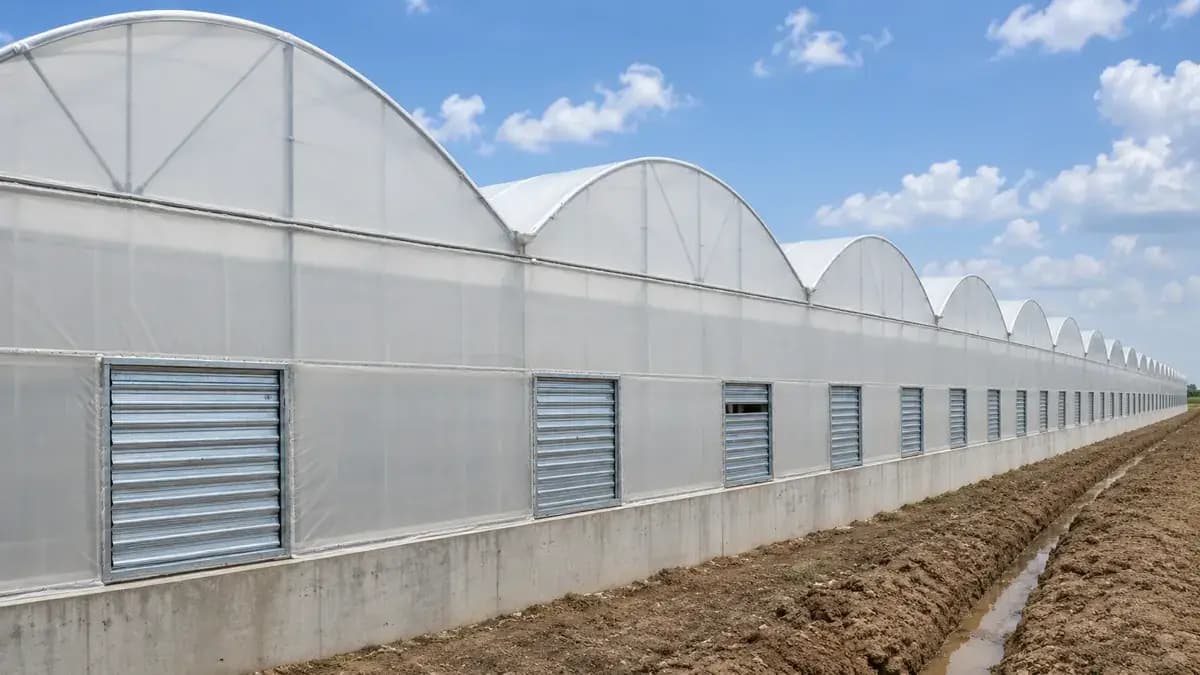
Start with Bengaluru’s actual climate, not a standard kit
At 920 m elevation, Bengaluru does not have one extreme season throughout the year. April is the hottest month, with a 35.4°C average afternoon high, while March and April receive the strongest sun at 6.6 kWh/m²/day. A house that only relies on open sides can become warm in this period, especially where crop rows and plant canopy restrict airflow.
The monsoon-side challenge is different. Humidity rises from June through November: it is 75% in June, 77% in July, 80% in September and 81% in October. September brings 152 mm rain and October 141 mm. Then night temperatures fall to 13.5°C in January and 13.9°C in December. The equipment choice should therefore combine cooling and shade for the hot months, steady internal air movement in humid weather, rain handling, and curtains and doors that close properly at night.
- Use exhaust fans and cellulose pads where active cooling is needed in March and April.
- Use air-circulation fans during the humid June–November period.
- Use white 50% shade net for the high-sun period; white shade net is the stated priority for Bengaluru.
- Include standard gutters for Bengaluru’s 844 mm annual rain.
- Check curtain closure and door sealing for the cooler December–January nights.
| Need | For Bengaluru | Why |
|---|---|---|
| Cooling | Exhaust fans + cellulose pads | Pads bring 35°C to ~29°C in April |
| Air movement | Air circulation fans | Humid from June to November |
| Shading | White 50% net | Sun peaks at 6.6 kWh/m² in March |
| Rain | Standard gutters | 844 mm a year |
| Nights | Curtains that close fully | 920 m above sea level |
The month-by-month operating window
The climate table below is useful when deciding when to run or service equipment. February turns warmer quickly at 32°C with relatively low 51% humidity. March reaches 35°C at 44% humidity, and April peaks at 35.4°C. May brings 110 mm rain while retaining a 32.8°C average high, so the change from heat management to rain and humidity management starts before June.
From June, afternoon highs are milder, between 29°C and 26.3°C through November, but humidity and rain place more importance on ventilation and dry crop conditions. July has the highest average wind shown, 4.5 m/s. January is dry at 2 mm rain but has the lowest night temperature, 13.5°C.
- March–April: prioritise shade, pad condition and exhaust-fan readiness.
- May–October: prioritise curtains, insect-net condition, drainage and air circulation.
- November–February: nethouse season in Bengaluru; check coverings, fittings and night closure.
| Month | Afternoon high | Night low | Humidity | Rain | Sun (kWh/m²/day) | Wind (m/s) |
|---|---|---|---|---|---|---|
| Jan | 28.7°C | 13.5°C | 63% | 2 mm | 5.5 | 2.4 |
| Feb | 32°C | 15°C | 51% | 5 mm | 6.3 | 2.6 |
| Mar | 35°C | 18.6°C | 44% | 17 mm | 6.6 | 2.6 |
| Apr | 35.4°C | 21.3°C | 49% | 57 mm | 6.6 | 2.3 |
| May | 32.8°C | 21.2°C | 64% | 110 mm | 6.2 | 2.6 |
| Jun | 29°C | 19.6°C | 75% | 76 mm | 5.3 | 4.2 |
| Jul | 28.1°C | 19°C | 77% | 100 mm | 4.8 | 4.5 |
| Aug | 27.8°C | 18.8°C | 79% | 113 mm | 4.8 | 4 |
| Sep | 27.6°C | 18.7°C | 80% | 152 mm | 5.3 | 2.8 |
| Oct | 27.1°C | 18°C | 81% | 141 mm | 5 | 2 |
| Nov | 26.3°C | 15.9°C | 79% | 56 mm | 4.7 | 2.3 |
| Dec | 26.6°C | 13.9°C | 74% | 15 mm | 4.8 | 2.5 |
Does fan-and-pad cooling make sense here?
Yes, fan-and-pad cooling works in Bengaluru’s hot period. For an April outside average high of 35°C, the stated pad-cooled inside temperature is about 29°C. That is a meaningful cooling function for a crop and production plan that needs a more controlled environment than naturally ventilated sides can provide.
Whether it pays for an individual farm cannot be decided from temperature alone. Compare the crop plan, the cost of operating the system and expected selling period before choosing fan and pad. District mandi records show capsicum averaging ₹4,032/q across eight markets, with its recorded high in November at ₹5,118/q and low in April at ₹3,195/q. Beans averaged ₹4,695/q across 10 markets and had a recorded high of ₹6,950/q in May. These are historical modal-price observations, not a future-price promise.
For a reference scale only, the sizing figures below show a 52 × 76 m fan-and-pad house of 3,952 m² using 12 exhaust fans and 82 cellulose pads. The material figure shown is ₹32,48,775 including GST for that example; it is not a quote for every site or size.
- Choose fan and pad when the crop needs active April heat reduction.
- Choose an NVPH where natural ventilation, roll-up curtains, insect net and shade are more suitable for the crop plan.
- Use the district market seasonality as one input, rather than assuming that cooling alone assures a return.
- Fan & pad house, 52 × 76 m
- 3,952 m²
- Exhaust fans
- 12 nos
- Cellulose pads
- 82 nos
- Material incl. GST
- ₹32,48,775
Equipment list and current listed item rates
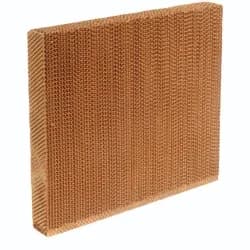
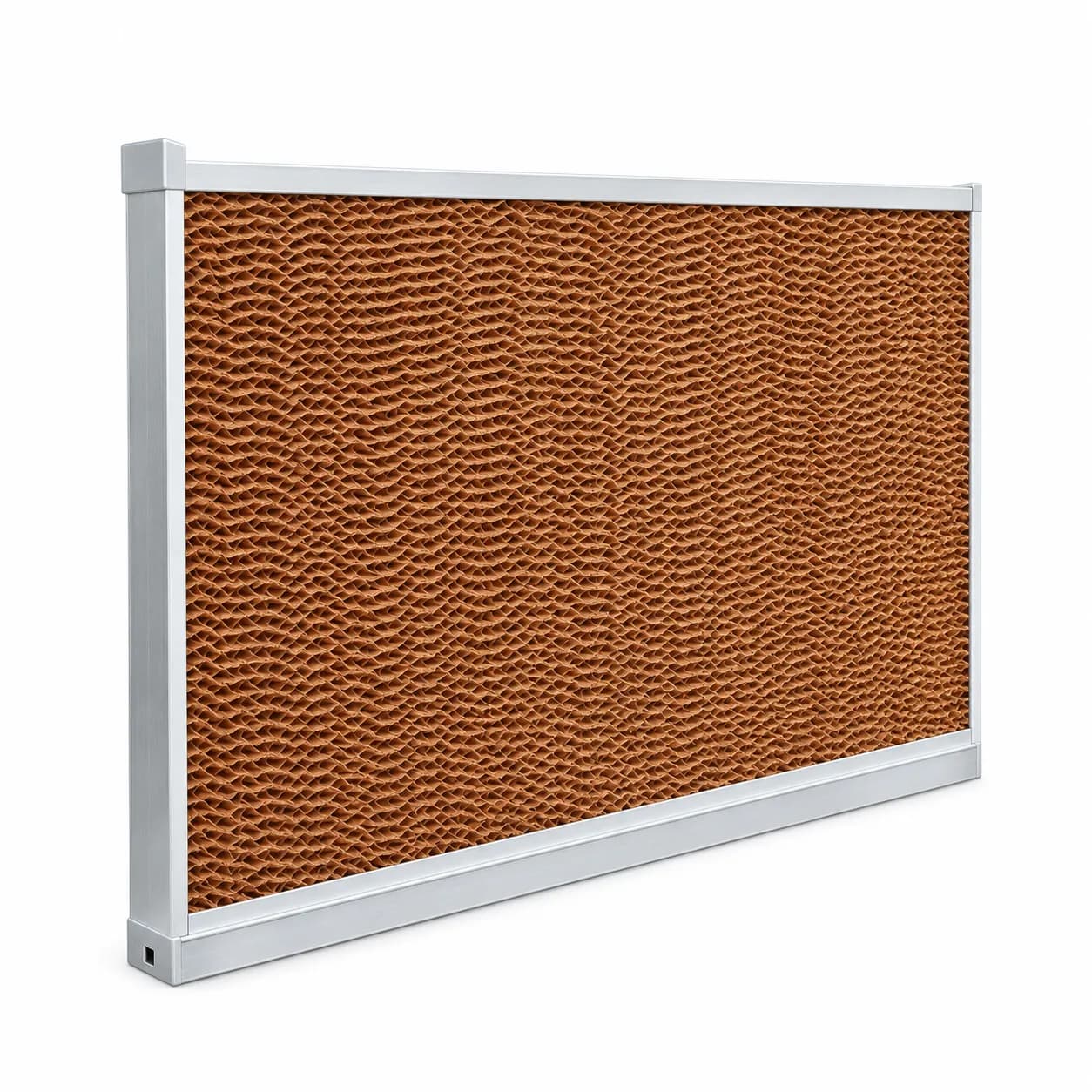
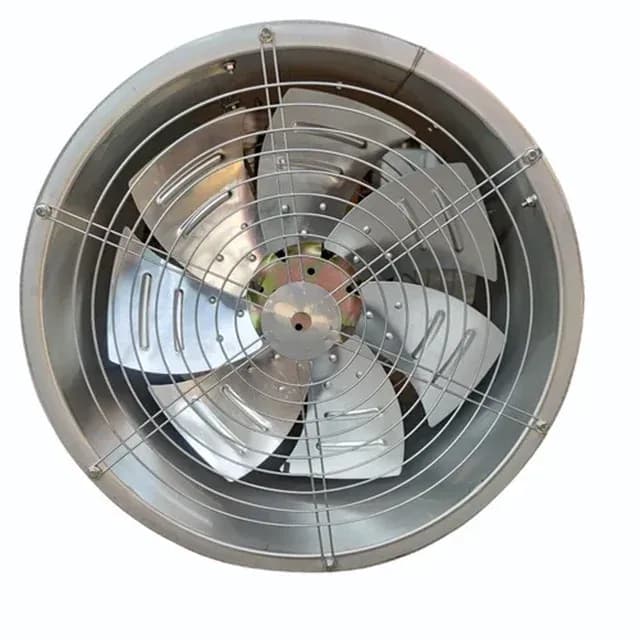
For a fan-and-pad house, the key cooling items are an Exhaust Fan at ₹22,700 per piece + GST, a Cellulose Pad (600X150X1800) at ₹2,616 per piece + GST, and an Aluminium Pad Frame (150 mm) at ₹815 per metre + GST. An Air Circulation Fan is ₹8,999 per piece + GST and can be used in NVPH or fan-and-pad systems as an optional upgrade.
For the roof and shade layer, Polyfilm White Diffused 250 Micron (4.5 m) is ₹254 per metre + GST and White Shade Net 50% is ₹27 per metre + GST. The polyfilm is UV stabilised. Where reflective shade is wanted, Aluminium Shade Net (4 m) is ₹315 per metre + GST. Green Shade Net 50% is also ₹27 per metre + GST and is an optional nethouse upgrade.
These are listed item rates, while GI and plastic prices are updated every Friday. A farmer can build a complete kit online to see every item, quantity and that week’s rate. A 5% bulk discount applies on 10 or more units of an item.
- NVPH and fan-and-pad houses use white diffused 250-micron polyfilm, white shade net and GI gutters.
- Square nethouses use side insect net and can use white shade net; curved nethouses can use white shade net as an optional upgrade.
- Complete kits include GI structure, polyfilm, nets and fittings; individual equipment is also available.
Ventilation, rain protection and fittings that should not be skipped
An NVPH needs controllable side ventilation rather than permanently open sides. A Manual Gear Roll Up Curtain Unit is ₹1,050 per piece + GST, Curtain Pipe (27X2.0X6000) is ₹758 per piece + GST, Side Insect Net (5.2 m) is ₹221 per metre + GST, and a Curtain Clamp 0.75-inch circular clamp is ₹11 per piece + GST. These parts matter particularly from June to November, when the house needs airflow without leaving insects a direct path inside.
Rain hardware is not an optional detail in a place with 844 mm annual rainfall. A GI Gutter Sheet is ₹335 per metre + GST, a Gutter Funnel is ₹1,350 per piece + GST, and a Side Skirting Apron (1.5 m) is ₹64 per metre + GST. At entry points, an Aluminium Door is ₹3,250 per piece + GST or a Fibre Door is ₹2,050 per piece + GST. Doors and curtains help retain warmth on Bengaluru’s coldest nights as well as control access.
Ask for the equipment schedule appropriate to the chosen system. Exhaust fans and cellulose pads are standard for fan-and-pad houses, while manual roll-up curtains and side insect net belong to NVPH ventilation. Do not add parts merely because they appear in another system’s kit.
- GI Gutter Sheet and Gutter Funnel are used in NVPH and fan-and-pad houses.
- Side insect net is used in NVPH and square nethouses.
- Aluminium profiles at ₹27 per metre + GST and GI springs at ₹6 per metre + GST are used across all four listed systems.
| Equipment | NVPH | Fan & pad | Square NH | Curved NH |
|---|---|---|---|---|
| Exhaust Fan | — | ✓ | — | — |
| Cellulose Pad (600X150X1800) | — | ✓ | — | — |
| Manual Gear Roll Up Curtain Unit | ✓ | — | — | — |
| Side Insect Net (5.2 m) | ✓ | — | ✓ | — |
| White Shade Net 50% | ✓ | ✓ | ✓ | Optional |
| Polyfilm White Diffused 250 Micron (4.5 m) | ✓ | ✓ | — | — |
| GI Gutter Sheet | ✓ | ✓ | — | — |
| Air Circulation Fan | Optional | Optional | — | — |
A Bengaluru care calendar for the equipment
Do the hot-season checks before April, rather than after the first heat stress. Wash or replace cellulose pads, clean the pad gutter and filter, and inspect every exhaust-fan belt and shutter before the 35°C peak. This is also the sensible time to inspect shade material after the dry, high-sun March period.
From June to November, run air-circulation fans in the mornings, grease curtain gear units and look for tears in insect net. Humid air increases fungal-disease and pest pressure, so the aim is dependable movement of air and intact screening. During November to February, tighten clamps and bolts, inspect GI springs in aluminium profiles and plan replacement film or net ahead of the next season. In the cold months, confirm that curtains fully close and doors seal.
- Before April: pads, pad gutter, filter, fan belts and shutters.
- June–November: circulation fans, curtain gears and insect nets.
- November–February: clamps, bolts, GI springs, film and net planning.
- December–January: check night closure at the 920 m site elevation.
- 1
Before April
Wash or replace cellulose pads, clean the pad gutter and filter, and check every exhaust fan belt and shutter before the 35°C peak.
- 2
June to November
Run air circulation fans in the mornings, keep curtain gear units greased and check insect net for tears; humid air brings fungal disease and pests.
- 3
November to February
Tighten clamps and bolts, check GI springs in the aluminium profiles, and order replacement film or net before the next season.
- 4
Cold months
At 920 m, check that curtains close fully and doors seal, to hold warmth at night.
Material checks, warranty and ordering from Bengaluru
Polyhouse Constructions is a manufacturer and a venture of Kryzen Biotech Pvt Ltd, not a Bengaluru office. Material is manufactured at Degaon on the Pune–Bangalore Highway, Tal. Wai, Satara, and supplied from there. Bengaluru is 880 km from the factory, with delivery stated as 4 days after dispatch. Construction or erection is done by Kryzen Biotech’s construction team.
The GI pipes are ISI-marked branded steel from Tata, Jindal and JSW. Each dispatch has a lab test certificate and each product has a technical data sheet. The in-house process includes a 32-point QA checklist; the checks include third-party tensile testing of GI-pipe steel strength, salt-spray testing for corrosion resistance, and chemical analysis of steel composition. The written warranty is 15 years for the GI structure, 2.5 years for polyfilm and 3 years for shade and insect nets.
Booking is with 5% advance and 95% before dispatch. For subsidy planning, confirm current norms and eligibility with the Karnataka state horticulture department before starting work; norms can change.
- Ask for the technical data sheet and dispatch lab certificate with the material.
- Match the selected system to its correct fan, curtain, net, gutter and fitting schedule.
- For replacements, order only the required part rather than changing an entire system.

Tensile test
Strength of the GI pipe steel, by a third-party lab.
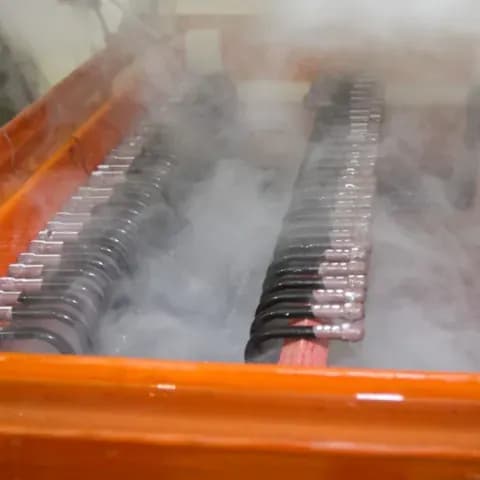
Salt spray test
Corrosion resistance; worth it in humid Bengaluru.
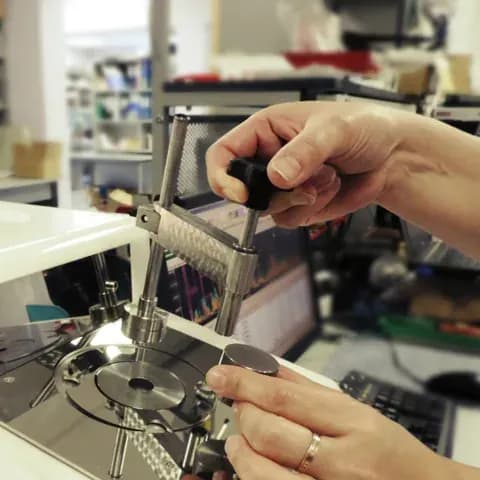
Chemical analysis
Spectrometer check of the steel composition.
| Part | Warranty |
|---|---|
| GI structure | 15 years |
| Polyfilm | 2.5 years |
| Shade and insect nets | 3 years |
Spares and individual items after installation
A torn net, worn curtain part, damaged pad or a required fitting does not have to mean buying a complete kit again. Every fan, pad, net and fitting is sold individually at the weekly rate for repairs and extensions. This is useful for Bengaluru farms that want to replace material after inspection or expand in stages.
Keep the original technical data sheet and identify the exact part before ordering: for example, the 150 mm aluminium pad frame, 5.2 m side insect net, 27X2.0X6000 curtain pipe, or the relevant clamp. Correct matching is especially important for curtain movement, film retention and pad-wall repair.
- Individual material is available for repairs and extensions.
- Weekly rates are updated every Friday.
- A 5% bulk discount applies when ordering 10+ units of an item.
Need only a few items?
Every fan, pad, net and fitting is sold on its own at the weekly rate, for repairs and extensions.
Buy from India's biggest CEA manufacturing company
Choose your structure and size and get the complete material list, priced this week.
FAQs
Which protected-cultivation equipment is most important for Bengaluru’s April heat?
April averages a 35.4°C afternoon high, while March and April receive 6.6 kWh/m²/day of sun. Exhaust fans with cellulose pads are the stated cooling priority, and white 50% shade net is the stated shading priority.
Can a fan-and-pad polyhouse cool conditions in Bengaluru?
Yes. Pad cooling is stated to work here, bringing a 35°C outside condition to about 29°C inside. The decision to install it should still consider the crop, operating requirement and market plan, not temperature alone.
What should I maintain during Bengaluru’s humid months?
From June to November, humidity ranges from 75% to 81%. Run air-circulation fans in the mornings, grease curtain gear units and inspect insect net for tears; also ensure gutters and rain components remain clear.
How soon can material reach Bengaluru, and who erects it?
Material is supplied from the Satara factory, 880 km away, with delivery stated as 4 days after dispatch. Polyhouse Constructions has no Bengaluru office; construction and erection are done by Kryzen Biotech’s construction team.
What warranty and quality documents come with the material?
The GI structure has a 15-year manufacturing warranty, polyfilm has 2.5 years and shade and insect nets have 3 years. Dispatch includes a lab test certificate, and every product has a technical data sheet; the process uses a 32-point QA checklist.
Equipment supply near Bengaluru
Nearby towns on the same route, and whether pad cooling works there.
| Town | From Bengaluru | Pad cooling | Humid months | Hottest month |
|---|---|---|---|---|
| Equipment supplier in Nelamangala | ~30 km | Works (~29°C) | 6 | Apr, 35°C |
| Equipment supplier in Magadi | ~50 km | Works (~29°C) | 6 | Apr, 35°C |
| Equipment supplier in Malur | ~50 km | Limited | 5 | Apr, 35°C |
| Equipment supplier in Hosur | ~50 km | Works (~29°C) | 5 | Apr, 35°C |
| Equipment supplier in Ramanagaram | ~60 km | Works (~30°C) | 6 | Apr, 36°C |
| Equipment supplier in Sidlaghatta | ~70 km | Works (~29°C) | 5 | Apr, 36°C |