
Polyhouse material · Bengaluru Urban district, Karnataka
Polyhouse material for Bengaluru farms
By Editorial Team, Kryzen Biotech · Updated 13 November 2026
For most Bengaluru farms, a naturally ventilated polyhouse is the practical first structure: it protects crops through the June–November humid, rainy period while using roof vents and side curtains rather than powered cooling. Polyhouse Constructions supplies complete, climate-matched material kits from its Satara factory, with construction carried out by Kryzen Biotech’s team.
- Distance from factory
- ~880 km by road
- Delivery after dispatch
- ~4 days
- Hottest month
- April, ~35°C
- Climate pick
- NVPH + fan & pad
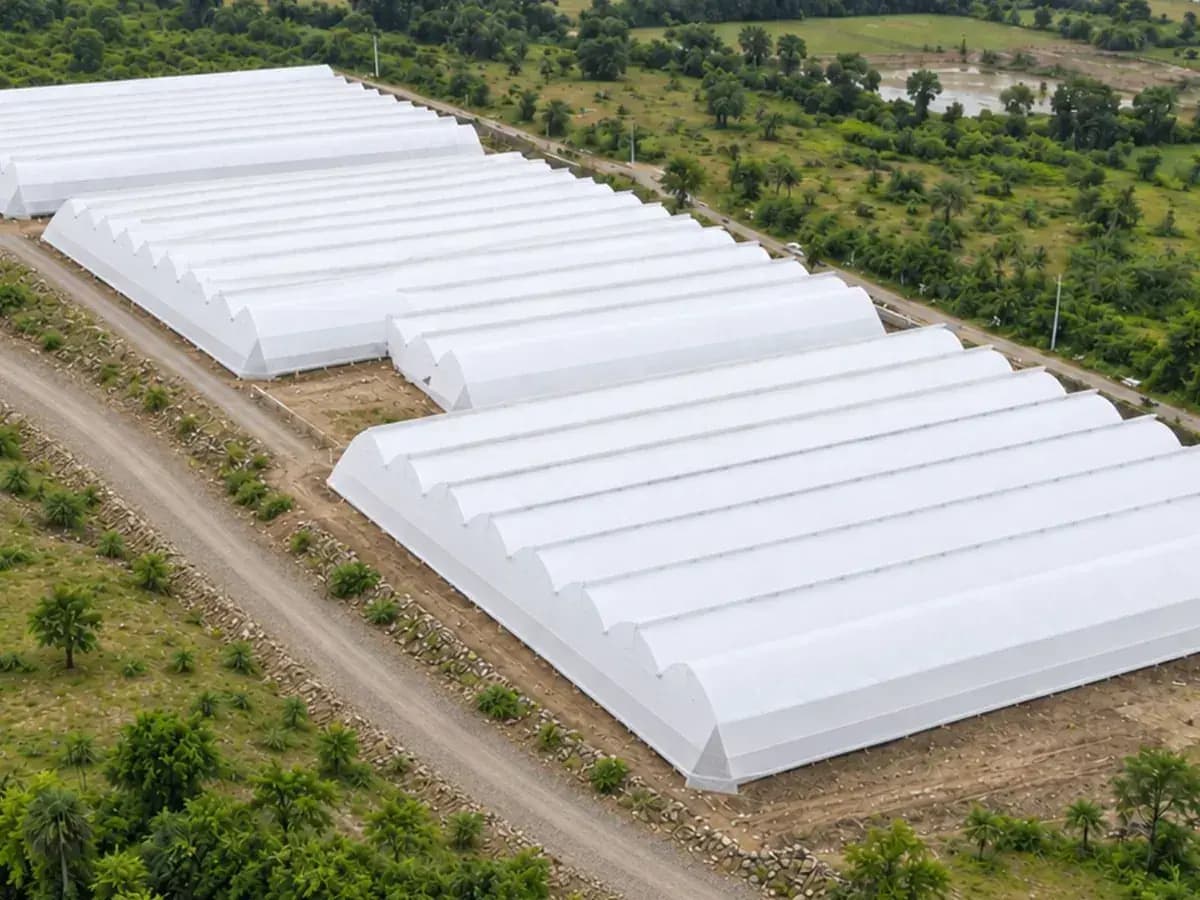
Start with a naturally ventilated polyhouse
Bengaluru’s climate has two distinct protected-cultivation needs. March and April bring the strongest sunlight, at 6.6 kWh/m²/day, and April reaches an average afternoon high of 35.4°C. From June to November, humidity is 75% or higher, while annual rainfall is about 844 mm. For a vegetable grower wanting production through these wetter months, a naturally ventilated polyhouse (NVPH) is usually the right starting point.
Its film roof keeps rain off the crop, while roof vents and roll-up curtains allow air movement without power. This makes it suitable for crops such as coloured capsicum, parthenocarpic cucumber and indeterminate tomato. For leafy greens through the hotter period, a fan and pad polyhouse is also a good fit: in April, pad cooling can bring a 35°C afternoon down to about 29°C inside.
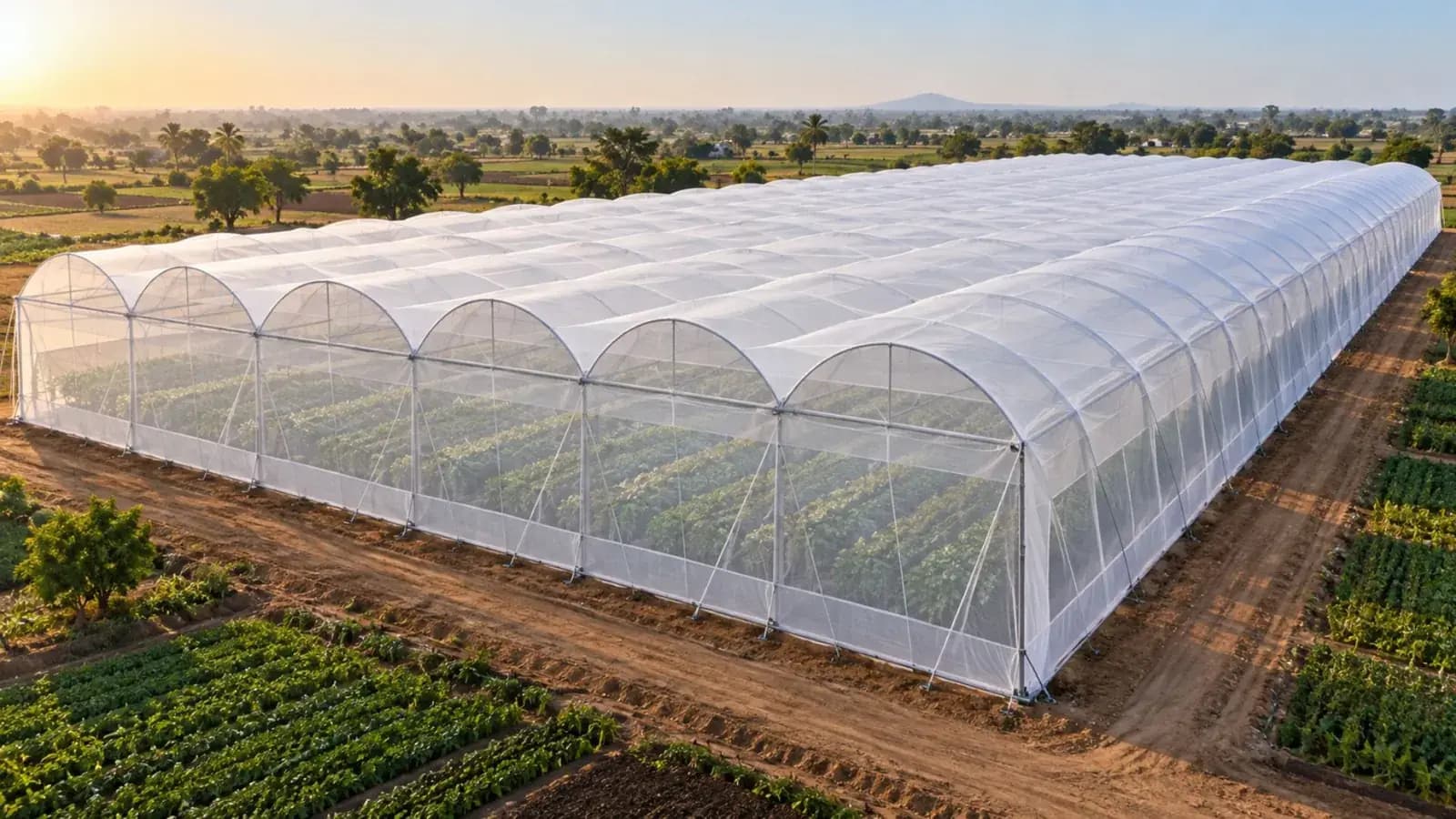
A square or curved nethouse is better treated as a seasonal, lower-cover option. In Bengaluru it is best used from November to February, when rainfall is low. A curved nethouse can provide more air around taller crops, while a square nethouse suits nursery work.
- Choose NVPH for rain protection and naturally ventilated vegetable production.
- Consider fan and pad cooling where summer leafy-green production is the priority.
- Use nethouses mainly in the November–February low-rain window rather than as a year-round substitute for a rainproof polyhouse.
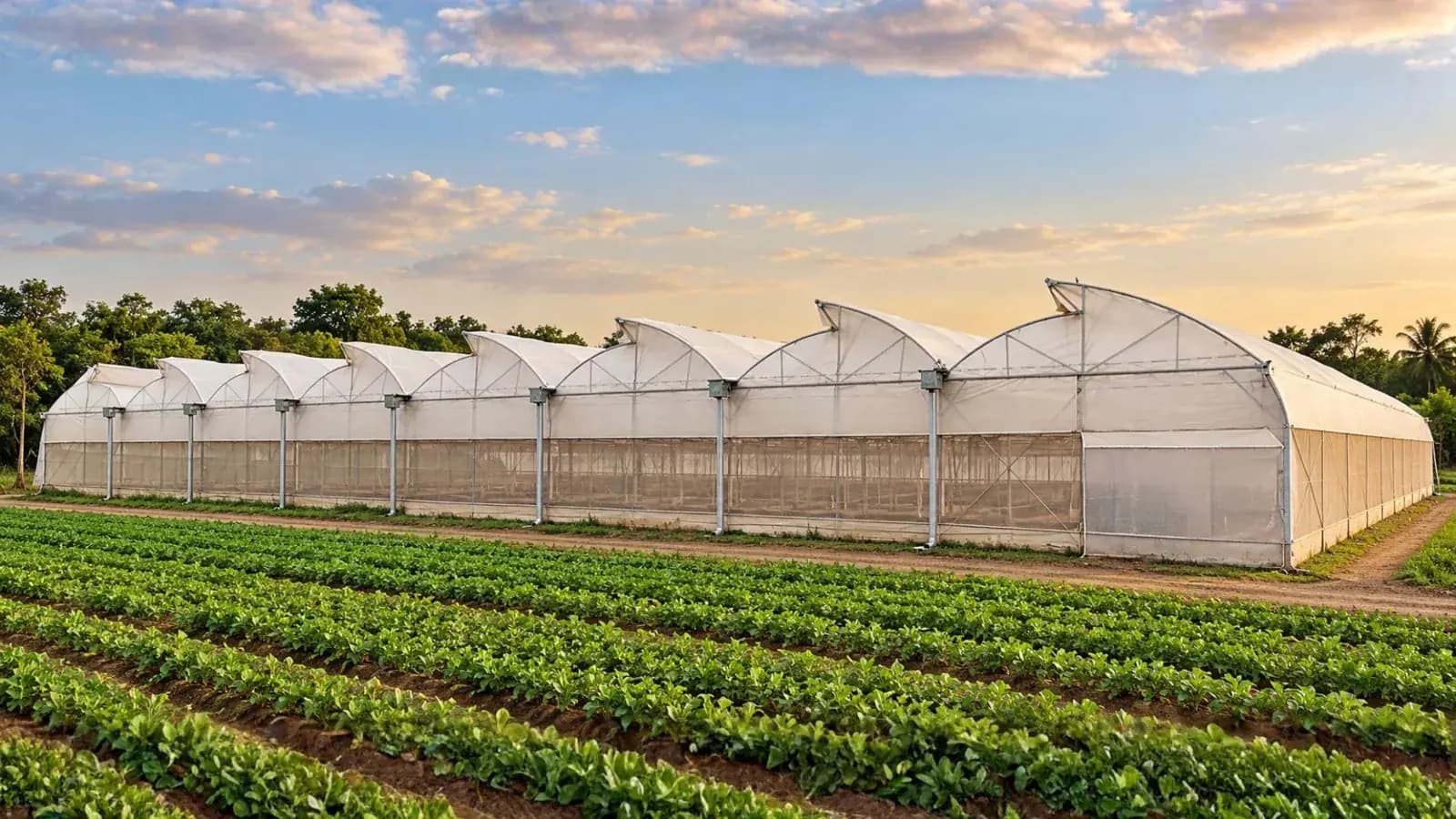
Naturally ventilated polyhouse
Best fitFilm roof keeps June–November rain off the crop; roof vents and roll-up curtains move air without power. The usual first choice in Bengaluru.
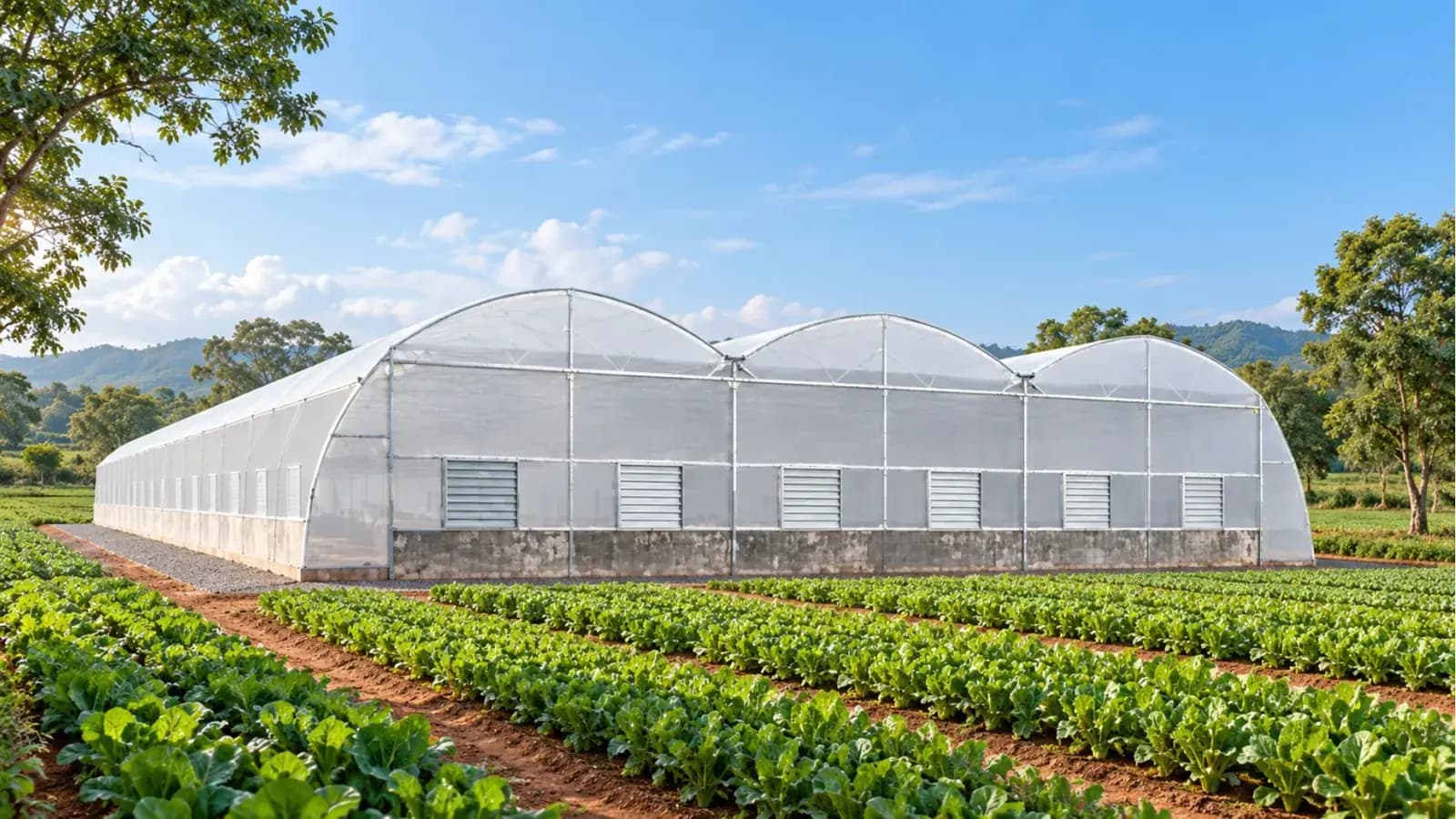
Fan & pad polyhouse
Good fitExhaust fans pull air through wet pads. In April that can take a 35°C afternoon down to about 29°C inside, cool enough for leafy greens.
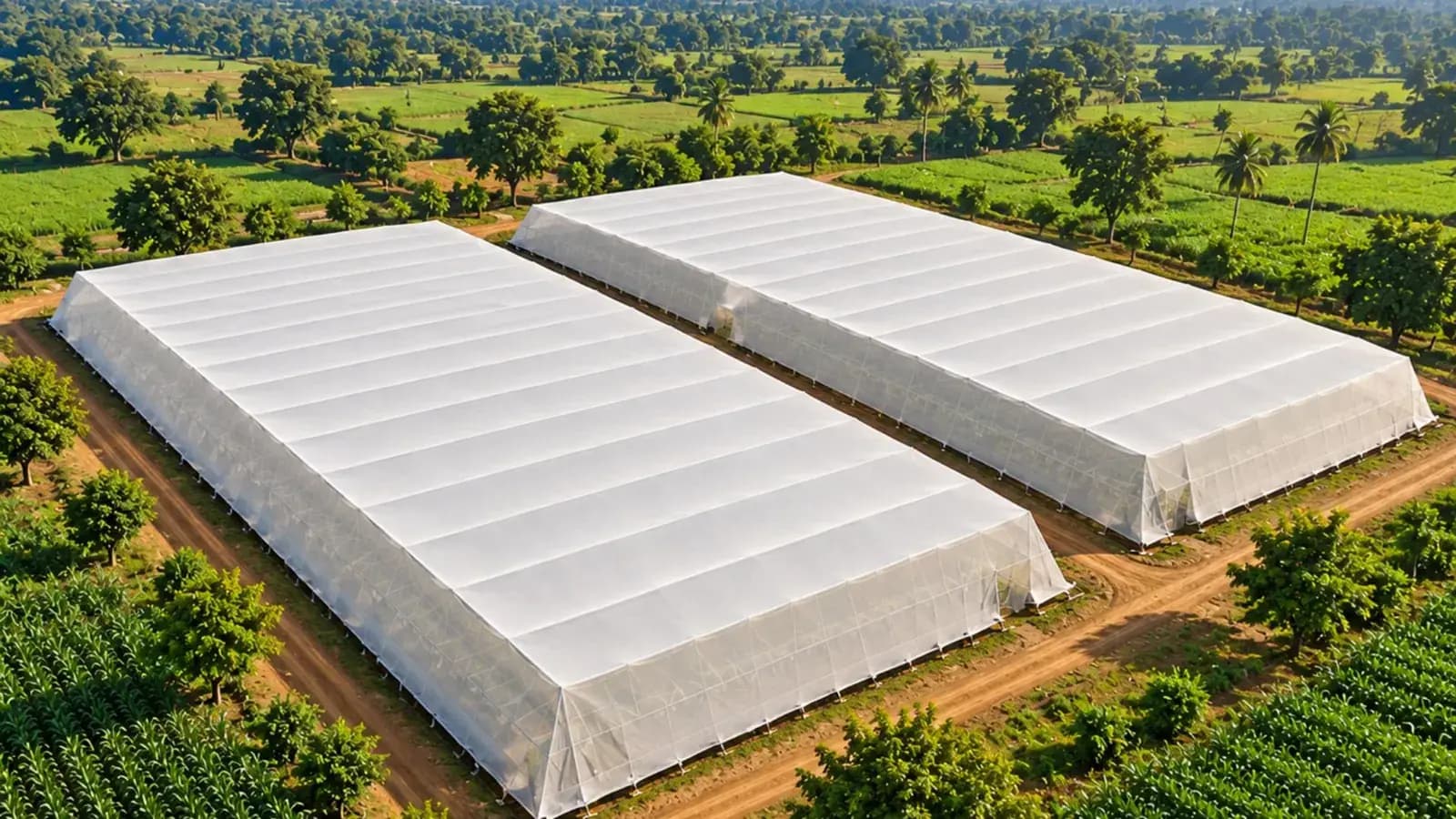
Square nethouse
SeasonalFlat-roof 4 × 4 m grid with shade and insect net, the NHB nursery design. Best from November to February, when rain is low.
Curved nethouse
SeasonalArched GI frame covered in shade net: taller crops, more air and a lower cost than a polyhouse. Shading pays off when sunlight peaks in March.
What Bengaluru weather changes in the structure
The structure should be selected not only by crop, but also by the months it will carry the crop. Bengaluru’s peak heat is limited mainly to April, but humidity persists for six months, from June through November. That makes ventilation and insect exclusion important alongside the roof cover. September has the highest listed rainfall, 152 mm, followed by October at 141 mm.
Cooler nights also matter. January nights average 13.5°C and December nights 13.9°C at Bengaluru’s 920 m elevation. Curtains that close fully in the evening are useful for reducing exposure on these cooler nights. The month-by-month table below is useful when discussing planting dates, ventilation and shade with the construction team.
- March: strongest sunshine, 6.6 kWh/m²/day.
- April: hottest average afternoon, 35.4°C.
- June–November: humidity of 75% or more.
- November–February: the stated nethouse season.
| Month | Afternoon high | Night low | Humidity | Rain | Sun (kWh/m²/day) | Wind (m/s) |
|---|---|---|---|---|---|---|
| Jan | 28.7°C | 13.5°C | 63% | 2 mm | 5.5 | 2.4 |
| Feb | 32°C | 15°C | 51% | 5 mm | 6.3 | 2.6 |
| Mar | 35°C | 18.6°C | 44% | 17 mm | 6.6 | 2.6 |
| Apr | 35.4°C | 21.3°C | 49% | 57 mm | 6.6 | 2.3 |
| May | 32.8°C | 21.2°C | 64% | 110 mm | 6.2 | 2.6 |
| Jun | 29°C | 19.6°C | 75% | 76 mm | 5.3 | 4.2 |
| Jul | 28.1°C | 19°C | 77% | 100 mm | 4.8 | 4.5 |
| Aug | 27.8°C | 18.8°C | 79% | 113 mm | 4.8 | 4 |
| Sep | 27.6°C | 18.7°C | 80% | 152 mm | 5.3 | 2.8 |
| Oct | 27.1°C | 18°C | 81% | 141 mm | 5 | 2 |
| Nov | 26.3°C | 15.9°C | 79% | 56 mm | 4.7 | 2.3 |
| Dec | 26.6°C | 13.9°C | 74% | 15 mm | 4.8 | 2.5 |
A material kit matched to heat, rain and humidity
A complete Polyhouse Constructions kit can include the GI structure, roof cover, nets and fittings rather than leaving the farmer to source parts separately. For Bengaluru, the roof material is 250-micron white diffused, UV-stabilised polyfilm. Diffused light is relevant in March, when the town’s sunlight is at its strongest, because it spreads incoming light and helps reduce leaf scorch.
The side specification matters just as much as the roof. During the humid June–November period, roll-up side curtains with gear unit, side insect net and an entry cabin support air movement while helping keep pests out. GI gutter sheets with funnels are supplied for rain handling; with about 844 mm yearly rain, standard gutters are sufficient. White 50% shade net is useful through March. The table below sets out the Bengaluru-specific material match.
- ISI-marked GI pipes made from branded Tata, Jindal and JSW steel.
- 250-micron white diffused polyfilm for the roof.
- White, green or black 50% shade net, aluminium reflective shade net, and side insect net are available.
- Fittings are counted as part of the design-specific kit.
| Part | What we supply | Why in Bengaluru |
|---|---|---|
| Roof film | 250-micron white diffused polyfilm | Sunlight peaks in March at about 6.6 kWh per m² a day; diffused film spreads it and cuts leaf scorch. |
| Shading | White shade net 50% | Useful through March, when sunlight is at its strongest here. |
| Gutters | GI gutter sheet with funnels | About 844 mm of rain a year, so standard gutters are enough. |
| Ventilation | Roll-up side curtains with gear unit, side insect net, entry cabin | Humidity stays at 75% or more from June to November; open sides and a double-door cabin keep air moving and pests out. |
| Nights | Curtains that close fully | At about 920 m above sea level, nights get cool; close up in the evening. |
Crops to consider under cover
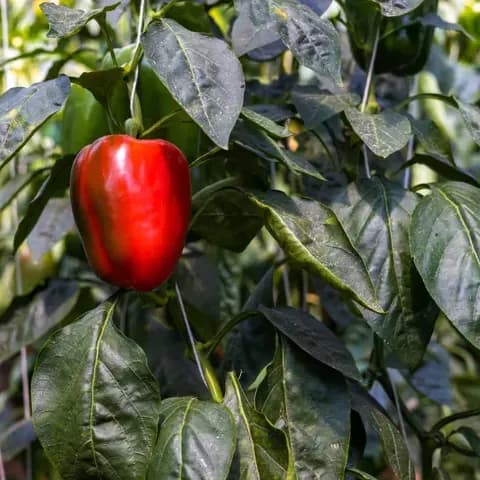
Coloured capsicum is a common NVPH crop and has an 8–10 month cycle. Cucumber is a faster 3–4 month protected crop; drip irrigation helps it continue through dry spells. Indeterminate tomato can be trained on strings for a longer harvest under cover. These crops are appropriate starting points for a farmer comparing a polyhouse investment with local market demand.
For an April-to-summer leafy-green plan, a fan and pad house is the more suitable system because its pads can reduce the April afternoon condition to about 29°C inside. Gerbera and rose are other NVPH options for growers targeting city florists and events. If the objective is vegetable seedlings for the local planting season, a square nethouse is suited to raising them from November to February.
The final crop choice should still begin with the buyer’s marketing route and labour plan. A crop with a strong seasonal price can be useful, but crop cycle, grading and harvest schedule need to be planned before the structure size and internal layout are finalised.
- NVPH: coloured capsicum, cucumber and tomato.
- Fan and pad polyhouse: lettuce and leafy greens in warmer conditions.
- Square nethouse: vegetable seedlings in the November–February period.
- NVPH: gerbera and rose for cut-flower production.
Coloured capsicum
NVPHThe most common polyhouse crop: steady yields over an 8–10 month cycle.

Cucumber (parthenocarpic)
NVPHFast 3–4 month crop; drip irrigation keeps it going in dry spells.

Tomato
NVPHIndeterminate varieties trained up strings give a long harvest under cover.

Lettuce and leafy greens
Fan & pad polyhousePads bring April afternoons down to about 29°C, so greens can grow through summer.

Gerbera and rose
NVPHCut flowers with year-round demand from city florists and events.

Vegetable seedlings
Square nethouseRaise nursery seedlings from November to February for the local planting season.
Plan harvests around Bengaluru market seasons
District mandi records cover markets including Binny Mill (FF&V) Bengaluru APMC, Ramanagara APMC, Channapatana APMC, Kanakapura APMC and Doddaballa Pur APMC. The figures below are modal prices from the last two years and are useful as a season signal, not a promise of the price a farm will receive.
November is notable for several protected-cultivation crops: brinjal reached ₹4,306/q, capsicum ₹5,118/q, bitter gourd ₹3,323/q, cauliflower ₹3,124/q, ridge gourd ₹3,433/q and cabbage ₹1,673/q. Tomato’s highest listed month is December at ₹3,029/q. Green chilli peaks in February at ₹5,341/q, beans in May at ₹6,950/q, and cucumber in July at ₹2,426/q.
This does not mean planting should simply chase one peak month. Use the price pattern to work backwards from the desired harvest period, then check whether that production period falls in Bengaluru’s dry, hot or humid window. For example, a monsoon cucumber crop needs close attention to side ventilation and crop hygiene even though July is its highest listed price month.
- Capsicum: average modal price ₹4,032/q across 8 markets; highest month November.
- Tomato: average ₹2,088/q across 12 markets; highest month December.
- Cucumber: average ₹1,751/q across 11 markets; highest month July.
- Beans: average ₹4,695/q across 10 markets; highest month May.
| Crop | Markets | Average modal price | Highest month | Lowest month |
|---|---|---|---|---|
| Brinjal | 10 | ₹2,503/q | Nov (₹4,306) | Mar (₹1,596) |
| Beans | 10 | ₹4,695/q | May (₹6,950) | Feb (₹3,599) |
| Capsicum | 8 | ₹4,032/q | Nov (₹5,118) | Apr (₹3,195) |
| Tomato | 12 | ₹2,088/q | Dec (₹3,029) | Mar (₹1,019) |
| Cucumber | 11 | ₹1,751/q | Jul (₹2,426) | Nov (₹1,182) |
| Green chilli | 10 | ₹4,452/q | Feb (₹5,341) | May (₹3,852) |
| Bitter gourd | 9 | ₹2,872/q | Nov (₹3,323) | Mar (₹2,202) |
| Cauliflower | 10 | ₹2,329/q | Nov (₹3,124) | Mar (₹1,569) |
| Ridge gourd | 10 | ₹2,836/q | Nov (₹3,433) | Mar (₹2,273) |
| Cabbage | 10 | ₹1,212/q | Nov (₹1,673) | Mar (₹740) |
Why buy a designed kit instead of site-cut material
A local fabricator may be convenient for an on-site discussion, but ask for the drawing, load checks, pipe source, part list and written warranty before comparing quotations. Polyhouse Constructions manufactures in-house, with material cut and drilled to the drawing. Every dispatch has a 32-point QA checklist, lab test certificate and technical data sheet for every product.
The GI structure carries a 15-year manufacturing warranty, polyfilm has a 2.5-year warranty and nets have a 3-year warranty. The kit approach is intended to avoid a mismatch between the design and the quantities delivered: every part is counted per design. This is particularly useful where Bengaluru’s ventilation, curtain and net requirements need to be specified at the outset rather than added after erection.
Our prices follow weekly GI and plastic rates, updated every Friday. A 5% bulk discount applies on 10 or more units of an item. Compare the full specification—not just the headline pipe rate—when deciding between a factory-manufactured kit and a local fabrication quote.
- In-house engineering and manufacturing rather than pipes bought from traders and cut on site.
- Branded steel from Tata, Jindal and JSW.
- Written warranty, product documentation and dispatch quality checks.
- The comparison table below lists the points to ask any supplier about.
| What you get | Polyhouse Construction | Typical local fabricator |
|---|---|---|
| Experience | 30 years of collective experience in greenhouse engineering | Often a small crew learning on the job |
| Technical know-how | Strong technical understanding: structure planned for your climate and crop | Usually repeats one standard design |
| Warranty | 15-year manufacturing warranty | Rarely a written warranty |
| Engineering | In-house engineering team | No design or load checks |
| Manufacturing | In-house manufacturing, cut and drilled to drawing | Buys pipes from traders, cuts on site |
| Quality checks | 32-point QA checklist for every part | Visual check at best |
| Lab certificate | Lab test certificate with every dispatch | Not provided |
| Technical sheet | Technical data sheet for every product | Not available |
| Material match | Zero material mismatch: every part counted per design | Short or excess material is common |
| Raw material | Branded steel from Tata, Jindal and JSW | Unbranded or mixed sources |
| Price | Lowest cost across India, with real-time price benefits from weekly rates | Fixed quote; rate drops are not passed on |
| Backing | Backed by industry leader Kryzen Biotech | Single-owner workshop |
Ordering and delivery to Bengaluru
Polyhouse Constructions is a manufacturer, not a Bengaluru office. Material is supplied from the factory at Degaon on the Pune–Bangalore Highway, Tal. Wai, Satara, Maharashtra, approximately 880 km from Bengaluru. Delivery is estimated at 4 days after dispatch.
Build the requirement online at polyhouseconstructions.com. The kit builder shows every item, its quantity and that week’s rate, so a farmer can review the GI structure, film, shade net, insect net, curtains, gutters and fittings before booking. Individual items are also available if an existing structure needs replacement material.
Booking is with a 5% advance, with the remaining 95% payable before dispatch. Construction or erection is done by Kryzen Biotech’s construction team, not by a separate Polyhouse Constructions town office. Share the crop, intended structure type and farm requirement with the team so the material list can be built around the chosen design.
- Factory supply: Satara, Maharashtra.
- Estimated delivery: 4 days after dispatch to Bengaluru.
- Online kit builder: item-wise quantities and weekly rates.
- Erection: Kryzen Biotech construction team.
Check subsidy eligibility before work begins
For protected cultivation under MIDH/NHM, the stated support is 50% of the cost norm for up to 4,000 m² per beneficiary. Bengaluru is not under the higher hilly/NE norm in the information provided. The listed standard cost norms are ₹844/m² for tubular NVPH, ₹1,400/m² for fan and pad, and ₹710/m² for shade net house.
For larger commercial projects, NHB guidelines state that projects above 2,500 m² can receive a credit-linked back-ended subsidy of 50% of project cost at admissible norms, capped at ₹56 lakh per project. In-Principle Approval from NHB is needed before starting. These norms can change, so confirm the current position and procedure with the Karnataka state horticulture department before placing an order or beginning construction.
- MIDH/NHM: 50% of cost norm, up to 4,000 m² per beneficiary.
- NHB: commercial projects above 2,500 m²; In-Principle Approval is required before starting.
- Confirm current norms and eligibility with the state horticulture department.
Buy from India's biggest CEA manufacturing company
Choose your structure and size and get the complete material list, priced this week.
FAQs
Which polyhouse is best for a Bengaluru vegetable farm?
A naturally ventilated polyhouse is usually the first choice because it protects crops during the June–November humid and rainy period while using roof vents and roll-up curtains for airflow. A fan and pad polyhouse is a good option for leafy greens through hotter weather, as April afternoons can be brought down to about 29°C inside.
Can I use a nethouse in Bengaluru throughout the year?
The stated nethouse season is November to February, when rainfall is low. For production during Bengaluru’s June–November humid and rainy months, a film-roof polyhouse offers more reliable rain protection.
What material is included in a Bengaluru polyhouse kit?
A complete kit can include the GI structure, 250-micron white diffused polyfilm, shade net, side insect net, curtains, gutters, fittings and related specified parts. The online kit builder shows each item and quantity for the selected design.
Which nearby markets should I consider when planning protected crops?
District records include Binny Mill (FF&V) Bengaluru APMC, Ramanagara APMC, Channapatana APMC, Kanakapura APMC and Doddaballa Pur APMC. Capsicum’s highest listed month is November, tomato’s is December, cucumber’s is July, beans’ is May and green chilli’s is February.
How long does material delivery take to Bengaluru, and who erects it?
Material is supplied from the Satara factory, about 880 km away, with estimated delivery in 4 days after dispatch. Construction and erection are handled by Kryzen Biotech’s construction team; Polyhouse Constructions does not have a Bengaluru office.
Polyhouse material near Bengaluru
Neighbouring towns we deliver to from the same route, and how their climate compares with Bengaluru.
| Town | From Bengaluru | Hottest month | Rain a year | Suits |
|---|---|---|---|---|
| Polyhouse material in Nelamangala | ~30 km | Apr, 35°C | 844 mm | NVPH + fan & pad |
| Polyhouse material in Magadi | ~50 km | Apr, 35°C | 844 mm | NVPH + fan & pad |
| Polyhouse material in Malur | ~50 km | Apr, 35°C | 877 mm | NVPH |
| Polyhouse material in Hosur | ~50 km | Apr, 35°C | 897 mm | NVPH + fan & pad |
| Polyhouse material in Ramanagaram | ~60 km | Apr, 36°C | 834 mm | NVPH + fan & pad |
| Polyhouse material in Sidlaghatta | ~70 km | Apr, 36°C | 815 mm | NVPH + fan & pad |