
Polyhouse material · Ahmedabad district, Gujarat
Polyhouse material supplier for Ahmedabad farms
By Editorial Team, Kryzen Biotech · Updated 13 November 2026
For Ahmedabad’s very hot, high-sun summer and short humid monsoon spell, a naturally ventilated polyhouse is usually the practical first structure for commercial vegetables and flowers. Polyhouse Constructions manufactures complete material kits at its Satara factory; farmers can also buy individual structure, film, net and fitting items, with construction handled by Kryzen Biotech’s team.
- Distance from factory
- ~750 km by road
- Delivery after dispatch
- ~3 days
- Hottest month
- May, ~44°C
- Climate pick
- NVPH + fan & pad
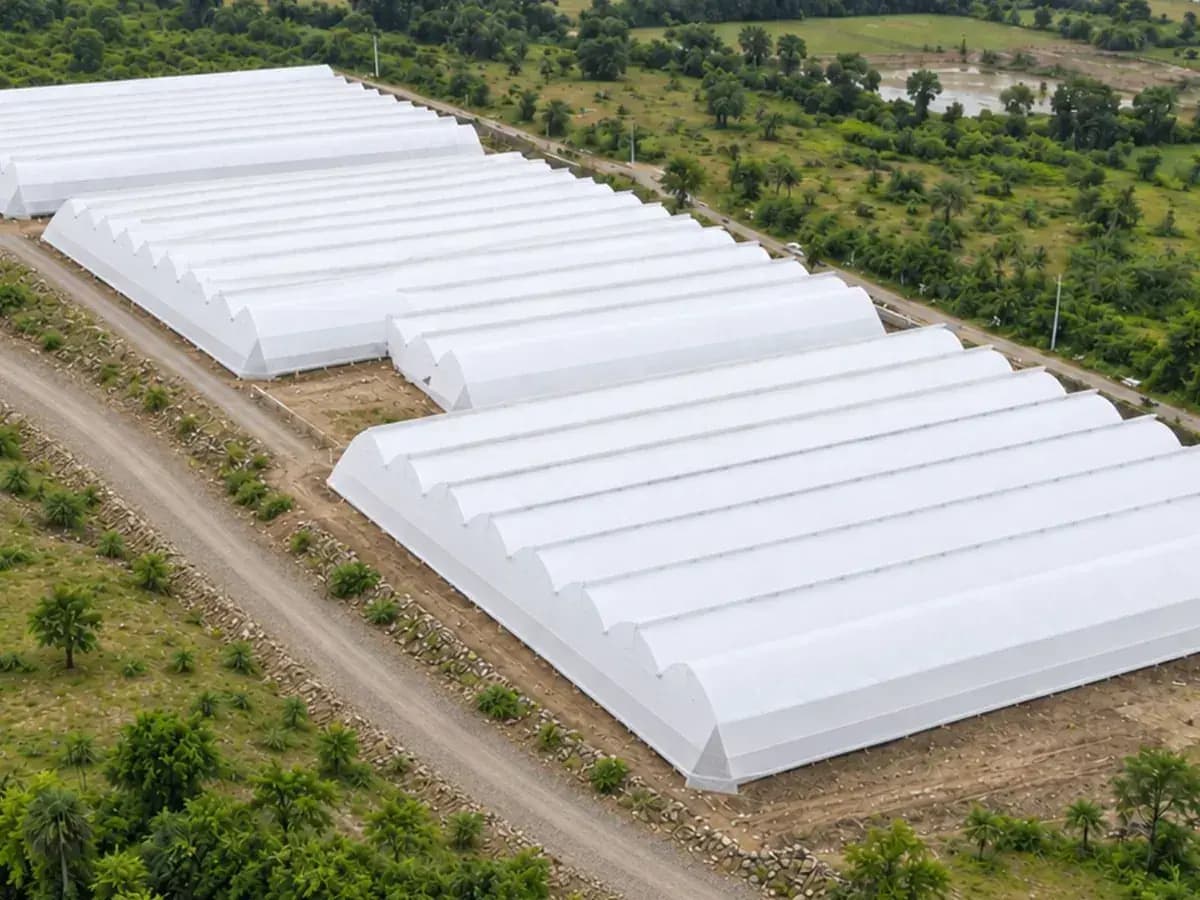
Start with the structure that handles heat and rain
Ahmedabad is among Gujarat’s hotter locations: May averages 43.5°C in the afternoon, with the strongest sun at 7.5 kWh/m²/day. Rain is concentrated in the monsoon, especially July at 267 mm, while August and September are the humid months. A structure here has to shed rain, reduce heat stress and still allow strong air movement.
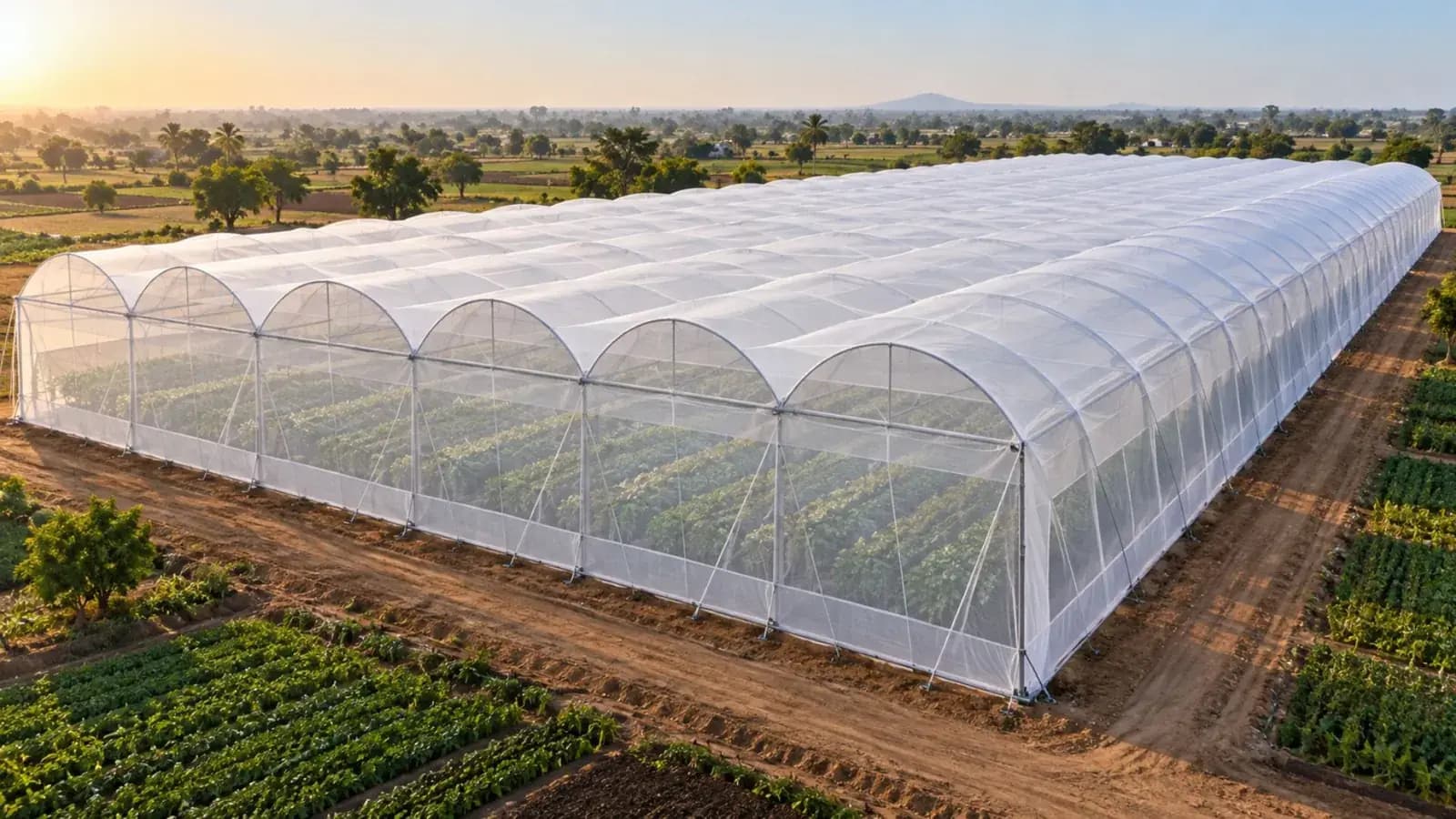
A naturally ventilated polyhouse (NVPH) is the usual first choice. Its film roof keeps monsoon rain away from the crop, while roof vents and roll-up side curtains allow natural ventilation without depending on power. This is a sensible option for crops such as capsicum, cucumber, flowers and protected vegetables where rain protection and insect exclusion matter.
A fan & pad polyhouse is worth considering when the plan is to grow leafy greens through summer or maintain a more controlled environment. In May, pad cooling can bring an approximately 44°C afternoon down to about 33°C inside. A square or curved nethouse is better treated as a seasonal, lower-cost option from October to February, when rainfall is low; it is not a substitute for a rain-proof polyhouse during the monsoon.
- Choose NVPH for an all-season covered production structure with natural ventilation.
- Choose fan & pad where summer cooling is essential for the intended crop.
- Use a square nethouse for nursery seedlings or a curved nethouse for taller seasonal crops, mainly in the October–February window.
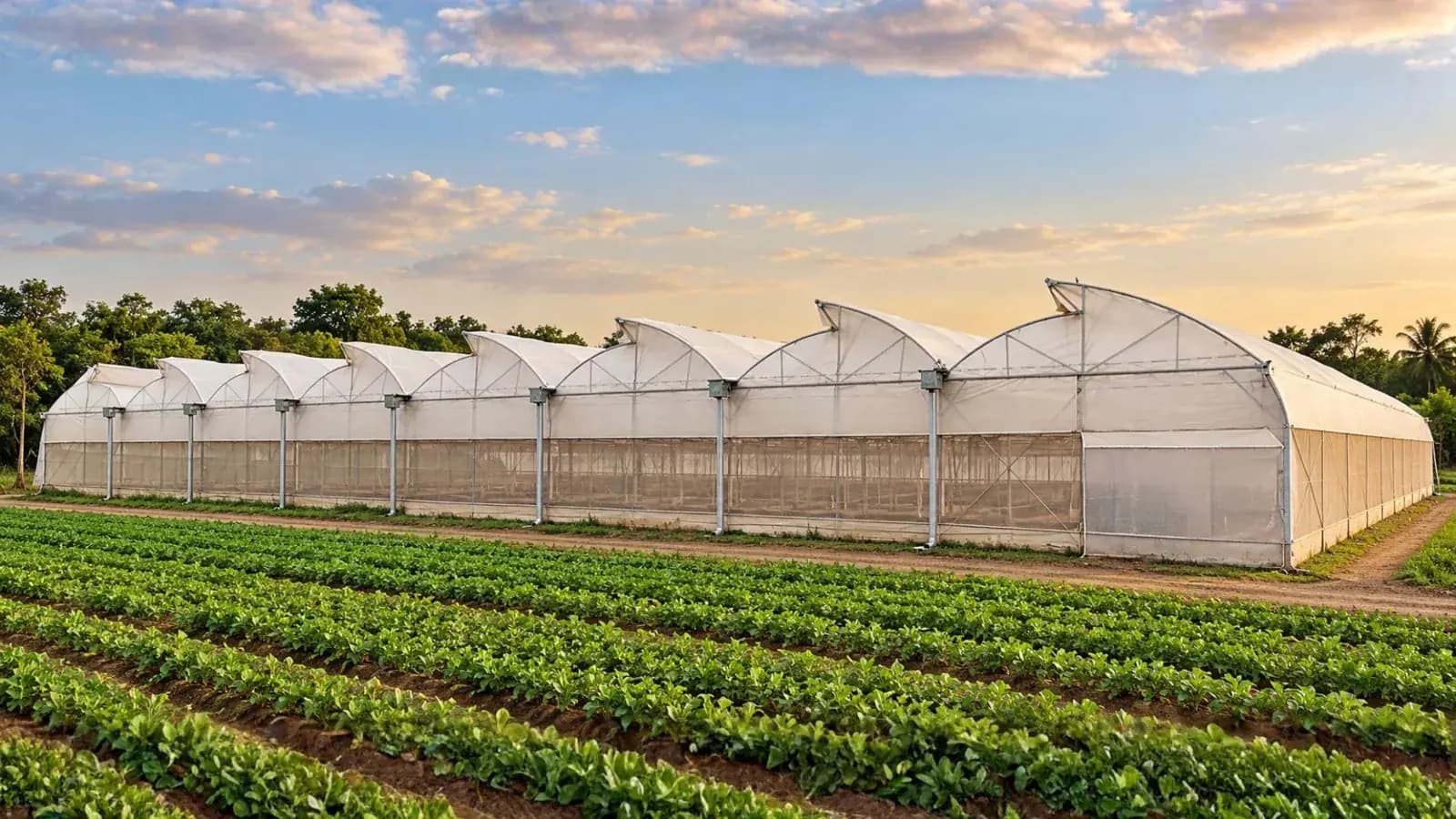
Naturally ventilated polyhouse
Best fitFilm roof keeps monsoon rain off the crop; roof vents and roll-up curtains move air without power. The usual first choice in Ahmedabad.
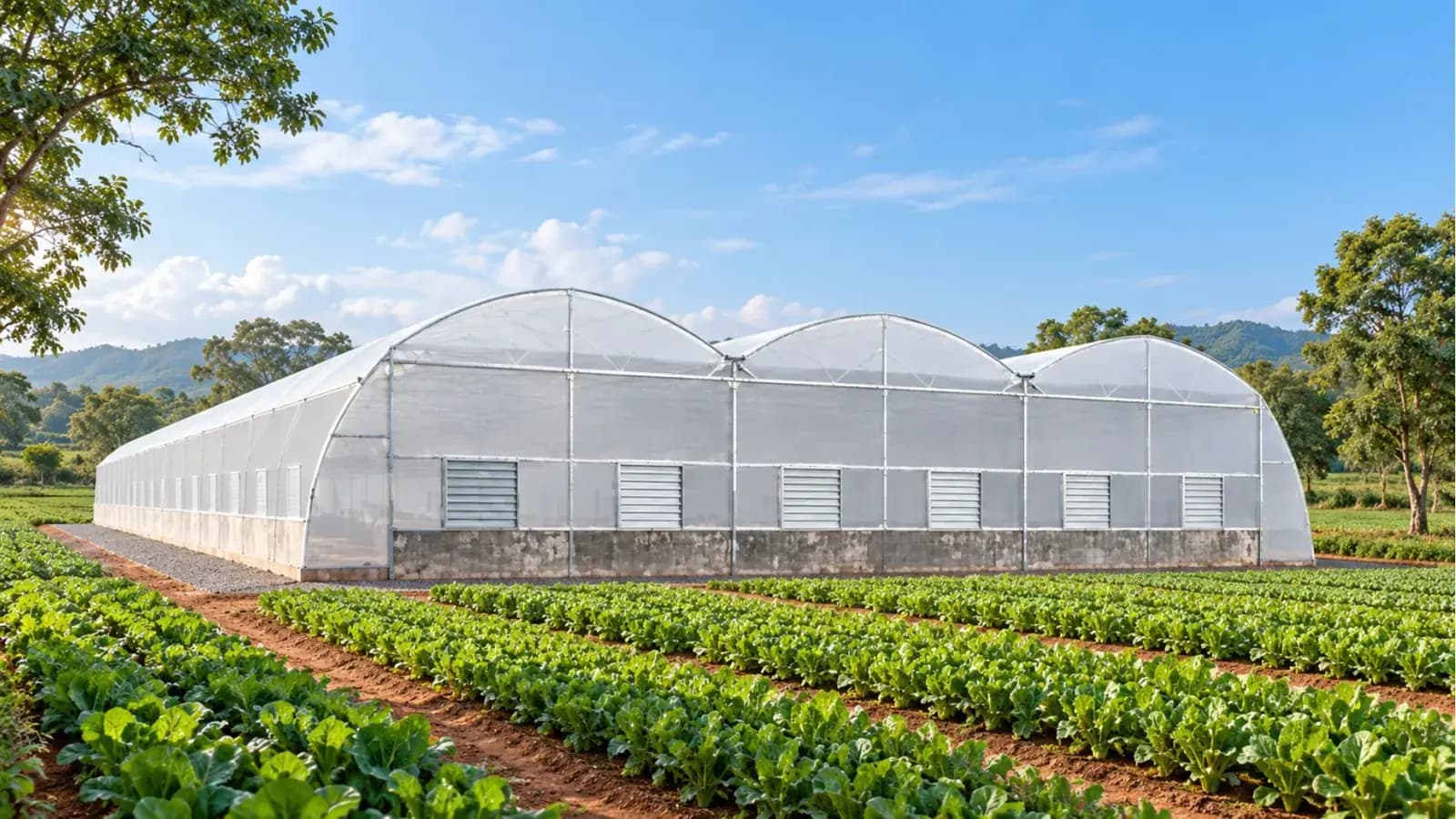
Fan & pad polyhouse
Good fitExhaust fans pull air through wet pads. In May that can take a 44°C afternoon down to about 33°C inside, cool enough for leafy greens.
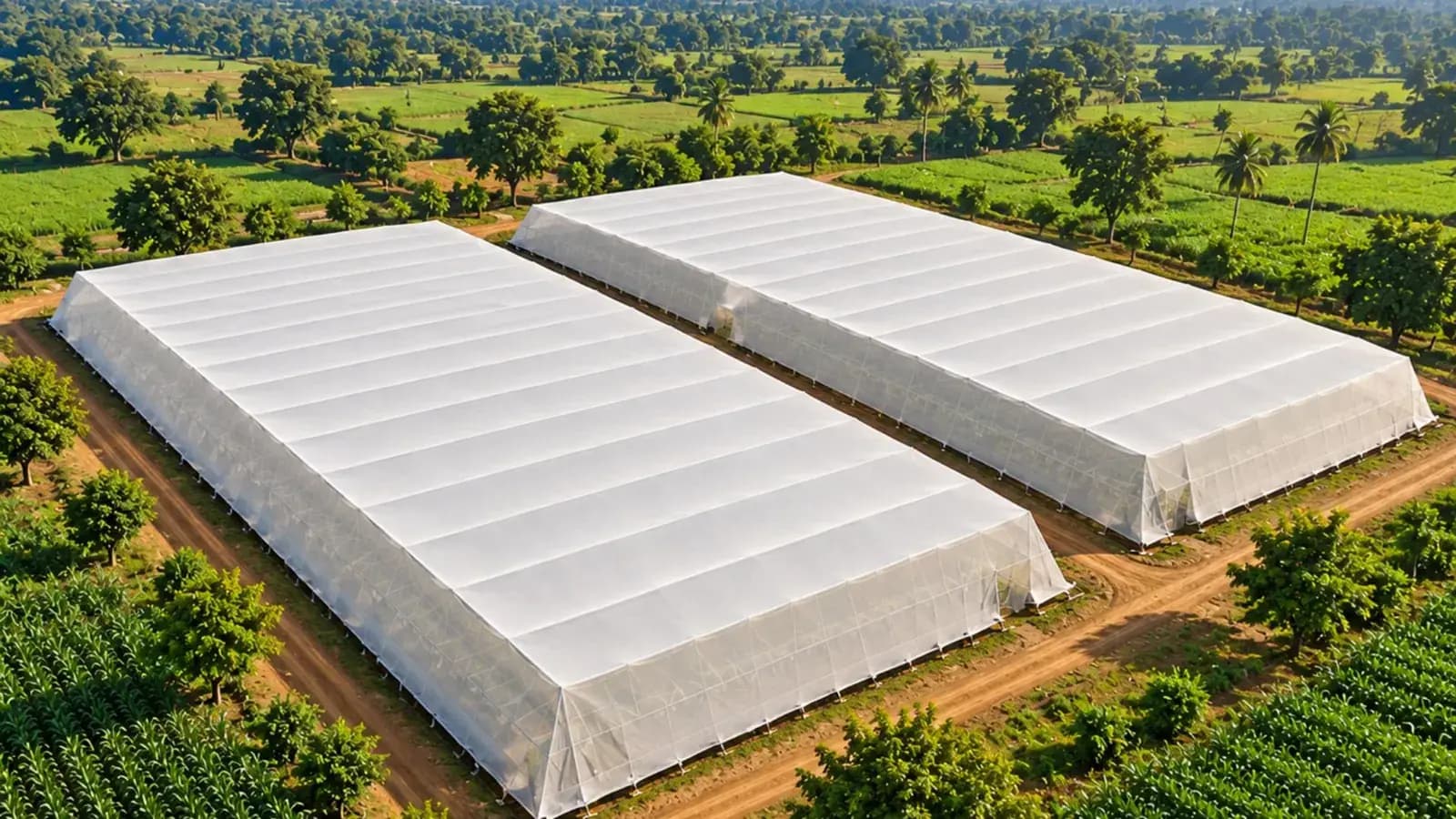
Square nethouse
SeasonalFlat-roof 4 × 4 m grid with shade and insect net, the NHB nursery design. Best from October to February, when rain is low.
Curved nethouse
SeasonalArched GI frame covered in shade net: taller crops, more air and a lower cost than a polyhouse. Shading pays off when sunlight peaks in May.
Specify materials for Ahmedabad’s sun and humid months
The kit should not be chosen only by area. May heat calls for a roof cover and shading plan that diffuse or reflect excess solar load, while the August–September humid period needs side ventilation that can be opened fully. The table below shows the material match for these local conditions.
For the roof, we supply 250-micron white diffused, UV-stabilised polyfilm. Diffused light helps spread the intense sunlight rather than concentrating it on leaves. For heat management, aluminium reflective shade net is the relevant option because it reflects heat outward. White, green and black 50% shade nets are also available where the crop plan calls for shade-net use.
A complete kit can include the GI structure, polyfilm, shade net or side insect net, gutters, fittings and the required counted parts. GI pipes are ISI-marked branded steel from Tata, Jindal and JSW. Roll-up side curtains with side insect net are particularly important for ventilation in humid weather; standard GI gutter sheets with funnels suit the town’s approximately 770 mm annual rainfall.
- Ask for roof vents, roll-up curtains and side insect net as part of the design, not as later additions.
- Plan reflective shade for peak May heat, based on the crop and structure selected.
- Check the item-wise list before booking so the structure, covering and fittings are all included.
| Part | What we supply | Why in Ahmedabad |
|---|---|---|
| Roof film | 250-micron white diffused polyfilm | Sunlight peaks in May at about 7.5 kWh per m² a day; diffused film spreads it and cuts leaf scorch. |
| Shading | Aluminium (reflective) shade net | 44°C highs and strong sun: a reflective net sends heat back out instead of holding it inside. |
| Gutters | GI gutter sheet with funnels | About 770 mm of rain a year, so standard gutters are enough. |
| Ventilation | Roll-up side curtains, side insect net | Humid spell from August to September; open the curtains fully in those months. |
Plan crops around Ahmedabad APMC price seasons
Protected cultivation should begin with a crop and marketing plan, not only a structure decision. Ahmedabad district has the Ahmedabad APMC and Ahmedabad markets in the available price data. The mandi table below gives modal-price observations from the last two years, in ₹ per quintal; these are historical market signals, not assured future prices.
For a cooler-season vegetable plan, tomato recorded its highest month in December at ₹3,280/q, bhindi in December at ₹5,844/q, and cabbage, cauliflower and brinjal in November at ₹1,912/q, ₹2,795/q and ₹3,298/q respectively. Bitter gourd’s highest month was February at ₹4,015/q. These windows can help a farmer work backward from expected harvest, while allowing for crop duration and local market arrivals.
Summer and monsoon price patterns differ. Cucumber’s highest month was June at ₹3,055/q, while green chilli and capsicum peaked in July at ₹5,046/q and ₹5,763/q. July also has 267 mm rain and high humidity follows in August–September, so these crops need a structure, disease-management plan and ventilation that suit wet-season production. Do not base planting solely on the highest observed month: grades, arrivals and weather can change the realised price.
- Tomato: average modal price ₹2,094/q; highest observed in December, lowest in March at ₹676/q.
- Capsicum: average modal price ₹3,720/q; highest observed in July, lowest in February at ₹1,701/q.
- Cucumber: average modal price ₹2,181/q; highest observed in June, lowest in March at ₹1,136/q.
| Crop | Markets | Average modal price | Highest month | Lowest month |
|---|---|---|---|---|
| Tomato | 2 | ₹2,094/q | Dec (₹3,280) | Mar (₹676) |
| Okra (bhindi) | 2 | ₹4,197/q | Dec (₹5,844) | May (₹3,123) |
| Bitter gourd | 2 | ₹3,122/q | Feb (₹4,015) | Sep (₹2,266) |
| Cabbage | 2 | ₹1,129/q | Nov (₹1,912) | Mar (₹516) |
| Cauliflower | 2 | ₹1,886/q | Nov (₹2,795) | Mar (₹1,059) |
| Bottle gourd | 2 | ₹1,626/q | Sep (₹2,173) | Mar (₹1,154) |
| Brinjal | 2 | ₹2,217/q | Nov (₹3,298) | Mar (₹1,209) |
| Green chilli | 2 | ₹3,319/q | Jul (₹5,046) | Sep (₹1,929) |
| Capsicum | 2 | ₹3,720/q | Jul (₹5,763) | Feb (₹1,701) |
| Cucumber | 2 | ₹2,181/q | Jun (₹3,055) | Mar (₹1,136) |
Use the climate calendar before fixing planting and covers
Ahmedabad has a long dry, bright period before the monsoon. April averages 41.7°C and May 43.5°C, so establish crops with adequate irrigation, ventilation and shade planning rather than expecting an uncovered or poorly ventilated house to remain cool. May nights average 26.7°C, which also limits natural night cooling.
The wettest period is July, followed by 256 mm in August and 122 mm in September. August reaches 83% relative humidity and September 79%. Keep gutters clear, maintain the roof cover, and use the roll-up curtains for maximum practical airflow in these months. January has the coolest nights at 11.1°C, but the town’s nethouse season is October to February because this period is comparatively dry.
The calendar below is a useful quick check for timing a nethouse nursery, a protected vegetable crop, or summer operation of a cooled house. It should sit alongside the crop’s own temperature, irrigation and disease requirements.
| Month | Jan | Feb | Mar | Apr | May | Jun | Jul | Aug | Sep | Oct | Nov | Dec | Detail |
|---|---|---|---|---|---|---|---|---|---|---|---|---|---|
| Peak heat | ~44°C highs | ||||||||||||
| Strongest sun | 7.5 kWh/m²/day | ||||||||||||
| Wettest month | ~267 mm | ||||||||||||
| Humid (75%+) | August–September | ||||||||||||
| Nethouse season | October–February |
What buying direct from the manufacturer changes
Polyhouse Constructions is a manufacturer of protected-cultivation structures and material, and a venture of Kryzen Biotech Pvt Ltd. Material is manufactured at Degaon on the Pune–Bangalore Highway, Tal. Wai, Satara, Maharashtra—not from an Ahmedabad office. The factory is 750 km from Ahmedabad, and delivery is stated as 3 days after dispatch.
This differs from buying a structure assembled around locally cut pipe. Our kits are engineered in-house, manufactured cut and drilled to the drawing, and checked through a 32-point QA checklist. Every dispatch has a lab test certificate, and every product has a technical data sheet. The GI structure carries a 15-year manufacturing warranty, polyfilm 2.5 years and nets 3 years.
The comparison below is useful when comparing quotations. Ask any supplier whether the design is specific to the crop and climate, whether component quantities are counted against a drawing, and whether test certificates, technical data and written warranties will be supplied.
- In-house engineering helps match ventilation, cover and components to the selected structure.
- A complete kit reduces the risk of missing or excess parts that can occur when materials are sourced separately.
- Construction and erection are done by Kryzen Biotech’s construction team.
| What you get | Polyhouse Construction | Typical local fabricator |
|---|---|---|
| Experience | 30 years of collective experience in greenhouse engineering | Often a small crew learning on the job |
| Technical know-how | Strong technical understanding: structure planned for your climate and crop | Usually repeats one standard design |
| Warranty | 15-year manufacturing warranty | Rarely a written warranty |
| Engineering | In-house engineering team | No design or load checks |
| Manufacturing | In-house manufacturing, cut and drilled to drawing | Buys pipes from traders, cuts on site |
| Quality checks | 32-point QA checklist for every part | Visual check at best |
| Lab certificate | Lab test certificate with every dispatch | Not provided |
| Technical sheet | Technical data sheet for every product | Not available |
| Material match | Zero material mismatch: every part counted per design | Short or excess material is common |
| Raw material | Branded steel from Tata, Jindal and JSW | Unbranded or mixed sources |
| Price | Lowest cost across India, with real-time price benefits from weekly rates | Fixed quote; rate drops are not passed on |
| Backing | Backed by industry leader Kryzen Biotech | Single-owner workshop |
Build an item-wise kit before you place the order
Use the kit builder at polyhouseconstructions.com to select the structure and add the required material. It shows every item, its quantity and that week’s rate, which makes it easier to compare a complete NVPH, fan & pad house or nethouse with a partial material list. Individual items are also available if an existing structure needs film, net, fittings or another specified component.
Start with the crop, structure type and intended area, then review the GI members, film or net, side insect net, curtains, gutters and fittings shown in the kit. For Ahmedabad, confirm the summer shading and side-ventilation arrangement before finalising. A farm near Sanand, Adalaj, Gandhinagar, Mahemdabad or Kadi faces the same broad district climate pattern, but site layout and crop choice should still guide the final design.
Rates follow weekly GI and plastic rates and are updated every Friday. There is a 5% bulk discount on 10 or more units of an item. Booking requires 5% advance, with 95% due before dispatch.
- Review quantities and weekly rates online before booking.
- Keep the selected crop and target selling period ready when discussing the kit.
- Confirm whether only material is needed or whether erection by Kryzen Biotech’s team is also required.
Check subsidy eligibility before construction starts
For Gujarat farmers, subsidy should be confirmed with the state horticulture department before treating it as part of the project budget. Under the MIDH/NHM figures used here, assistance is 50% of the cost norm up to 4,000 m² per beneficiary. Ahmedabad is not under the hilly or North-East higher-norm category.
The stated NHB route is for commercial projects above 2,500 m² and provides a credit-linked back-ended subsidy of 50% of project cost at admissible norms, capped at ₹56 lakh per project under NHB guidelines. In-Principle Approval from NHB is required before starting the project.
The NHB cost norms listed are ₹844/m² for tubular NVPH, ₹1,400/m² for fan & pad, and ₹710/m² for shade net house. These norms can change, so obtain the current scheme conditions, documents and approval process from the relevant department before ordering material or beginning civil and erection work.
Buy from India's biggest CEA manufacturing company
Choose your structure and size and get the complete material list, priced this week.
FAQs
Which structure is best for an Ahmedabad vegetable farm?
A naturally ventilated polyhouse is usually the first choice because it keeps monsoon rain off the crop and uses roof vents and roll-up curtains for airflow. For leafy greens through the 43.5°C May heat, a fan & pad house can reduce an approximately 44°C afternoon to about 33°C inside.
Can I use a nethouse throughout the year in Ahmedabad?
A nethouse is best used seasonally from October to February, when rainfall is low. It is useful for nursery seedlings and seasonal crops, but its net cover does not provide the rain protection of a polyfilm-roof polyhouse during monsoon months.
What is included in a complete polyhouse material kit?
A kit can include the GI structure, polyfilm, nets, gutters and fittings, with every item and quantity shown in the online kit builder. Ahmedabad specifications can include 250-micron white diffused polyfilm, aluminium reflective shade net, side insect net and roll-up curtains.
How long does delivery to Ahmedabad take?
Material is supplied from the Satara factory, which is 750 km from Ahmedabad. Delivery is stated as 3 days after dispatch; booking terms are 5% advance and 95% before dispatch.
Which protected-cultivation crops have favourable observed mandi months in Ahmedabad?
In the available Ahmedabad district data, tomato and bhindi had their highest observed months in December, while cabbage, cauliflower and brinjal peaked in November. Capsicum and green chilli peaked in July, but that period needs careful rain, humidity and ventilation management; historical mandi prices do not guarantee future returns.
Polyhouse material near Ahmedabad
Neighbouring towns we deliver to from the same route, and how their climate compares with Ahmedabad.
| Town | From Ahmedabad | Hottest month | Rain a year | Suits |
|---|---|---|---|---|
| Polyhouse material in Adalaj | ~20 km | May, 44°C | 770 mm | NVPH + fan & pad |
| Polyhouse material in Gandhinagar | ~30 km | May, 44°C | 770 mm | NVPH + fan & pad |
| Polyhouse material in Sanand | ~30 km | May, 44°C | 770 mm | NVPH + fan & pad |
| Polyhouse material in Mahemdabad | ~40 km | May, 44°C | 770 mm | NVPH + fan & pad |
| Polyhouse material in Kadi | ~50 km | May, 43°C | 718 mm | NVPH + fan & pad |
| Polyhouse material in Kapadvanj | ~60 km | May, 43°C | 842 mm | NVPH + fan & pad |