
Nethouse material · Ahmedabad district, Gujarat
Nethouse material wholesale rates for Ahmedabad farmers
By Editorial Team, Kryzen Biotech · Updated 13 November 2026
For an Ahmedabad nethouse, buy the roof net, insect net and GI structure against the current weekly factory rate—not a long-held dealer quote. This page lists this week’s material rates, explains the 5% bulk discount, and helps you choose a nethouse and net for May heat that can reach 43.5°C.
- Nethouse season
- October–February
- Strongest sun
- May, 7.5 kWh/m²
- Net we suggest
- Aluminium or 50% white
- Square nethouse, 1 acre
- ₹291/m²
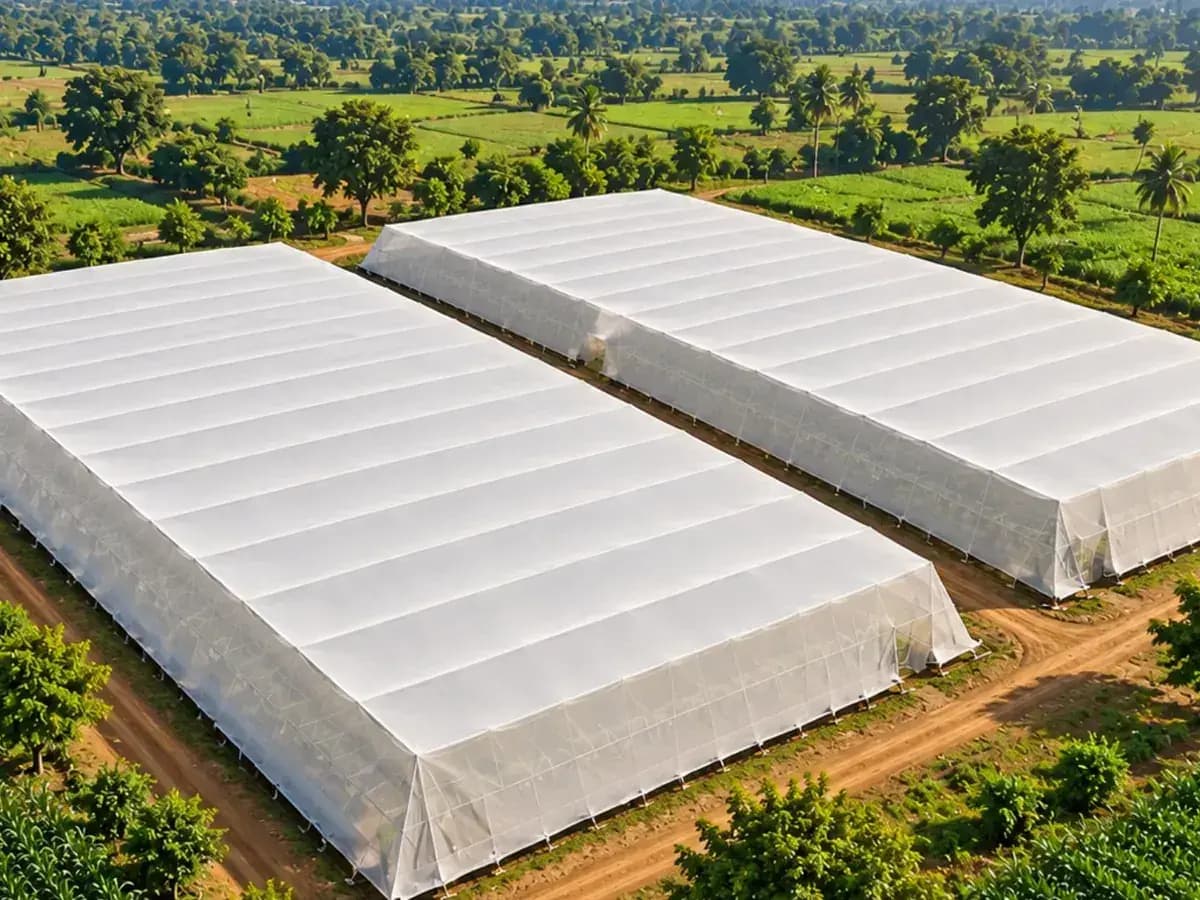
This week’s nethouse net and GI rates
The current rate table below is ex-factory and excludes GST. GI is ₹94.50/kg this week. For the roof, white, green and black 50% shade net are each ₹27.00 per running metre in 4 m width, or ₹6.75/m²; their 8 m versions are ₹54.00 per running metre at the same ₹6.75/m² rate.
Side insect net is ₹191.25 per running metre for 4.5 m width and ₹221.00 per running metre for 5.2 m width, both ₹42.50/m². Aluminium shade net is ₹315.00 per running metre in 4 m width, or ₹78.75/m². Rates change every Friday with GI and plastic prices, so use the current table when finalising quantities rather than an older quotation.
- White Shade Net 50%, 4 m: ₹27.00 per running metre; ₹6.75/m².
- Green Shade Net 50%, 4 m: ₹27.00 per running metre; ₹6.75/m².
- Black Shade Net 50%, 4 m: ₹27.00 per running metre; ₹6.75/m².
- Side Insect Net, 5.2 m: ₹221.00 per running metre; ₹42.50/m².
- Aluminium Shade Net, 4 m: ₹315.00 per running metre; ₹78.75/m².
| Net | Roll width | Per running metre | Per m² | 10+ units (5% off) |
|---|---|---|---|---|
| Aluminium Shade Net (4 m) | 4 m | ₹315.00 | ₹78.75 | ₹299.25 |
| Black Shade Net 50% | 4 m | ₹27.00 | ₹6.75 | ₹25.65 |
| Black Shade Net 50% (8 m) | 8 m | ₹54.00 | ₹6.75 | ₹51.30 |
| Green Shade Net 50% | 4 m | ₹27.00 | ₹6.75 | ₹25.65 |
| Green Shade Net 50% (8 m) | 8 m | ₹54.00 | ₹6.75 | ₹51.30 |
| Side Insect Net (4.5 m) | 4.5 m | ₹191.25 | ₹42.50 | ₹181.69 |
| Side Insect Net (5.2 m) | 5.2 m | ₹221.00 | ₹42.50 | ₹209.95 |
| White Shade Net 50% | 4 m | ₹27.00 | ₹6.75 | ₹25.65 |
| White Shade Net 50% (8 m) | 8 m | ₹54.00 | ₹6.75 | ₹51.30 |
- GI rate this week
- ₹94.50/kg
- Bulk discount
- 5% on 10+ units
- Distance to Ahmedabad
- ~750 km
What wholesale pricing means when you buy material
Wholesale here does not mean that a farmer needs to find a local dealer or commit to a complete acre. The weekly factory rate is the same whether buying one roll or material for a larger nethouse. The relevant saving begins when you buy 10 or more units of an item: the cart applies a 5% discount automatically.
At that level, the 4 m 50% shade-net rate becomes ₹25.65 per running metre, the 5.2 m side insect net becomes ₹209.95 per running metre, and aluminium shade net becomes ₹299.25 per running metre. A net roll, a fitting or an individual structural item can be bought on its own. For a full structure, the online kit builder shows every line item, quantity and the week’s rate before ordering.
Book with 5% advance and pay the remaining 95% before dispatch. Material is supplied from the Degaon factory on the Pune–Bangalore Highway at Wai, Satara; Ahmedabad is about 750 km away, with delivery stated as 3 days after dispatch.
- Weekly rates are updated every Friday.
- The 5% discount applies on 10+ units of an item.
- GST invoice includes HSN codes for accounts and subsidy files.
- A full kit can be ordered, or nets and fittings can be ordered individually.
- 1
One rate, any quantity
Weekly factory rate whether you buy one roll or a whole acre. No dealer margin in between.
- 2
5% bulk discount
Buy 10 or more of any item and the discount is applied automatically in the cart.
- 3
Rates every Friday
Nets and film follow the plastic rate, the frame follows the GI rate; both are updated weekly and shown on every page.
- 4
Quotation and invoice
GST invoice with HSN codes, ready for subsidy files and accounts.
Buy nets and fittings on their own
Every net, wire, ring and pulley is in the individual items shop at the weekly rate.
For Ahmedabad heat, start with white or aluminium roof net
Ahmedabad’s net choice should deal first with intense dry-season sun. May averages a 43.5°C afternoon high and 7.5 kWh/m²/day of sun, while April is already 41.7°C. A white 50% shade net is the practical standard roof net: it diffuses light and cuts May glare without making the crop too dim.
For a hotter exposed site or a crop suffering from heat load, aluminium shade net is worth considering because its reflective surface sends heat upward. Green 50% net has the same shade level and suits nurseries and leafy greens. Black 50% net gives the same nominal shade, but can hold some heat in 44°C conditions; white or aluminium is the better choice here. Use side insect net on walls where keeping whitefly and thrips away from vegetables is the objective.
The choice is not only about the roof. In a hot nethouse, adequate height, open sides protected with insect net, and crop-specific ventilation matter alongside the shade material.
- White 50%: the standard Ahmedabad roof choice.
- Aluminium: reflective option for severe sun and heat.
- Green 50%: useful for nurseries and leafy greens.
- Side insect net: for walls of vegetable nethouses.
| Net | What it does | In Ahmedabad |
|---|---|---|
| White shade net 50% | Diffuses light; the standard roof net | Our pick for Ahmedabad: cuts the May glare without dimming the crop |
| Green shade net 50% | Same shade, green colour | Nurseries and leafy greens; a cooler look in the field |
| Black shade net 50% | Same shade, black colour | Holds some heat at 44°C; prefer white or aluminium |
| Aluminium shade net | Reflective; sends heat back up | Worth it here: 44°C highs and 7.5 kWh/m² |
| Side insect net | Fine mesh for the walls | Keeps whitefly and thrips off vegetables |

Square or curved structure: match the frame to the crop and site
A square, flat-roof nethouse uses the NHB 4 × 4 m grid and a flat net roof on GI wire. It is the lower-cost-per-m² option and is easy to extend. Ahmedabad receives about 770 mm of rain a year, so it is a suitable practical choice for nursery seedlings, leafy greens and other lower-growing work where economical covered area is the priority.
A curved nethouse has an arched GI frame and more internal height. That extra air movement is important for tall tomato and capsicum, particularly through the Ahmedabad summer. It is the stronger fit when the crop plan has to operate in conditions near 44°C, rather than only through the main October–February nethouse season.
This week, a 32 × 32 m square medium kit of 1,024 m² is ₹3,30,900 for material including GST, or ₹323/m². A 64 × 64 m square kit of 4,096 m² is ₹11,91,523, or ₹291/m². A curved 52 × 76 m kit of 3,952 m² is ₹16,81,233, or ₹425/m². These are material-only kit figures.
- Choose square for lower cost per m², extension and nursery or leafy-green use.
- Choose curved for taller crops and better summer air movement.
- The right frame is driven by crop height and heat exposure, not only initial rate.
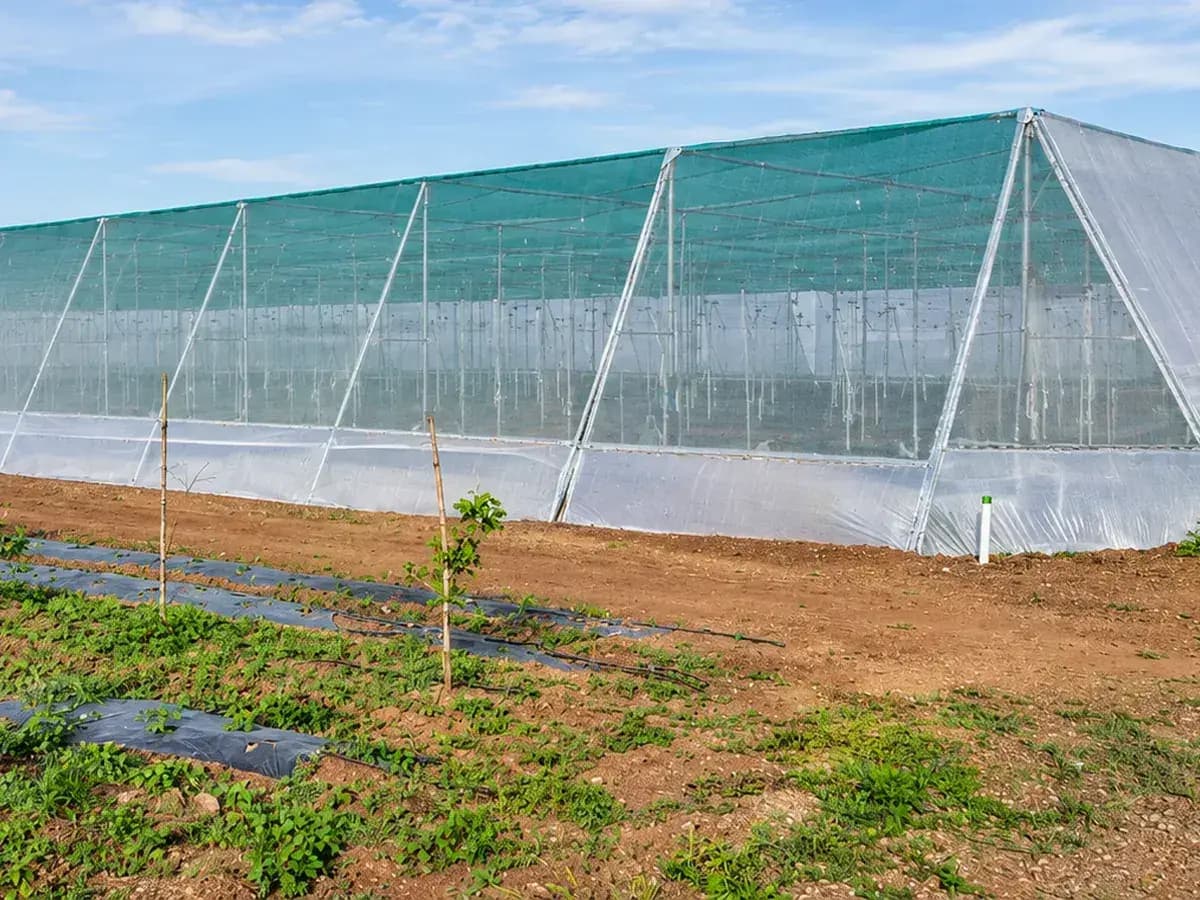
Square (flat-roof) nethouse
Good fitThe NHB 4 × 4 m grid with a flat net roof on GI wire. Lowest cost per m² and easy to extend; it suits Ahmedabad's 770 mm of rain well.
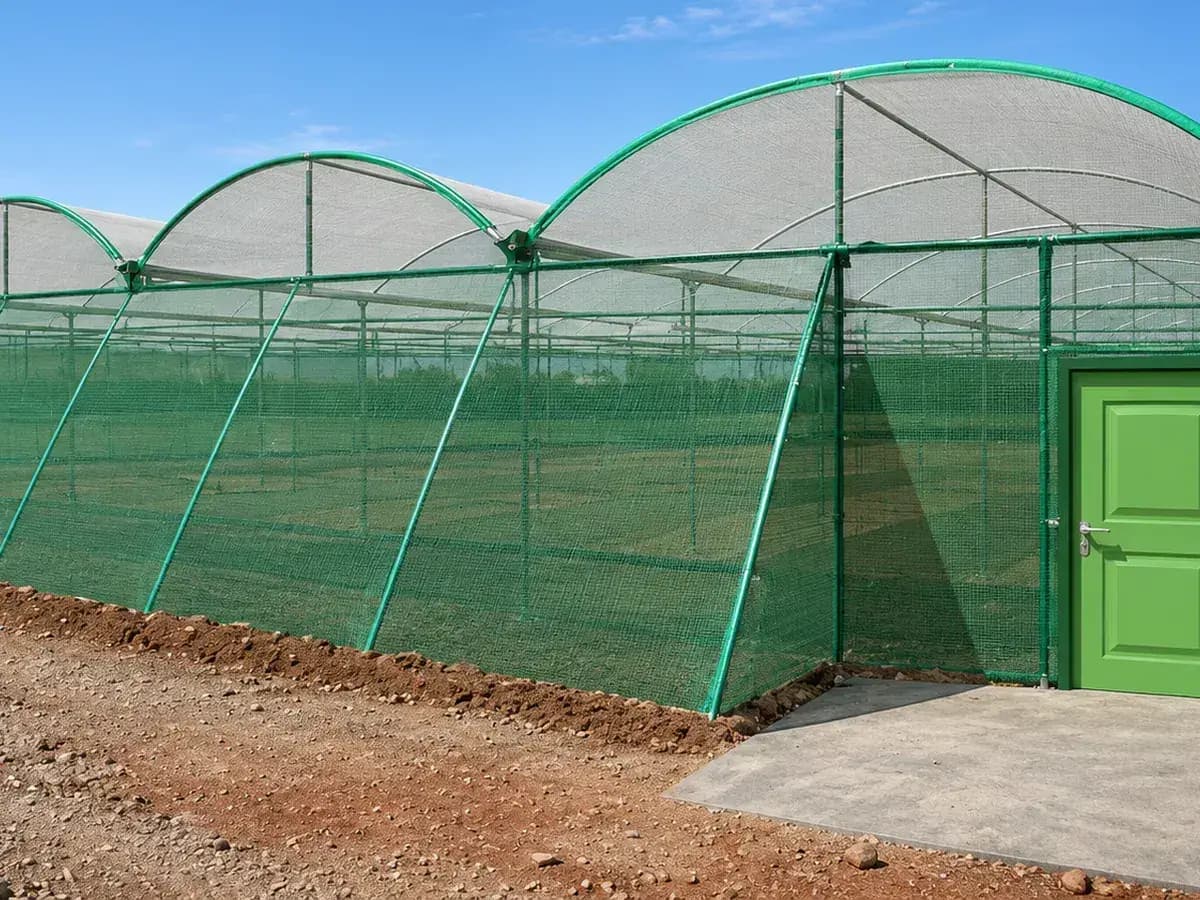
Curved (dome) nethouse
Best for heatArched GI frame covered in net: more height and air movement, better for tall crops like capsicum and tomato, and for 44°C summers.
| Kit | Span × bay | Area | Material incl. GST | Per m² |
|---|---|---|---|---|
| Square nethouse, medium | 32 × 32 m | 1,024 m² | ₹3,30,900 | ₹323 |
| Square nethouse, ~1 acre | 64 × 64 m | 4,096 m² | ₹11,91,523 | ₹291 |
| Curved nethouse, ~1 acre | 52 × 76 m | 3,952 m² | ₹16,81,233 | ₹425 |
What is included in a roughly one-acre square kit
The 64 × 64 m square kit covers 4,096 m², close to an acre. It is not simply a net purchase: the quoted kit brings together the GI structure, roof and side nets, skirting and the fittings that hold the system together. This matters when comparing a material kit with a loose local pipe-and-net quotation.
The table below shows major items from this kit. It includes 480 purlins of 42 × 2.0 × 4000, 256 columns of 60 × 2.0 × 4000 and 256 foundation pipes, plus side hockey members and five-way couplers. Its 25 items total about 8.6 tonnes of steel and fittings. Exact quantities should still be generated for the final size rather than assumed from an acre example.
For the covering, this example includes 900 m of White Shade Net 50% and 258 m of 5.2 m side insect net, with a 1.5 m side skirting apron. It also lists 1,224 m each of aluminium profile and GI spring, 6,900 self-drilling screws, and two fibre doors.
- GI structure: columns, purlins, foundation pipes, side members and couplers.
- Covering: roof shade net, side insect net and skirting apron.
- Fittings: profiles, GI spring, screws and doors.
- Build the final kit to the actual length, width and structure selected.
| Group | Item | Quantity | Weight |
|---|---|---|---|
| GI structure | Purlin - NH (42X2.0X4000) | 480 nos | 3,994 kg |
| GI structure | Column - NH (60X2.0X4000) | 256 nos | 2,918 kg |
| GI structure | Foundation Pipe (48X2.0X1200) | 256 nos | 707 kg |
| GI structure | Side Hockey - NH (33X2.0X4200) | 64 nos | 430 kg |
| GI structure | Five Way Pipe Coupler (48 OD) | 196 nos | 338 kg |
| Film & nets | Side Insect Net (5.2 m) | 258 mtr | — |
| Film & nets | White Shade Net 50% | 900 mtr | — |
| Film & nets | Side Skirting Apron (1.5 m) | 258 mtr | — |
| Fittings & accessories | Aluminium Profile | 1,224 mtr | — |
| Fittings & accessories | Self Drilling Screw | 6,900 nos | — |
| Fittings & accessories | GI Spring | 1,224 mtr | — |
| Fittings & accessories | Fibre Door Big | 1 nos | — |
| Fittings & accessories | Fibre Door | 1 nos | — |
Plan the working season around heat, rain and humidity
October to February is Ahmedabad’s defined nethouse season. October averages 33.8°C by day and 20.6°C at night; by January, the average daytime high is 28.8°C and the night low is 11.1°C. This is the cleaner window for raising vegetable seedlings and growing crops under a simple shaded structure.
May is the peak heat and strongest-sun month, so crop protection needs to be planned before April. June through September changes the operating problem: July alone averages 267 mm rain, while August and September average 83% and 79% humidity. Prioritise good drainage, maintained net fixing and crop hygiene in the humid period. Ahmedabad has only two humid months in the climate summary, August through September.
Where crop quality has to continue into the hottest period, fan-and-pad cooling works in this climate; the stated pad-cooled inside temperature is 33°C. That is a different decision from choosing a naturally ventilated nethouse, but it shows why heat management cannot be ignored in a May crop plan.
- October–February: main nethouse season.
- May: highest heat and strongest sun.
- July: wettest month at 267 mm.
- August–September: humid months requiring closer crop hygiene.
| Month | Jan | Feb | Mar | Apr | May | Jun | Jul | Aug | Sep | Oct | Nov | Dec | Detail |
|---|---|---|---|---|---|---|---|---|---|---|---|---|---|
| Peak heat | ~44°C highs | ||||||||||||
| Strongest sun | 7.5 kWh/m²/day | ||||||||||||
| Wettest month | ~267 mm | ||||||||||||
| Humid (75%+) | August–September | ||||||||||||
| Nethouse season | October–February |
Crops to consider and the months Ahmedabad markets have paid more
A nethouse can suit vegetable seedlings from October to February, leafy greens such as spinach, coriander and lettuce under 50% shade, and chilli or capsicum where May shading reduces sunscald risk. Tall capsicum and tomato are more natural candidates for a curved structure; seedlings and greens fit the simpler square structure well.
Market timing should be checked against the crop calendar rather than assuming protection guarantees a price. In Ahmedabad district’s two reported markets, tomato recorded its high of ₹3,280/q in December and its low of ₹676/q in March. Okra was highest in December at ₹5,844/q, while bitter gourd was highest in February at ₹4,015/q. These months support a cooler-season planning discussion, but they are historical market observations, not a promised price.
Other useful signals differ by crop: cabbage and cauliflower had their highs in November at ₹1,912/q and ₹2,795/q; brinjal was highest in November at ₹3,298/q. Green chilli and capsicum reached their reported highs in July at ₹5,046/q and ₹5,763/q, while cucumber was highest in June at ₹3,055/q. Review actual Ahmedabad APMC prices before planting and selling.
- Tomato: highest observed month December; ₹3,280/q.
- Okra: highest observed month December; ₹5,844/q.
- Bitter gourd: highest observed month February; ₹4,015/q.
- Capsicum: highest observed month July; ₹5,763/q.
- Cucumber: highest observed month June; ₹3,055/q.
| Crop | Markets | Average modal price | Highest month | Lowest month |
|---|---|---|---|---|
| Tomato | 2 | ₹2,094/q | Dec (₹3,280) | Mar (₹676) |
| Okra (bhindi) | 2 | ₹4,197/q | Dec (₹5,844) | May (₹3,123) |
| Bitter gourd | 2 | ₹3,122/q | Feb (₹4,015) | Sep (₹2,266) |
| Cabbage | 2 | ₹1,129/q | Nov (₹1,912) | Mar (₹516) |
| Cauliflower | 2 | ₹1,886/q | Nov (₹2,795) | Mar (₹1,059) |
| Bottle gourd | 2 | ₹1,626/q | Sep (₹2,173) | Mar (₹1,154) |
| Brinjal | 2 | ₹2,217/q | Nov (₹3,298) | Mar (₹1,209) |
| Green chilli | 2 | ₹3,319/q | Jul (₹5,046) | Sep (₹1,929) |
| Capsicum | 2 | ₹3,720/q | Jul (₹5,763) | Feb (₹1,701) |
| Cucumber | 2 | ₹2,181/q | Jun (₹3,055) | Mar (₹1,136) |
Ordering material and arranging construction
Polyhouse Constructions is a manufacturer and a venture of Kryzen Biotech Pvt Ltd, not a town office in Ahmedabad. The structure and material are manufactured in-house at the Satara factory. GI pipes are ISI-marked branded steel from Tata, Jindal and JSW, and every dispatch includes a lab test certificate and technical data sheet. The GI structure has a 15-year manufacturing warranty, nets have a 3-year warranty, and polyfilm has a 2.5-year warranty.
For farmers who want erection along with material, construction is carried out by Kryzen Biotech’s construction team. Start by choosing square or curved, entering the required dimensions in the kit builder and checking the item list and current rates. Ahmedabad district also includes Sanand and Viramgam; the same factory-supplied material approach applies there.
- In-house engineering and manufacturing with a 32-point QA checklist.
- Complete kits and individual items are available.
- Construction is done by Kryzen Biotech’s construction team.
- Ahmedabad supply is from Satara, not from a local company office.
Buy from India's biggest CEA manufacturing company
Choose your structure and size and get the complete material list, priced this week.
FAQs
What is the wholesale rate of 50% shade net for Ahmedabad this week?
White, green and black 50% shade net are each ₹6.75/m² this week, excluding GST and ex-factory. In 4 m width, that is ₹27.00 per running metre; buying 10 or more units of that item brings it to ₹25.65 per running metre.
Which roof net is better for Ahmedabad’s May heat?
White 50% shade net is the standard recommendation because it diffuses light and reduces glare. Ahmedabad averages 43.5°C and 7.5 kWh/m²/day in May, so aluminium shade net is also worth considering for very hot, exposed conditions.
Should I choose a square or curved nethouse in Ahmedabad?
Choose a square flat-roof nethouse when low cost per m², easy extension, seedlings or leafy greens are the main need. Choose a curved nethouse for taller tomato or capsicum and better air movement in summer heat.
What does the roughly one-acre nethouse kit cost?
This week’s 64 × 64 m square kit covers 4,096 m² and costs ₹11,91,523 for material including GST. The curved 52 × 76 m kit covers 3,952 m² and costs ₹16,81,233 for material including GST; both are material-only figures.
How long will material take to reach Ahmedabad, and who constructs it?
Ahmedabad is about 750 km from the Satara factory, with delivery stated as 3 days after dispatch. Polyhouse Constructions supplies the material, while construction and erection are done by Kryzen Biotech’s construction team.
Nethouse material near Ahmedabad
Nearby towns on the same route, with their nethouse season and sunlight.
| Town | From Ahmedabad | Nethouse season | Strongest sun | Rain a year |
|---|---|---|---|---|
| Nethouse material in Adalaj | ~20 km | Oct–Feb | 7.5 kWh/m² | 770 mm |
| Nethouse material in Gandhinagar | ~30 km | Oct–Feb | 7.5 kWh/m² | 770 mm |
| Nethouse material in Sanand | ~30 km | Oct–Feb | 7.4 kWh/m² | 770 mm |
| Nethouse material in Mahemdabad | ~40 km | Oct–Feb | 7.4 kWh/m² | 770 mm |
| Nethouse material in Kadi | ~50 km | Oct–Feb | 7.5 kWh/m² | 718 mm |
| Nethouse material in Kapadvanj | ~60 km | Oct–Feb | 7.4 kWh/m² | 842 mm |