
Subsidy guide · Coimbatore district, Tamil Nadu
NHB subsidy polyhouse project in Coimbatore
By Editorial Team, Kryzen Biotech · Updated 13 November 2026
A protected-cultivation project in Coimbatore can fall under MIDH or NHB depending on its area and commercial financing route. Decide the scheme and obtain the required approval before placing foundations or erecting the structure: NHB requires In-Principle Approval (IPA) before work starts.
- NHB route
- Projects above 2,500 m²
- MIDH / NHM route
- Up to 4,000 m² per farmer
- Cost norms here
- General area
- Structure for this climate
- NVPH or fan & pad
Choose the route by project area, not just subsidy percentage
Both routes show assistance at 50% of the applicable cost norm, but their application route and financing are different. MIDH/NHM is for individual farmers, groups and FPOs, with assistance up to 4,000 m² per beneficiary. The application is made at the Coimbatore district horticulture office.
NHB is the commercial-project route for farmers, companies, FPOs and entrepreneurs with projects above 2,500 m². It is credit-linked and back-ended: a term loan is needed, and the subsidy is credited to that loan account after completion and inspection. The NHB guideline ceiling is ₹56 lakh per project; current limits and norms should be confirmed with the state horticulture department before applying.
That means a project from 2,501 m² to 4,000 m² may need a careful discussion with the horticulture office and bank on the appropriate route. Do not assume approval merely because a design is within an area band; sanctioned specifications, current norms and inspection matter.
- MIDH/NHM: up to 4,000 m² per beneficiary; apply at the Coimbatore district horticulture office.
- NHB: above 2,500 m²; apply online for IPA and proceed with a bank term loan.
- For either route, the subsidy is based on admissible norms, not automatically on the supplier invoice value.
| MIDH / NHM (state mission) | NHB commercial project | |
|---|---|---|
| Who it is for | Individual farmers, groups, FPOs | Commercial projects: farmers, companies, FPOs, entrepreneurs |
| Project size | Up to 4,000 m² per beneficiary | Above 2,500 m² (1,000 m² in the North-East) |
| Assistance | 50% of cost, up to the cost norm | 50% of project cost at admissible norms, credit-linked and back-ended |
| Ceiling | Area limit per beneficiary | ₹56 lakh per project in the NHB scheme guidelines; check the current limit |
| Bank loan | Not always needed | Needed: subsidy is credited to the term loan |
| Apply at | the Coimbatore district horticulture office | NHB online portal (In-Principle Approval) and your bank |
Coimbatore weather calls for rain protection and ventilation
Coimbatore has its hottest and strongest-sun period in March, when the average afternoon high is 35°C and sun is 6.4 kWh/m²/day. From May to December, humidity is high; it reaches 83% in June and 85% from July to October. Annual rain is 1,142 mm, with October averaging 192 mm.
This pattern makes a covered structure useful for keeping prolonged rain off the crop, while side ventilation needs attention during the humid months. The month-by-month table below is useful when discussing vent area, curtains, crop calendar and drainage with the project team. It also shows the relatively low-rain December to February period that suits seasonal nethouse use.
For a temperature-sensitive crop, note that fan-and-pad cooling works locally: a 35°C March afternoon can be brought to about 29°C inside. That is a design decision with power and operating implications, rather than a reason to choose cooling for every crop.
- March: 35°C average afternoon high and 53% humidity.
- June to October: 126–192 mm monthly rain and 83–85% humidity.
- December to February: the lower-rain window for seasonal nethouse crops.
| Month | Afternoon high | Night low | Humidity | Rain | Sun (kWh/m²/day) | Wind (m/s) |
|---|---|---|---|---|---|---|
| Jan | 29.5°C | 16°C | 67% | 6 mm | 5.5 | 1.8 |
| Feb | 32.7°C | 17.5°C | 56% | 9 mm | 6.2 | 1.8 |
| Mar | 35°C | 20.3°C | 53% | 30 mm | 6.4 | 1.6 |
| Apr | 34.5°C | 22.2°C | 63% | 60 mm | 6.1 | 1.5 |
| May | 31.1°C | 22°C | 76% | 118 mm | 5.6 | 2.2 |
| Jun | 28°C | 21°C | 83% | 162 mm | 4.5 | 3.3 |
| Jul | 27.1°C | 20.5°C | 85% | 157 mm | 4.1 | 3.3 |
| Aug | 27.2°C | 20.2°C | 85% | 136 mm | 4.4 | 3 |
| Sep | 27.8°C | 20.1°C | 85% | 126 mm | 5 | 2.4 |
| Oct | 27.7°C | 20°C | 85% | 192 mm | 4.7 | 1.6 |
| Nov | 26.9°C | 18.7°C | 84% | 118 mm | 4.6 | 1.5 |
| Dec | 27.3°C | 16.7°C | 79% | 28 mm | 4.9 | 1.8 |
Which protected structure is practical here?
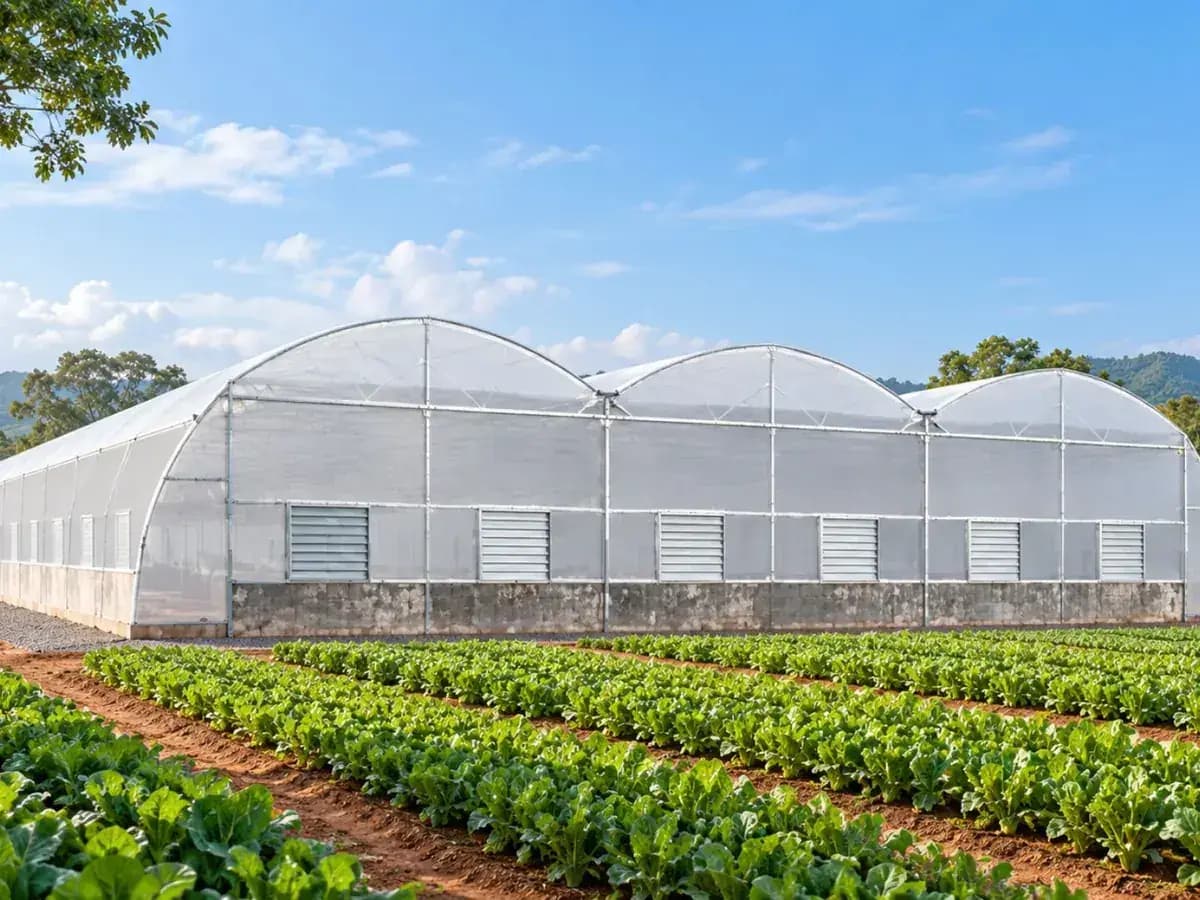
For many Coimbatore vegetable projects, a naturally ventilated polyhouse is the usual first choice. Its film roof protects the crop through the May–December wet period, while roof vents and roll-up curtains provide airflow without requiring fan power. It is a practical starting point for a project that needs rain exclusion as well as protected production.
A fan-and-pad polyhouse is a good fit where the crop plan needs lower daytime temperature, particularly around March. It can support leafy greens under conditions where natural ventilation alone may not provide the desired cooling. Size the system and crop plan together, because this structure depends on exhaust fans and wet pads.
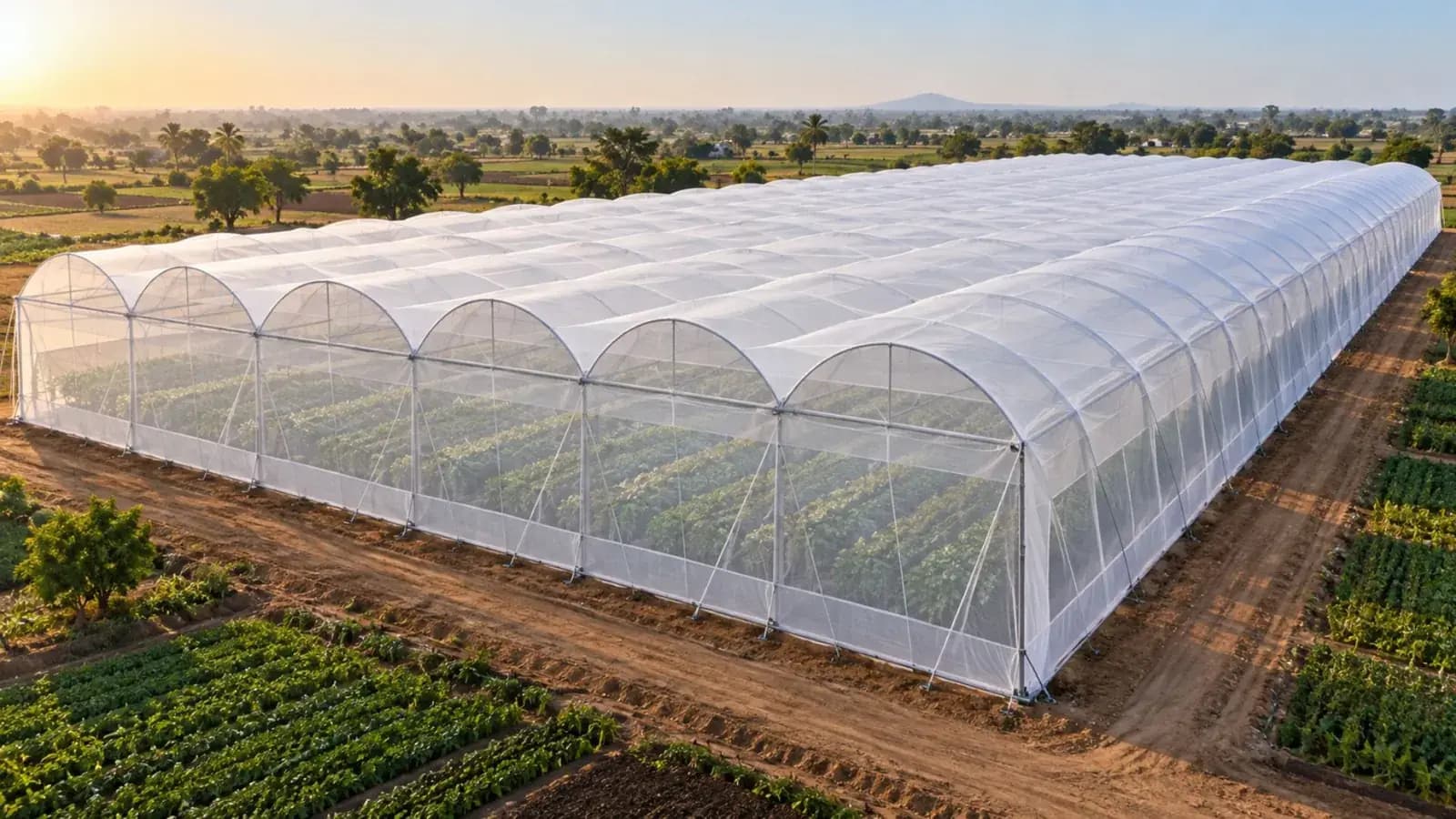
Square and curved nethouses are seasonal choices, not substitutes for a rainproof polyhouse in the wet months. They allow rain through. In Coimbatore they are best considered from December to February, with crops chosen for their tolerance of those conditions.
- Naturally ventilated polyhouse: best fit for rain protection and passive ventilation.
- Fan-and-pad polyhouse: good fit for active cooling and leafy greens.
- Square or curved nethouse: seasonal option when rainfall is low.
Naturally ventilated polyhouse
Best fitFilm roof keeps May–December rain off the crop; roof vents and roll-up curtains move air without power. The usual first choice in Coimbatore.
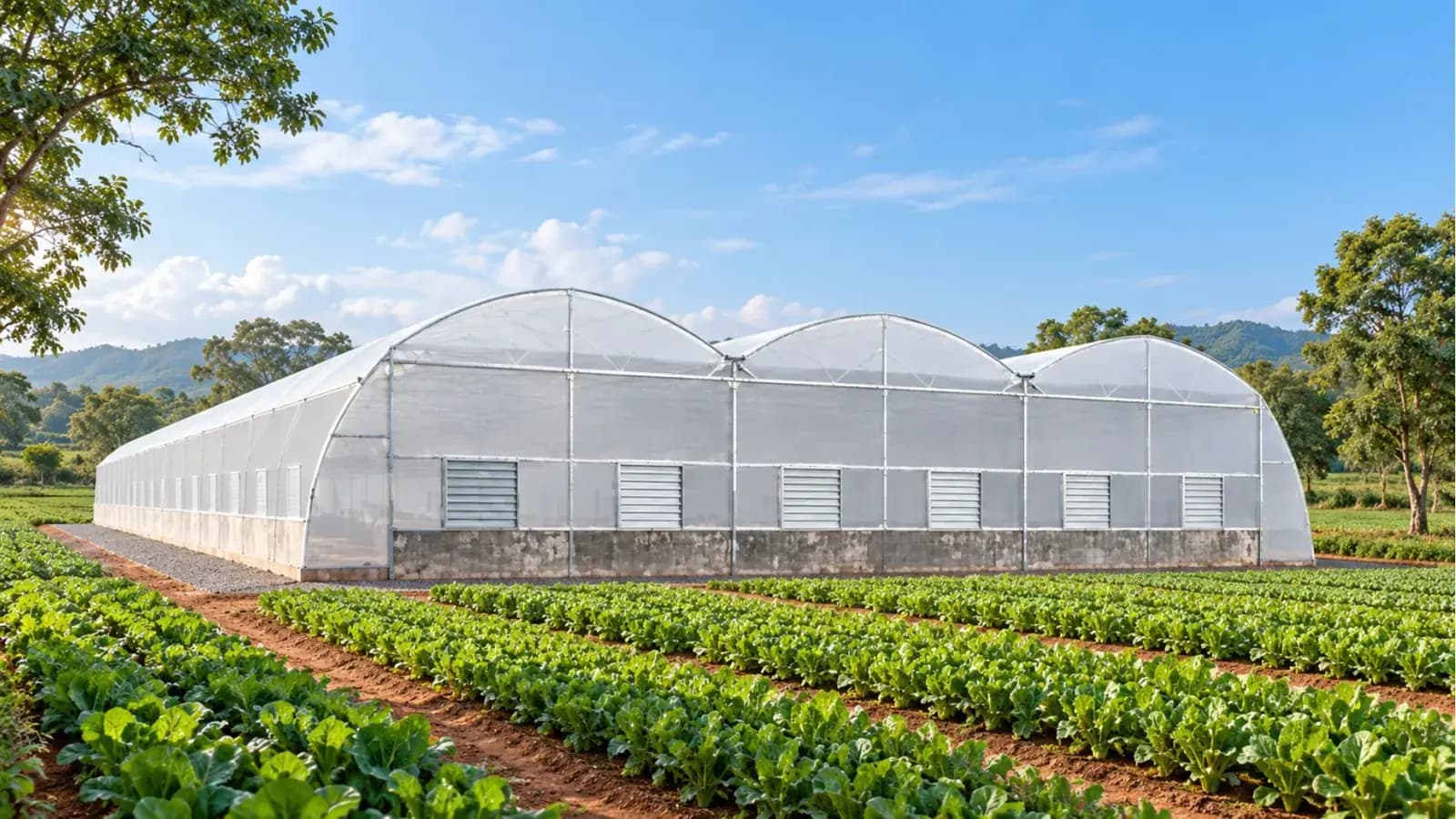
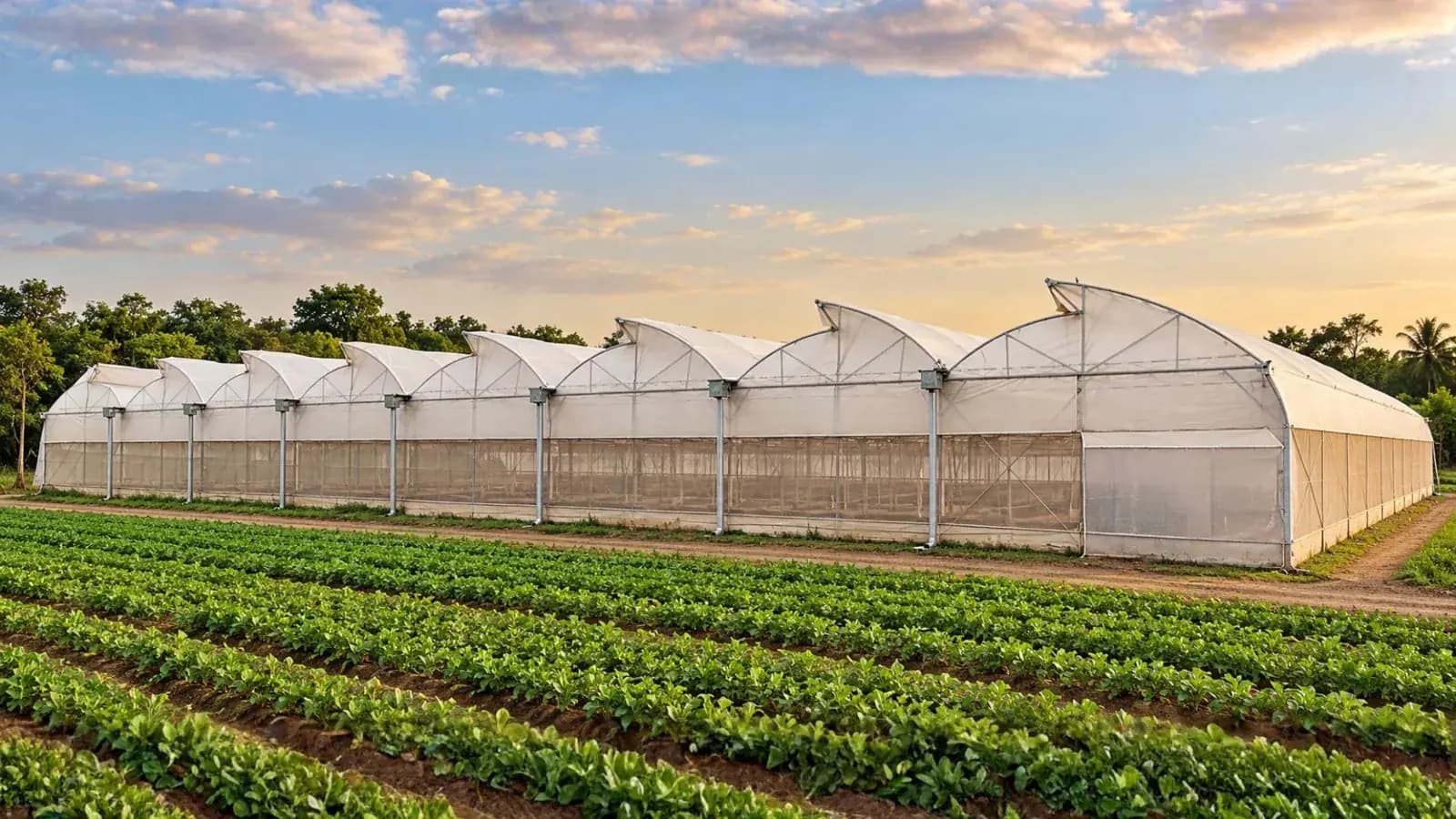
Fan & pad polyhouse
Good fitExhaust fans pull air through wet pads. In March that can take a 35°C afternoon down to about 29°C inside, cool enough for leafy greens.
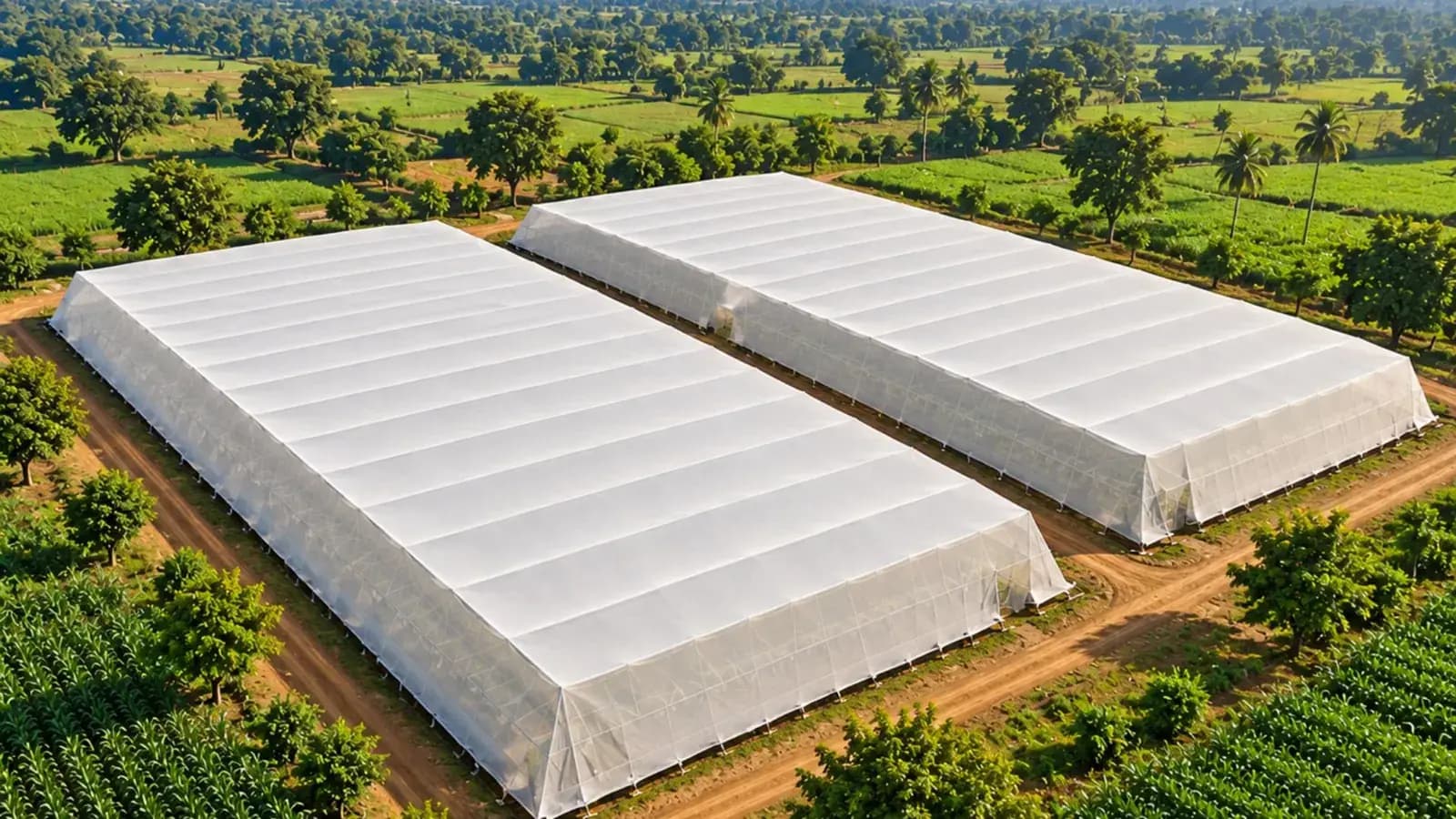
Square nethouse
SeasonalFlat-roof 4 × 4 m grid with shade and insect net, the NHB nursery design. Best from December to February, when rain is low.
Curved nethouse
SeasonalArched GI frame covered in shade net: taller crops, more air and a lower cost than a polyhouse. Rain passes through, so pick crops that tolerate it.
Match planting-material norms with the crop plan
For high-value vegetables, the listed NHB planting-material norm is ₹140 per m². The group includes coloured capsicum, parthenocarpic cucumber, tomato, lettuce and leafy greens, which are identified as suitable for Coimbatore. These crops align with either a naturally ventilated polyhouse or, where active cooling is justified, a fan-and-pad structure.
Flower planting-material norms in the table are ₹700 per m² for orchid and anthurium, ₹610 per m² for carnation and gerbera, and ₹426 per m² for rose and lilium. Orchid and anthurium are marked less suited here; gerbera and rose are marked as suitable options. Select the crop before preparing the DPR, because it affects planting-material provision, structure choice, operating requirements and the project description submitted for sanction.
Use these as admissible planning norms rather than a promise of a fixed payment. The approved crop, project cost and current scheme norms govern the final sanctioned amount.
- High-value vegetables: ₹140 per m².
- Orchid and anthurium: ₹700 per m², but marked less suited.
- Carnation and gerbera: ₹610 per m²; rose and lilium: ₹426 per m².
| Crop group | NHB norm | Suits Coimbatore? |
|---|---|---|
| High-value vegetables | ₹140 per m² | Yes: Coloured capsicum, Cucumber (parthenocarpic), Tomato, Lettuce and leafy greens |
| Orchid and anthurium | ₹700 per m² | Less suited |
| Carnation and gerbera | ₹610 per m² | Yes: Gerbera and rose |
| Rose and lilium | ₹426 per m² | Yes: Gerbera and rose |
Use local market seasons as a crop-planning check
The Coimbatore district price record covers 18 markets for beans, green chilli, okra, bottle gourd, coriander leaves, snake gourd, ridge gourd and papaya, and 16 markets for cabbage and cauliflower. Relevant outlets listed include Pollachi Uzhavar Sandhai, Sundarapuram Uzhavar Sandhai, Singanallur Uzhavar Sandhai, Mettupalayam Uzhavar Sandhai, Vadavalli Uzhavar Sandhai, Kurichi Uzhavar Sandhai, R S Puram Uzhavar Sandhai, Sulur Uzhavar Sandhai and Udumalpet APMC.
Treat the seasonal figures below as a marketing signal, not as a projected protected-crop return. For example, coriander leaves had its highest recorded month in October at ₹7,790/q, green chilli in June at ₹5,634/q, okra and ridge gourd in December at ₹5,513/q and ₹5,464/q respectively, and cauliflower in November at ₹5,394/q. Planting dates should be worked back from likely harvest periods, while considering the humid monsoon months and the buyer or market you actually intend to use.
The same data also shows weak-season risk: bottle gourd was lowest in March at ₹1,956/q, green chilli in April at ₹3,709/q and cauliflower in March at ₹3,101/q. Do not write a DPR around only the highest month.
- Beans: highest in May at ₹6,768/q.
- Coriander leaves: highest in October at ₹7,790/q.
- Papaya: highest in September at ₹3,943/q.
| Crop | Markets | Average modal price | Highest month | Lowest month |
|---|---|---|---|---|
| Beans | 18 | ₹5,808/q | May (₹6,768) | Feb (₹4,446) |
| Green chilli | 18 | ₹4,817/q | Jun (₹5,634) | Apr (₹3,709) |
| Okra (bhindi) | 18 | ₹4,543/q | Dec (₹5,513) | Jun (₹3,836) |
| Bottle gourd | 18 | ₹2,577/q | Dec (₹3,490) | Mar (₹1,956) |
| Coriander (leaves) | 18 | ₹5,244/q | Oct (₹7,790) | Jan (₹3,084) |
| Snake gourd | 18 | ₹3,430/q | Oct (₹3,851) | Mar (₹2,884) |
| Ridge gourd | 18 | ₹4,772/q | Dec (₹5,464) | Mar (₹4,122) |
| Papaya | 18 | ₹3,305/q | Sep (₹3,943) | Jun (₹2,702) |
| Cabbage | 16 | ₹2,628/q | Jul (₹3,184) | Apr (₹1,951) |
| Cauliflower | 16 | ₹4,162/q | Nov (₹5,394) | Mar (₹3,101) |
A one-acre fan-and-pad example for subsidy planning
The worked example below uses 3,952 m², about one acre. Coimbatore is not under hilly norms, so it uses the general fan-and-pad structure cost norm of ₹1,400 per m². The eligible structure cost in the illustration is ₹55,32,800.
For high-value vegetables, planting material is shown at ₹140 per m², or ₹5,53,280. This takes the indicative eligible project cost to ₹60,86,080. At 50% of the norm, the maximum subsidy shown is ₹30,43,040, or ₹30.43 lakh.
The example also shows our material price this week, including GST, as ₹32,48,775 (₹822/m²). That is an ex-factory material price without freight or erection, not a subsidy calculation or an approved project cost. The final sanctioned amount depends on the approved project, inspection and current norms.
- Structure: fan-and-pad polyhouse.
- Area: 3,952 m².
- Illustrated maximum subsidy: ₹30,43,040 at 50% of the norm.
| Item | Amount |
|---|---|
| Structure | Fan and pad polyhouse |
| Area | 3,952 m² (about one acre) |
| Structure cost norm | ₹1,400 per m² |
| Eligible structure cost | ₹55,32,800 |
| Planting material norm (high-value vegetables) | ₹140 per m² → ₹5,53,280 |
| Eligible project cost | ₹60,86,080 |
| Maximum subsidy at 50% of the norm | ₹30,43,040 (₹30.43 lakh) |
| Our material price this week (incl. GST) | ₹32,48,775 (₹822/m²) |
Apply first, then build and inspect
Start by fixing the structure, area and crop plan. Obtain an itemised quotation and prepare the DPR; for an NHB proposal, the DPR should cover cost, high-value-vegetable crop plan and repayment. A quotation should list each supplied item with its HSN code.
For MIDH, take the application to the Coimbatore district horticulture office before construction. For NHB, file the online application for In-Principle Approval and obtain the required bank term loan. IPA has been required before work starts for NHB projects since 2017, so excavation, foundation work or erection before it is a serious avoidable risk.
After sanction and construction, retain invoices and test certificates. The project is inspected for structure and specification. Following joint inspection, NHB subsidy is released to the bank loan account; MIDH release follows the state process.
- Choose the area and design before submitting documents.
- For NHB, obtain IPA before any work starts.
- Build to the approved standard and keep evidence for inspection.
- 1
Pick the structure and size
Match it to Coimbatore's climate (see above) and your market. Keep under 4,000 m² for MIDH, or above 2,500 m² for an NHB project.
- 2
Get a quotation and project report
A supplier quotation listing every item with its HSN code, and for an NHB project a DPR covering cost, the high-value vegetables crop plan and repayment.
- 3
Apply before you build
MIDH: apply at the Coimbatore district horticulture office. NHB: file for In-Principle Approval on the NHB portal; NHB has required IPA before work starts since 2017.
- 4
Bank loan (NHB)
Get the term loan sanctioned. The subsidy is back-ended: it is paid into the loan account after the project is complete.
- 5
Build to standard
Use materials that meet BIS standards and keep the test certificates; the inspection checks structure and specification.
- 6
Inspection and release
After a joint inspection, the subsidy is released to your bank (NHB) or to you (MIDH, as per the state process).
Keep the land, finance and material records ready
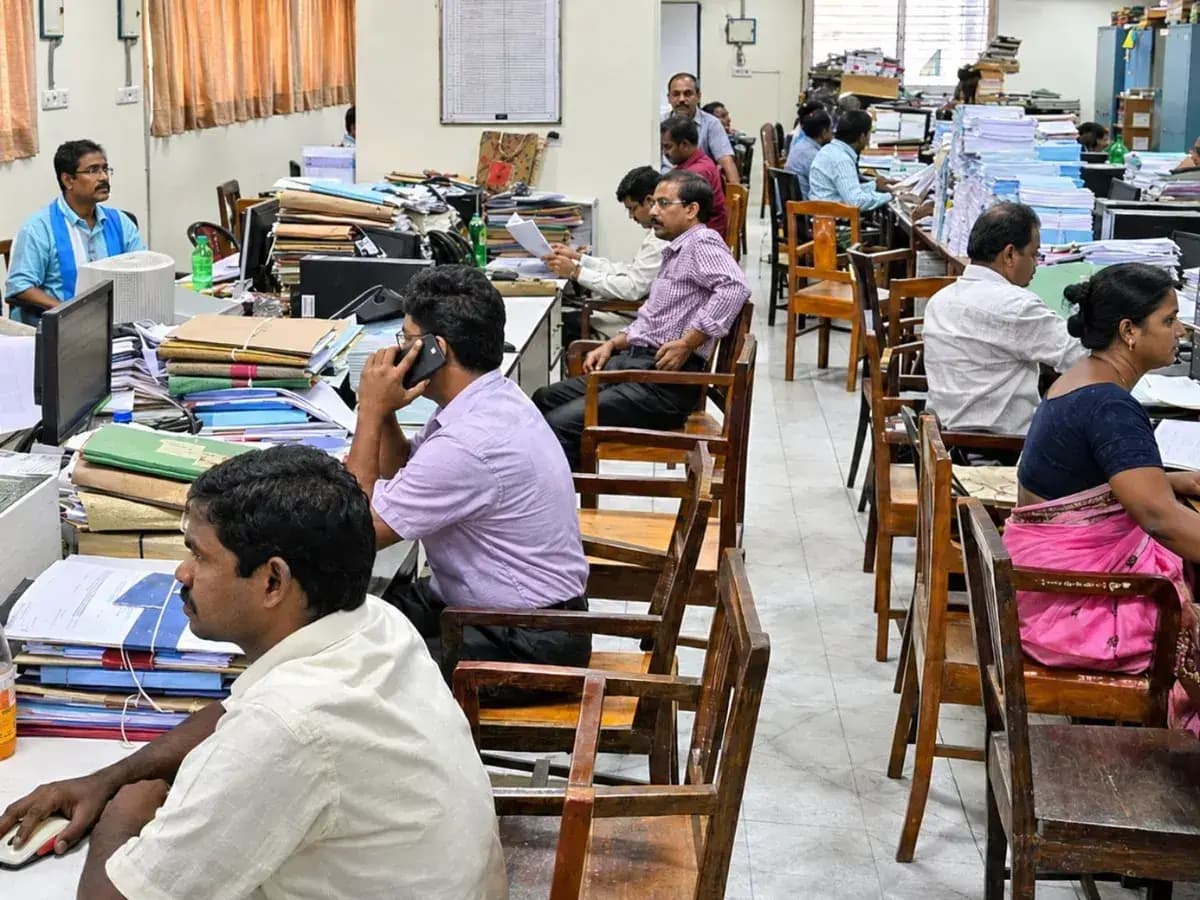
Prepare land records in the applicant’s name: in Tamil Nadu, Patta and Chitta with A-Register, or a registered lease, together with a site map. Keep Aadhaar, PAN and bank details ready; companies and FPOs also need their registration papers. Soil and water test reports should be obtained early rather than after the structure is ordered.
The application file should include the supplier quotation with HSN codes and specifications. NHB applicants also need the DPR and bank sanction letter. After purchase, preserve invoices and test certificates for the material, as these support the inspection record.
Polyhouse Constructions can provide an itemised quotation, along with lab test certificates and material documentation. The GI structure uses ISI-marked pipes from Tata, Jindal or JSW steel. The papers supplied should be checked against the approved design and the items delivered.
- Land record or registered lease plus site map.
- Identity, PAN, bank details, soil report and water report.
- Quotation, DPR and NHB bank sanction where applicable; then invoices and test certificates.
- Land records in your name (in Tamil Nadu: Patta and Chitta (with A-Register)), or a registered lease, with a site map
- Aadhaar, PAN and bank details; for companies and FPOs, registration papers
- Soil and water test report
- Supplier quotation with HSN codes and specifications
- Detailed project report and bank sanction letter (NHB)
- Test certificates and invoices for the material, after purchase
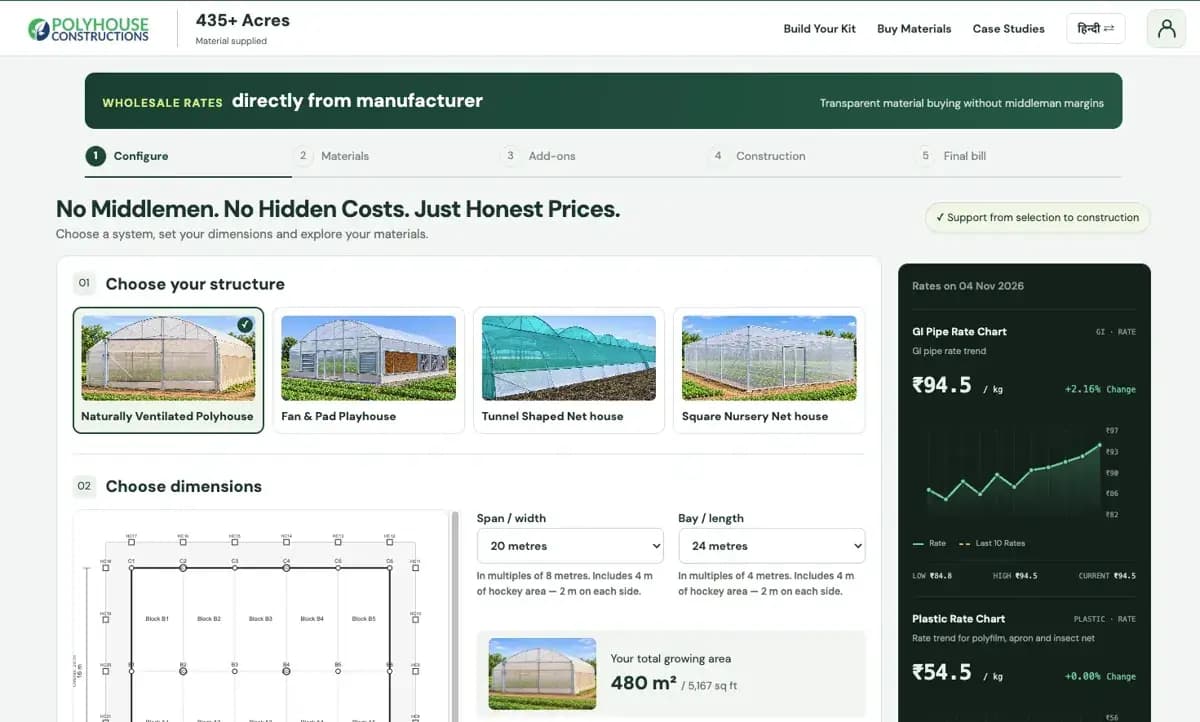
Itemised quotation
Every item with size, quantity, HSN code and GST, ready to attach to the application.

Lab test certificates
Tensile, chemical, salt spray and other tests on the steel, by third-party labs.
ISI-marked GI
GI pipes from Tata, Jindal or JSW steel, with a 15-year warranty.
Avoid mistakes that can weaken a subsidy file
The most important mistake is beginning an NHB project before IPA. Another is treating a supplier quote as the sanctioned cost, or changing the area, structure or crop after approval without checking the effect on the application. Keep the design, quotation, DPR and construction record consistent.
Do not choose a nethouse simply because it has a lower initial material requirement if the crop needs rain exclusion from May to December. Likewise, do not plan production around a single highest mandi month. Include the humid weather period, operating needs and realistic marketing route in the crop plan.
Polyhouse Constructions is a manufacturer of complete material kits from its Degaon, Satara factory, not a Coimbatore office. Kits can include the GI structure, polyfilm, nets and fittings; material is dispatched with a technical data sheet and lab test certificates. Erection is undertaken by Kryzen Biotech’s construction team. The GI structure has a 15-year manufacturing warranty, polyfilm 2.5 years and nets 3 years.
- Do not start NHB work before IPA.
- Do not substitute unapproved material or lose invoices and certificates.
- Check item quantities against the approved drawing before erection.
| What you get | Polyhouse Construction | Typical local fabricator |
|---|---|---|
| Experience | 30 years of collective experience in greenhouse engineering | Often a small crew learning on the job |
| Technical know-how | Strong technical understanding: structure planned for your climate and crop | Usually repeats one standard design |
| Warranty | 15-year manufacturing warranty | Rarely a written warranty |
| Engineering | In-house engineering team | No design or load checks |
| Manufacturing | In-house manufacturing, cut and drilled to drawing | Buys pipes from traders, cuts on site |
| Quality checks | 32-point QA checklist for every part | Visual check at best |
| Lab certificate | Lab test certificate with every dispatch | Not provided |
| Technical sheet | Technical data sheet for every product | Not available |
| Material match | Zero material mismatch: every part counted per design | Short or excess material is common |
| Raw material | Branded steel from Tata, Jindal and JSW | Unbranded or mixed sources |
| Price | Lowest cost across India, with real-time price benefits from weekly rates | Fixed quote; rate drops are not passed on |
| Backing | Backed by industry leader Kryzen Biotech | Single-owner workshop |
Buy from India's biggest CEA manufacturing company
Choose your structure and size and get the complete material list, priced this week.
FAQs
Can a 3,952 m² polyhouse in Coimbatore use MIDH or NHB?
3,952 m² is within the MIDH limit of up to 4,000 m² per beneficiary and is also above NHB’s 2,500 m² commercial-project threshold. MIDH is applied for through the Coimbatore district horticulture office, while NHB requires online IPA and a term loan; confirm the applicable route before applying.
Is IPA compulsory before building an NHB polyhouse?
Yes. NHB requires In-Principle Approval before work starts, and this requirement has applied since 2017. Apply online, obtain the bank term loan sanction, and only then proceed with erection.
Which structure should I choose for Coimbatore’s humid rainy months?
A naturally ventilated polyhouse is the usual first choice because the film roof keeps May–December rain off the crop while vents and curtains move air. A fan-and-pad polyhouse is useful where active cooling is needed, such as for leafy greens during the March heat.
What documents should I take to the horticulture office or bank?
Carry Patta and Chitta with A-Register or a registered lease, a site map, Aadhaar, PAN, bank details, soil and water reports, and an itemised quotation. For NHB, add the DPR and bank sanction letter; retain invoices and material test certificates after purchase.
What subsidy is shown in the one-acre fan-and-pad example?
For 3,952 m², the illustration shows eligible project cost of ₹60,86,080 and a maximum 50% subsidy of ₹30,43,040. It is indicative only: final sanction depends on current norms, approved project details and inspection.
Subsidy projects near Coimbatore
The same guide for nearby towns, with the structure that suits each.
| Town | From Coimbatore | District | Cost norms | Suits |
|---|---|---|---|---|
| Subsidy project in Chittur-Thathamangalam | ~50 km | Palakkad | General | NVPH / nethouse |
| Subsidy project in Palladam | ~50 km | Tiruppur | General | NVPH or fan & pad |
| Subsidy project in Pollachi | ~50 km | Coimbatore | General | NVPH / nethouse |
| Subsidy project in Palakkad | ~60 km | Palakkad | General | NVPH or fan & pad |
| Subsidy project in Tiruppur | ~60 km | Tiruppur | General | NVPH or fan & pad |
| Subsidy project in Udhagamandalam | ~70 km | Nilgiris | Hilly | NVPH / nethouse |
Sources
- NHB cost norms for protected cultivation
- NHB scheme guidelines (commercial horticulture)
- Mission for Integrated Development of Horticulture
- Kryzen: Polyhouse construction in Coimbatore
- Kryzen: Polyhouse farming in Coimbatore
- NASA POWER monthly climate averages for Coimbatore
- Agmarknet daily prices (data.gov.in)