
NVPH materials · Coimbatore district, Tamil Nadu
Naturally Ventilated Polyhouse Material for Coimbatore
By Editorial Team, Kryzen Biotech · Updated 13 November 2026
A naturally ventilated polyhouse can handle Coimbatore’s March heat when its roof vent and side curtains are used fully, but the bigger operating challenge is the long humid spell from May to December. For a new project, prioritise rain drainage, insect exclusion and air movement rather than treating this as a uniformly hot, dry location.
- Hottest month
- March, ~35°C
- Humid (75%+)
- 8 months
- NVPH material, 1 acre
- ₹734/m²
- Delivery
- ~4 days
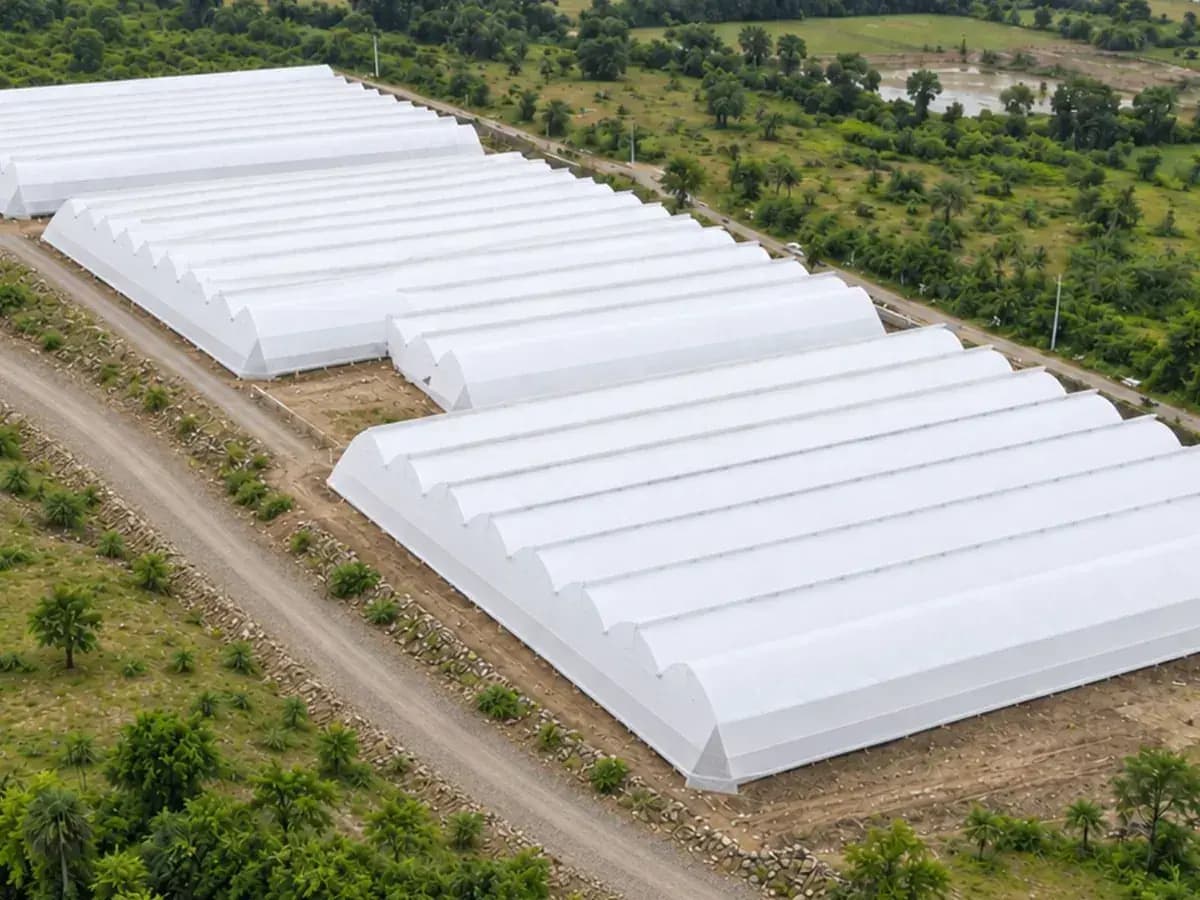
Is an NVPH suitable through Coimbatore’s year?
Yes, for many protected-cultivation crops, provided the house is operated for two distinct conditions. March is the hot and brightest month, with a 35°C average afternoon high and 6.4 kWh/m²/day of sun. Natural airflow through open side curtains and the roof vent is useful at this time, while white 50% shade net can be brought into use for sensitive crops.
From May through December, humidity is the deciding factor. Relative humidity is 76% in May and stays at 83–85% from June to October, before remaining 84% in November and 79% in December. Rain is also substantial: Coimbatore receives 1,142 mm in a year, including 192 mm in October. An NVPH will keep direct rain off the crop, but it does not remove humid air as tightly as a fan-and-pad house.
The comparatively cool nights are another reason not to run the house closed by default. January has a 16°C average night low and December 16.7°C. December to February is identified as the local nethouse season; it is also a dry, mild period for maximum light, planned planting and structural maintenance.
- March: 35°C average afternoon high; strongest sun.
- May–December: humid period requiring regular ventilation management.
- June–July: 3.3 m/s average wind, helping natural air exchange when openings can remain open.
- October: highest listed monthly rain at 192 mm; drainage and timely curtain operation matter.
| Month | Afternoon high | Night low | Humidity | Rain | Sun (kWh/m²/day) | Wind (m/s) |
|---|---|---|---|---|---|---|
| Jan | 29.5°C | 16°C | 67% | 6 mm | 5.5 | 1.8 |
| Feb | 32.7°C | 17.5°C | 56% | 9 mm | 6.2 | 1.8 |
| Mar | 35°C | 20.3°C | 53% | 30 mm | 6.4 | 1.6 |
| Apr | 34.5°C | 22.2°C | 63% | 60 mm | 6.1 | 1.5 |
| May | 31.1°C | 22°C | 76% | 118 mm | 5.6 | 2.2 |
| Jun | 28°C | 21°C | 83% | 162 mm | 4.5 | 3.3 |
| Jul | 27.1°C | 20.5°C | 85% | 157 mm | 4.1 | 3.3 |
| Aug | 27.2°C | 20.2°C | 85% | 136 mm | 4.4 | 3 |
| Sep | 27.8°C | 20.1°C | 85% | 126 mm | 5 | 2.4 |
| Oct | 27.7°C | 20°C | 85% | 192 mm | 4.7 | 1.6 |
| Nov | 26.9°C | 18.7°C | 84% | 118 mm | 4.6 | 1.5 |
| Dec | 27.3°C | 16.7°C | 79% | 28 mm | 4.9 | 1.8 |
Run curtains, vents and shade by season
Treat the roof vent as the permanent warm-air exit and the side curtains as the daily control. In dry months, open for maximum light and exchange of air rather than holding warm, still air inside. During March, roll curtains fully up, irrigate early in the day, and use added shade only where the crop is sensitive to the heat and strong sun.
From May to December, keep side curtains open whenever it is not raining. The aim is to reduce leaf wetness and stagnant humid air, not merely to lower temperature. Run air-circulation fans in the mornings during this humid season, and allow slightly wider plant spacing to reduce fungal-disease pressure. During rain, adjust curtains to stop rain entering while reopening them as soon as conditions allow.
In December to February, make full use of the drier, milder weather. Open the house for maximum light, schedule the main planting, inspect the roof film and curtain mechanism, and complete structural maintenance before the humid season returns.
- January–February: maximise light and natural opening; January rain is only 6 mm and February rain 9 mm.
- March–April: use maximum ventilation; assess shade crop by crop.
- May–December: prioritise open curtains when rain permits and morning air circulation.
- October–November: check gutters, funnels and runoff routes carefully during the wetter period.
| Month | Jan | Feb | Mar | Apr | May | Jun | Jul | Aug | Sep | Oct | Nov | Dec | Detail |
|---|---|---|---|---|---|---|---|---|---|---|---|---|---|
| Peak heat | ~35°C highs | ||||||||||||
| Strongest sun | 6.4 kWh/m²/day | ||||||||||||
| Humid (75%+) | May–December | ||||||||||||
| Nethouse season | December–February |
- 1
May to December
Humidity stays at 75% or more. Keep side curtains open whenever it is not raining and run air circulation fans in the mornings; space plants a little wider to cut fungal disease.
- 2
March
Peak heat, about 35°C. Roll the curtains fully up, add shade only for sensitive crops, and irrigate early in the day.
- 3
December to February
The dry, mild stretch. Open the house for maximum light, plan the main planting and do structural maintenance.
Material choices for this humid, rainy climate
The standard roof choice remains 250-micron white diffused, UV-stabilised polyfilm. It spreads the high March light evenly, while the standard white 50% shade net remains the indicated shade choice for this location. A second net layer is optional only for shade-loving crops; it should not be assumed necessary for every crop.
For Coimbatore, add air-circulation fans because there are eight humid months. Their role is leaf drying and circulation within the crop canopy; they are not a replacement for opening roof vents and side curtains. Keep the roof vent, insect-netted sides and manual curtain system as the core natural-ventilation arrangement.
Do not cut corners on rain handling. GI gutter sheet with funnels is retained because annual rainfall is about 1,142 mm. FRP fibre doors are retained for this climate. A double-door entry cabin is a useful inclusion where people frequently enter, because it helps keep whitefly and thrips out.
- Keep: 250-micron white diffused roof film.
- Keep: white 50% shade net; reflective net is not called for by the local sunlight condition.
- Add: air-circulation fans for the May–December humid season.
- Include: gutters and funnels; consider a double-door entry cabin.
| Part | Standard kit | For Coimbatore | Why |
|---|---|---|---|
| Roof film | 250-micron white diffused polyfilm | Keep | Spreads March's 6.4 kWh/m²/day of sunlight evenly |
| Shade net | White 50% | Keep white 50% | Sunlight here does not call for a reflective net |
| Second net layer | None | Optional | Only for shade-loving crops |
| Air circulation | Roof vent + curtains | Air Circulation Fan | 8 humid months: moving air keeps leaves dry |
| Doors | FRP (fibre) doors | Keep FRP | FRP lasts well in this climate |
| Gutters | GI gutter sheet + funnels | Keep | About 1,142 mm a year |
| Entry cabin | Optional | Include | A double door keeps whitefly and thrips out when people walk in |
What is in a 20 × 24 m NVPH material kit?
A complete material kit includes the GI structure, roof film, side insect net, skirting apron, shade net, profiles, springs, curtain units, doors and structural fittings. The live kit builder shows every line item, quantity, weight and current rate for the exact span and bay selected, rather than using a generic material estimate.
For the 20 × 24 m size, the larger listed structure items include 22 Side Hockey members, 18 Small Columns, 8 Big Bottom members, 18 Hockey Runners and 12 Big Arcs. It uses 158 m of 4.5 m white-diffused polyfilm, 73 m of 5.5 m film, 90 m of side insect net and four manual gear roll-up curtain units. This is a 67-item kit with about 2.5 tonnes of steel and fittings.
Polyhouse Constructions is a manufacturer supplying material from its Degaon, Satara factory on the Pune–Bangalore Highway. GI pipes use ISI-marked branded steel from Tata, Jindal and JSW. The GI structure has a 15-year manufacturing warranty, polyfilm has a 2.5-year warranty and nets have a 3-year warranty. Kryzen Biotech’s construction team carries out construction and erection; this is not a Coimbatore office-based supply claim.
- In-house engineering and manufacturing, with a 32-point QA checklist.
- Lab test certificate with dispatch and a technical data sheet for every product.
- Delivery to Coimbatore is listed as 4 days after dispatch; the factory distance is 1,090 km.
| Group | Item | Quantity | Weight |
|---|---|---|---|
| GI structure | Side Hockey (60X2.0X5500) | 22 nos | 378 kg |
| GI structure | Small Column (76X2.0X4500) | 18 nos | 305 kg |
| GI structure | Big Bottom (60X2.0X8000) | 8 nos | 200 kg |
| GI structure | Hockey Runner (42X2.0X4000) | 18 nos | 150 kg |
| GI structure | Big Arc (42X2.0X5200) | 12 nos | 130 kg |
| Film & nets | Polyfilm White Diffused 250 Micron (4.5 m) | 158 mtr | — |
| Film & nets | Polyfilm White Diffused 250 Micron (5.5 m) | 73 mtr | — |
| Film & nets | Side Insect Net (5.2 m) | 90 mtr | — |
| Film & nets | Side Skirting Apron (1.5 m) | 90 mtr | — |
| Film & nets | White Shade Net 50% | 80 mtr | — |
| Fittings & accessories | Aluminium Profile | 500 mtr | — |
| Fittings & accessories | GI Spring | 900 mtr | — |
| Fittings & accessories | Manual Gear Roll Up Curtain Unit | 4 nos | — |
| Fittings & accessories | Fibre Door | 2 nos | — |
| Fittings & accessories | F Bracket | 24 nos | — |
This week’s NVPH material prices
The table below is for material including GST, ex-factory. It does not include freight to Coimbatore or erection. Prices follow weekly GI and plastic rates, updated every Friday, so use the kit builder for the current list for the selected size.
The lower per-square-metre rate at larger sizes comes from shared gutters, end frames and doors. Compare a size on crop plan, working space and management capacity, not only on the unit material rate. Booking is with 5% advance and 95% before dispatch; a 5% bulk discount applies on 10 or more units of an item.
- 20 × 24 m, 480 m²: ₹4,68,814, or ₹977/m².
- 28 × 36 m, 1,008 m²: ₹8,59,963, or ₹853/m².
- 52 × 76 m, 3,952 m²: ₹28,99,897, or ₹734/m².
| Size | Span × bay | Area | Material incl. GST | Per m² |
|---|---|---|---|---|
| Small | 20 × 24 m | 480 m² | ₹4,68,814 | ₹977 |
| Medium | 28 × 36 m | 1,008 m² | ₹8,59,963 | ₹853 |
| About 1 acre | 52 × 76 m | 3,952 m² | ₹28,99,897 | ₹734 |
Price your own size for Coimbatore
Choose span and bay and get the full list with quantities, weights and rates in a minute.
Crop planning: combine crop fit with district price months
Crop choice should begin with the buyer and harvest period, then with the structure. District price records cover 18 markets for beans, green chilli, okra, bottle gourd, coriander, snake gourd, ridge gourd and papaya; cauliflower and cabbage have 16 markets. The listed outlets include Pollachi, Sundarapuram, Singanallur, Mettupalayam, Vadavalli, Kurichi, RSPuram, Sulur and Udumalpet.
For a trellised NVPH crop plan, cucumber, tomato and coloured capsicum are established protected-cultivation options, but the district price table specifically helps when considering crops with available local seasonal records. Beans had the highest listed month in May at ₹6,768/q, green chilli in June at ₹5,634/q, coriander leaves in October at ₹7,790/q, cauliflower in November at ₹5,394/q, and okra and ridge gourd in December at ₹5,513/q and ₹5,464/q respectively.
Do not read a highest modal-price month as an assured farm price. Use it as a marketing and planting discussion point, especially because the higher-price months for several crops overlap with Coimbatore’s humid period. In that period, select a crop only if its disease-management, ventilation and labour plan are practical for the house.
- Beans: average modal price ₹5,808/q; highest May, lowest February at ₹4,446/q.
- Green chilli: average ₹4,817/q; highest June, lowest April at ₹3,709/q.
- Coriander leaves: average ₹5,244/q; highest October, lowest January at ₹3,084/q.
- Cauliflower: average ₹4,162/q; highest November, lowest March at ₹3,101/q.
| Crop | Markets | Average modal price | Highest month | Lowest month |
|---|---|---|---|---|
| Beans | 18 | ₹5,808/q | May (₹6,768) | Feb (₹4,446) |
| Green chilli | 18 | ₹4,817/q | Jun (₹5,634) | Apr (₹3,709) |
| Okra (bhindi) | 18 | ₹4,543/q | Dec (₹5,513) | Jun (₹3,836) |
| Bottle gourd | 18 | ₹2,577/q | Dec (₹3,490) | Mar (₹1,956) |
| Coriander (leaves) | 18 | ₹5,244/q | Oct (₹7,790) | Jan (₹3,084) |
| Snake gourd | 18 | ₹3,430/q | Oct (₹3,851) | Mar (₹2,884) |
| Ridge gourd | 18 | ₹4,772/q | Dec (₹5,464) | Mar (₹4,122) |
| Papaya | 18 | ₹3,305/q | Sep (₹3,943) | Jun (₹2,702) |
| Cabbage | 16 | ₹2,628/q | Jul (₹3,184) | Apr (₹1,951) |
| Cauliflower | 16 | ₹4,162/q | Nov (₹5,394) | Mar (₹3,101) |
When fan and pad is worth considering
An NVPH cools through roof vents and side curtains with no cooling power consumption. It is suited here to capsicum, cucumber, tomato and flowers. It is the lower material-cost route in the comparison: about one acre of NVPH material is ₹28,99,897, or ₹734/m².
Fan and pad uses exhaust fans and wet pads. In March it is listed at about 29°C inside, against the local 35°C average afternoon high, so it provides tighter summer control. The trade-off is electricity for fans and a pump, plus a higher material figure of ₹32,48,775, or ₹822/m² for about one acre.
For Coimbatore, start with NVPH when the crop can tolerate seasonal variation and you will actively manage curtains, shade and humidity. Consider fan and pad for leafy greens or a crop needing tighter control during summer, and budget for its operating system rather than comparing material price alone.
| Naturally ventilated | Fan & pad | |
|---|---|---|
| Cooling | Roof vent and side curtains (no power) | Exhaust fans and wet pads, ~29°C inside in March |
| Running cost | None for cooling | Electricity for fans and a pump |
| Material price, 1 acre | ₹28,99,897 (₹734/m²) | ₹32,48,775 (₹822/m²) |
| Suits in Coimbatore | Capsicum, cucumber, tomato, flowers | Leafy greens and crops needing tight control in summer |
Ordering material and arranging construction
Build the required NVPH kit online at polyhouseconstructions.com to see the complete list, quantities, weights and that week’s rates. Polyhouse Constructions, a venture of Kryzen Biotech Pvt Ltd, supplies complete kits as well as individual items. The material is manufactured at the Satara factory and supplied to Coimbatore; there is no company office in the town.
Before ordering, finalise crop, required area, location of entry, drainage route and whether the project needs air-circulation fans and an entry cabin. If construction is required, it is done by Kryzen Biotech’s construction team. For support beyond Coimbatore district headquarters, material pages are also available for Pollachi and Valparai.
Buy from India's biggest CEA manufacturing company
Choose your structure and size and get the complete material list, priced this week.
FAQs
Will a naturally ventilated polyhouse be too hot in Coimbatore in March?
March is the hottest and sunniest listed month, at a 35°C average afternoon high and 6.4 kWh/m²/day of sun. An NVPH can be operated with roof vent and side curtains fully open; use shade only for sensitive crops, while fan and pad is the tighter-control option at about 29°C inside in March.
What is the main climate risk for an NVPH here?
Humidity is the main management issue, not only peak heat. It is 76% in May and 83–85% from June to October, so keep curtains open whenever rain permits and run air-circulation fans in the mornings.
Does the listed NVPH price include delivery and installation in Coimbatore?
No. The listed prices are material including GST, ex-factory; freight to Coimbatore and erection are extra. Delivery is listed as 4 days after dispatch, and construction is done by Kryzen Biotech’s construction team.
Which items should I add for Coimbatore’s rainy months?
Keep GI gutters and funnels because annual rainfall is about 1,142 mm, and add air-circulation fans for the eight humid months. A double-door entry cabin is also recommended where frequent entry could bring in whitefly and thrips.
Which crops have useful local price seasons to study before planting?
The district data shows high listed months for beans in May, green chilli in June, coriander leaves in October, cauliflower in November, and okra and ridge gourd in December. These are district modal-price patterns, so check your buyer and crop-management suitability before treating them as planting guarantees.
NVPH materials near Coimbatore
Neighbouring towns on the same delivery route, and how their summers compare.
| Town | From Coimbatore | Hottest month | Humid months | Suits |
|---|---|---|---|---|
| NVPH materials in Chittur-Thathamangalam | ~50 km | Mar, 37°C | 8 | NVPH |
| NVPH materials in Palladam | ~50 km | Apr, 38°C | 3 | NVPH + fan & pad |
| NVPH materials in Pollachi | ~50 km | Mar, 36°C | 8 | NVPH |
| NVPH materials in Palakkad | ~60 km | Mar, 38°C | 8 | NVPH + fan & pad |
| NVPH materials in Tiruppur | ~60 km | Apr, 38°C | 3 | NVPH + fan & pad |
| NVPH materials in Udhagamandalam | ~70 km | Mar, 24°C | 7 | NVPH |