
NVPH materials · Maharashtra
Naturally ventilated polyhouse material for Nagpur
By Editorial Team, Kryzen Biotech · Updated 13 November 2026
A naturally ventilated polyhouse (NVPH) can work in Nagpur, but it must be operated differently in the severe dry heat of April–May and in the humid, rainy period from July to October. For a new project, prioritise large working roof vents and side curtains, reflective shading for summer, insect exclusion, reliable gutters and air movement during humid months.
- Hottest month
- May, ~44°C
- Humid (75%+)
- 4 months
- NVPH material, 1 acre
- ₹734/m²
- Delivery
- ~4 days
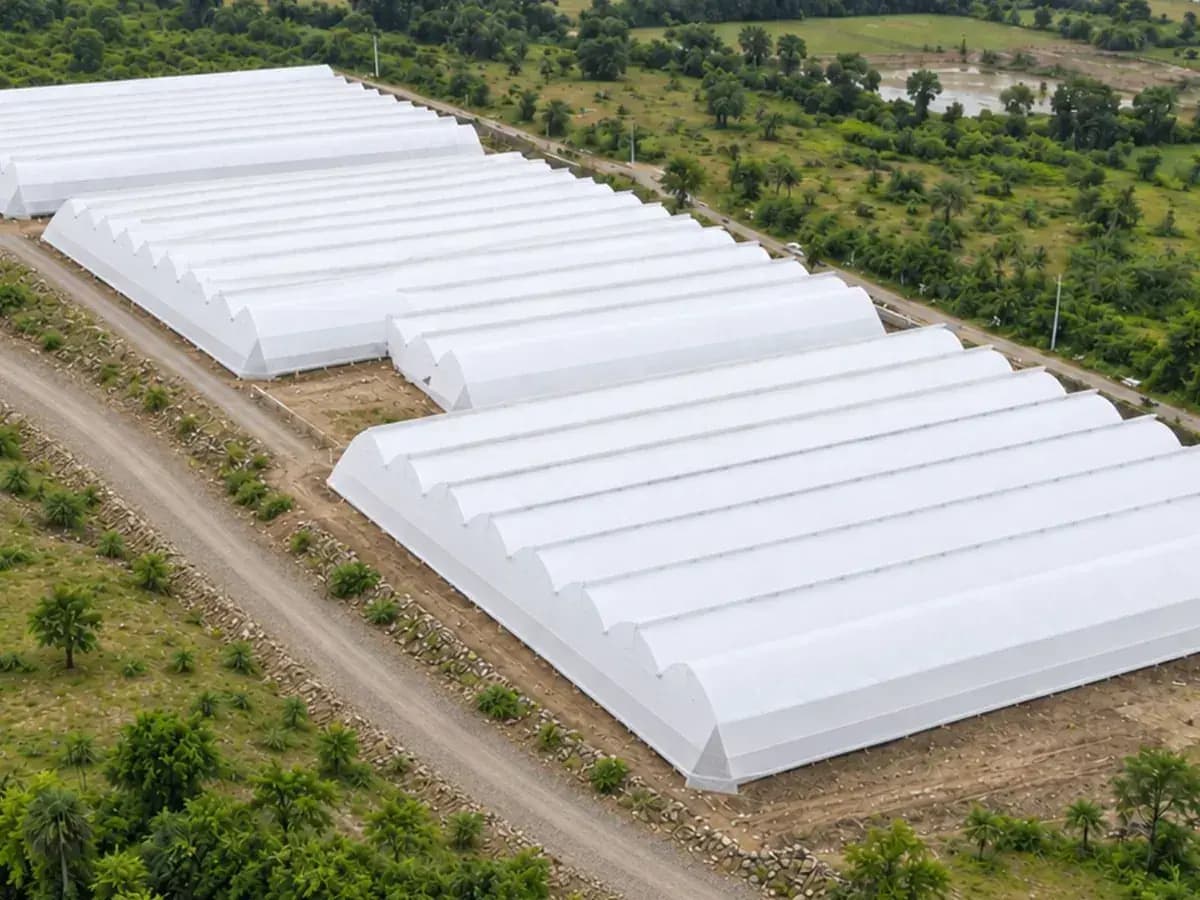
Can an NVPH handle Nagpur’s weather?
Yes, for crops that can be scheduled around the weather and for growers prepared to operate curtains and shade daily. But an NVPH is not a temperature-controlled room. Nagpur is among the hotter places in Maharashtra: its May average high is 44.1°C, compared with a 40.7°C state average. Natural airflow removes some accumulated heat, but it cannot bring the crop environment down to a chosen temperature in peak summer.
April has the strongest sun at 7 kWh/m²/day, followed by May at the same level. April is also dry, with 23% relative humidity, while May has a 44.1°C high and 25% humidity. This is the period when ventilation has to be fully open and reflective shade becomes important. From June, the challenge changes from dry heat to rain and humidity: July alone averages 361 mm rain, and humidity stays at 75% or more from July through October.
Winter is the easiest operating window. December nights can fall to 11.7°C, but afternoons remain near 28.2°C. The October–February nethouse season is the mild, relatively dry period for taking maximum light and planning the main crop cycle.
- Peak heat: May, 44.1°C average high.
- Strongest sunlight: April, 7 kWh/m²/day.
- Wettest month: July, about 361 mm rain.
- Humid period: July–October; August averages 87% humidity.
- Coolest night: December, 11.7°C.
| Measure | Nagpur | Maharashtra average (130 towns) | What it means for the NVPH |
|---|---|---|---|
| Hottest-month high | 44°C (May) | 40.7°C | 3.3°C hotter than the state average |
| Humidity in that month | 25% | 35% | Dry in May, but humid from July to October |
| Rain a year | 1,234 mm | 1,176 mm | close to the state average |
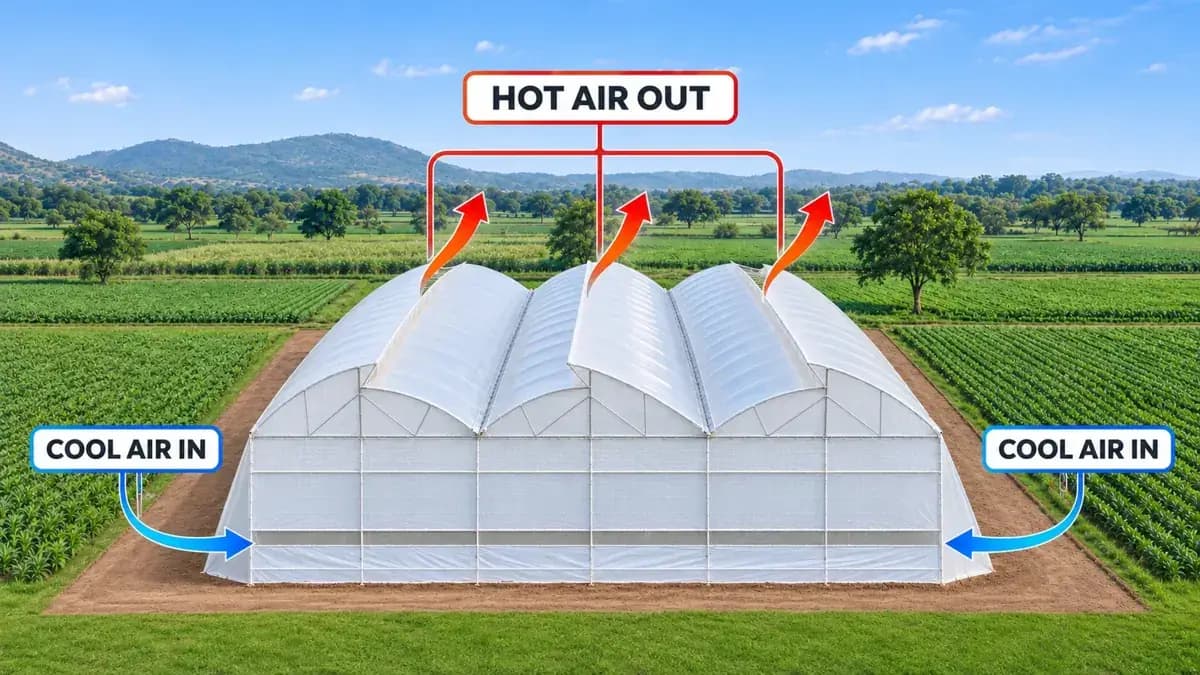
Operate curtains, vents and shade by season
The roof vent and side curtains are the working parts of an NVPH, not just accessories. Warm air should leave from the roof vent while cooler outside air enters through the side curtains. Keep the side openings available whenever rain is not entering the house; a closed house during humid weather can retain moisture around the crop.
In March, begin checking the curtain and shade routine as the average high reaches 37.6°C. During April and May, roll side curtains fully up, maintain free roof-vent airflow, and close the shade net or second shade layer over the crop in the high-heat period. Irrigate early in the day. Do not expect natural ventilation alone to offset May’s 44.1°C outside conditions.
Before the monsoon, clear gutters and funnels, inspect the roof film for tears, and tighten GI springs. From July to October, rain may require temporary curtain closure, but reopen curtains whenever conditions permit. Run air-circulation fans in the morning in these humid months and keep plants spaced to reduce leaf wetness. In November to February, open the structure for maximum light, while watching cool December nights before deciding the crop schedule.
- March: start heat-management checks as highs average 37.6°C.
- April–May: fully open curtains; use shade over the crop in intense sun.
- Before July: clean gutters and funnels and inspect film and springs.
- July–October: reopen curtains after rain where possible; use air movement in humid mornings.
- October–February: maximise light and schedule the main planting.
| Month | Jan | Feb | Mar | Apr | May | Jun | Jul | Aug | Sep | Oct | Nov | Dec | Detail |
|---|---|---|---|---|---|---|---|---|---|---|---|---|---|
| Peak heat | ~44°C highs | ||||||||||||
| Strongest sun | 7 kWh/m²/day | ||||||||||||
| Wettest month | ~361 mm | ||||||||||||
| Humid (75%+) | July–October | ||||||||||||
| Nethouse season | October–February |
- 1
Before July
Clear gutters and funnels, check the film for tears and tighten the GI springs. July brings about 361 mm, the heaviest rain of the year.
- 2
July to October
Humidity stays at 75% or more. Keep side curtains open whenever it is not raining and run air circulation fans in the mornings; space plants a little wider to cut fungal disease.
- 3
May
Peak heat, about 44°C. Roll the curtains fully up, close the shade net or second layer over the crop, and irrigate early in the day.
- 4
October to February
The dry, mild stretch. Open the house for maximum light, plan the main planting and do structural maintenance.
Material choices that suit this site
The standard roof cover is 250-micron white diffused, UV-stabilised polyfilm. It is the right base film to retain for Nagpur because diffused light spreads April’s strong sunlight more evenly. The structure uses ISI-marked branded steel from Tata, Jindal and JSW. The GI structure carries a 15-year manufacturing warranty, polyfilm has a 2.5-year warranty, and nets have a 3-year warranty.
For this climate, select aluminium reflective shade net rather than treating ordinary shading as the only summer measure. It reflects heat outward at the time Nagpur reaches 44°C. A second net layer operated with ropes and pulleys gives the grower the option to open or close it with the season. This flexibility matters more than keeping the same shade arrangement through the year.
Retain GI gutter sheet and funnels because of July’s heavy rainfall. Add air-circulation fans for the four humid months, and consider an entry cabin with a double door to reduce whitefly and thrips entering when people go in and out. Aluminium doors are the specified upgrade for heavy rain because they do not warp or swell.
- Keep: 250-micron white diffused polyfilm and GI gutters with funnels.
- Summer upgrade: aluminium reflective shade net plus a controllable second net layer.
- Monsoon upgrade: air-circulation fans and aluminium doors.
- Crop-protection upgrade: entry cabin with double door and side insect net.
| Part | Standard kit | For Nagpur | Why |
|---|---|---|---|
| Roof film | 250-micron white diffused polyfilm | Keep | Spreads April's 7 kWh/m²/day of sunlight evenly |
| Shade net | White 50% | Aluminium Shade Net (4 m) | Reflects heat back out at 44°C |
| Second net layer | None | Add (double layer) | Open or close it by the season with ropes and pulleys |
| Air circulation | Roof vent + curtains | Air Circulation Fan | 4 humid months: moving air keeps leaves dry |
| Doors | FRP (fibre) doors | Aluminium Door | Heavy rain: aluminium does not warp or swell |
| Gutters | GI gutter sheet + funnels | Keep | July brings ~361 mm; clean before June |
| Entry cabin | Optional | Include | A double door keeps whitefly and thrips out when people walk in |
What is in a 20 × 24 m NVPH kit?
A complete kit is more than pipes and a roof sheet. The table below shows the largest components of a 20 × 24 m, 480 m² NVPH kit; the full kit has 67 items and about 2.5 tonnes of steel and fittings. It includes the GI structure, roof film, side insect net, skirting apron, shade net, aluminium profile, GI spring, manual gear roll-up curtain units, fibre doors and fittings.
For example, this size includes 22 Side Hockey pipes, 18 Small Columns, eight Big Bottom pipes, 18 Hockey Runners and 12 Big Arcs. It also includes 158 m of 4.5 m-wide and 73 m of 5.5 m-wide white diffused polyfilm, plus four manual gear roll-up curtain units. Exact quantities change with span and bay, so use the online kit builder to see every line, weight and current rate for the planned size.
Polyhouse Constructions manufactures material at Degaon on the Pune–Bangalore Highway, Tal. Wai, Satara. Material is supplied from the factory; there is no Nagpur office. Delivery is 4 days after dispatch for Nagpur. If erection is required, it is done by Kryzen Biotech’s construction team.
- GI structure, polyfilm, nets and fittings supplied as a complete material kit.
- Manual gear roll-up curtain units are included in the illustrated 20 × 24 m kit.
- In-house engineering, 32-point QA, a lab test certificate with dispatch and a technical data sheet support the supplied material.
| Group | Item | Quantity | Weight |
|---|---|---|---|
| GI structure | Side Hockey (60X2.0X5500) | 22 nos | 378 kg |
| GI structure | Small Column (76X2.0X4500) | 18 nos | 305 kg |
| GI structure | Big Bottom (60X2.0X8000) | 8 nos | 200 kg |
| GI structure | Hockey Runner (42X2.0X4000) | 18 nos | 150 kg |
| GI structure | Big Arc (42X2.0X5200) | 12 nos | 130 kg |
| Film & nets | Polyfilm White Diffused 250 Micron (4.5 m) | 158 mtr | — |
| Film & nets | Polyfilm White Diffused 250 Micron (5.5 m) | 73 mtr | — |
| Film & nets | Side Insect Net (5.2 m) | 90 mtr | — |
| Film & nets | Side Skirting Apron (1.5 m) | 90 mtr | — |
| Film & nets | White Shade Net 50% | 80 mtr | — |
| Fittings & accessories | Aluminium Profile | 500 mtr | — |
| Fittings & accessories | GI Spring | 900 mtr | — |
| Fittings & accessories | Manual Gear Roll Up Curtain Unit | 4 nos | — |
| Fittings & accessories | Fibre Door | 2 nos | — |
| Fittings & accessories | F Bracket | 24 nos | — |
Current material price and what it includes
This week’s ex-factory material price for a small 20 × 24 m NVPH is ₹4,68,814 including GST, or ₹977/m². A 28 × 36 m, 1,008 m² medium house is ₹8,59,963 including GST, or ₹853/m². A 52 × 76 m house of 3,952 m², described as about 1 acre, is ₹28,99,897 including GST, or ₹734/m².
These are material-only rates. Freight to Nagpur and erection are extra. The lower per-square-metre figure at larger sizes reflects shared gutters, end frames and doors. Rates follow weekly GI and plastic prices and are updated every Friday; a final kit should therefore be built against the current weekly rate rather than an old quotation.
Booking requires 5% advance and the balance 95% before dispatch. A 5% bulk discount applies when purchasing 10 or more units of an item.
- Small: 480 m² — ₹4,68,814 material including GST.
- Medium: 1,008 m² — ₹8,59,963 material including GST.
- About 1 acre: 3,952 m² — ₹28,99,897 material including GST.
- Freight to Nagpur and erection are additional.
| Size | Span × bay | Area | Material incl. GST | Per m² |
|---|---|---|---|---|
| Small | 20 × 24 m | 480 m² | ₹4,68,814 | ₹977 |
| Medium | 28 × 36 m | 1,008 m² | ₹8,59,963 | ₹853 |
| About 1 acre | 52 × 76 m | 3,952 m² | ₹28,99,897 | ₹734 |
Price your own size for Nagpur
Choose span and bay and get the full list with quantities, weights and rates in a minute.
Crop planning around Nagpur mandi seasons
Choose the crop and transplant date together with the market window, not only according to what can be grown under cover. In Nagpur district’s reported markets, cucumber has its highest listed month in January at ₹2,953/q and lowest in August at ₹1,317/q. That makes a cucumber harvest aimed at the cooler season worth examining, while August selling falls within the humid monsoon period.
Tomato’s highest listed month is November at ₹2,948/q, against a March low of ₹753/q. Brinjal is highest in December at ₹1,946/q and lowest in February at ₹813/q. These figures do not guarantee a future price, but they show why an NVPH crop plan should work backwards from an intended harvest period rather than simply planting at one common date.
Leafy crops may offer specific seasonal opportunities, but they need close attention to humidity and crop health in the monsoon. Coriander leaves are highest in October at ₹7,249/q; methi is also highest in October at ₹6,876/q; and spinach reaches its highest listed month in October at ₹3,379/q. Green chilli has the highest listed month in July at ₹5,414/q, while okra is highest in December at ₹3,888/q. Check the relevant market and grade before committing area.
- Cucumber: January high ₹2,953/q; August low ₹1,317/q.
- Tomato: November high ₹2,948/q; March low ₹753/q.
- Coriander leaves: October high ₹7,249/q.
- Methi: October high ₹6,876/q.
- Green chilli: July high ₹5,414/q.
| Crop | Markets | Average modal price | Highest month | Lowest month |
|---|---|---|---|---|
| Tomato | 19 | ₹2,019/q | Nov (₹2,948) | Mar (₹753) |
| Brinjal | 19 | ₹1,429/q | Dec (₹1,946) | Feb (₹813) |
| Green chilli | 20 | ₹3,694/q | Jul (₹5,414) | Dec (₹2,704) |
| Okra (bhindi) | 19 | ₹2,864/q | Dec (₹3,888) | Sep (₹1,892) |
| Coriander (leaves) | 19 | ₹3,875/q | Oct (₹7,249) | Feb (₹1,810) |
| Cabbage | 17 | ₹1,214/q | Aug (₹1,667) | Apr (₹630) |
| Cauliflower | 17 | ₹1,901/q | Jul (₹3,465) | Mar (₹894) |
| Spinach | 19 | ₹2,017/q | Oct (₹3,379) | Jan (₹746) |
| Cucumber | 16 | ₹1,962/q | Jan (₹2,953) | Aug (₹1,317) |
| Methi (fenugreek leaves) | 18 | ₹3,771/q | Oct (₹6,876) | Jan (₹1,024) |
NVPH or fan and pad for Nagpur?
For capsicum, cucumber, tomato and flowers, an NVPH is the lower-cost starting option when crop scheduling and active curtain management are acceptable. Its cooling relies on roof vents and side curtains, so there is no cooling power cost. The material price shown for about 1 acre is ₹28,99,897, or ₹734/m².
Fan-and-pad cooling is the alternative where tighter summer temperature control is important. In Nagpur’s May conditions, the pad-cooled inside temperature is about 32°C. That is a meaningful difference from the 44.1°C average outdoor high, but it requires exhaust fans, wet pads, electricity for fans and a pump. The stated fan-and-pad material price for about 1 acre is ₹32,48,775, or ₹822/m².
For a grower relying on passive airflow, the critical decision is whether the chosen crop can avoid the most demanding part of April–May or tolerate a shaded NVPH. If it needs tight summer control, especially leafy greens, compare fan and pad rather than assuming a naturally ventilated house will deliver the same result.
- NVPH: roof vent and curtains; no power for cooling.
- Fan and pad: about 32°C inside in May, with electricity for fans and pump.
- About 1 acre material price: NVPH ₹28,99,897; fan and pad ₹32,48,775.
| Naturally ventilated | Fan & pad | |
|---|---|---|
| Cooling | Roof vent and side curtains (no power) | Exhaust fans and wet pads, ~32°C inside in May |
| Running cost | None for cooling | Electricity for fans and a pump |
| Material price, 1 acre | ₹28,99,897 (₹734/m²) | ₹32,48,775 (₹822/m²) |
| Suits in Nagpur | Capsicum, cucumber, tomato, flowers | Leafy greens and crops needing tight control in summer |
Buy from India's biggest CEA manufacturing company
Choose your structure and size and get the complete material list, priced this week.
FAQs
Is naturally ventilated polyhouse suitable for Nagpur’s May heat?
It can be suitable for crops and schedules that can be managed with full side ventilation, roof vents and reflective shade. May averages 44.1°C outside, so an NVPH will not provide the tighter temperature control available from a fan-and-pad house.
What should I do in the July–October humid period?
Humidity is 75% or more from July to October, with July averaging about 361 mm rain. Clean gutters before the monsoon, reopen side curtains whenever rain allows, and use air-circulation fans in humid mornings.
What is the current NVPH material price for Nagpur?
The displayed ex-factory material-only rate for a 20 × 24 m, 480 m² kit is ₹4,68,814 including GST. Freight to Nagpur and erection are extra, and rates are updated every Friday with GI and plastic prices.
Which crops have useful Nagpur mandi price windows for an NVPH?
Reported district-market data shows tomato highest in November at ₹2,948/q, cucumber highest in January at ₹2,953/q, and coriander leaves highest in October at ₹7,249/q. These are historical modal-price seasons, so confirm current demand and crop grade before planting.
Who erects the polyhouse in Nagpur?
Polyhouse Constructions manufactures and supplies the material kit from its Satara factory; it does not have a Nagpur office. Construction and erection are carried out by Kryzen Biotech’s construction team, and delivery is 4 days after dispatch.
NVPH materials near Nagpur
Neighbouring towns on the same delivery route, and how their summers compare.
| Town | From Nagpur | Hottest month | Humid months | Suits |
|---|---|---|---|---|
| NVPH materials in Savner | ~40 km | May, 43°C | 3 | NVPH + fan & pad |
| NVPH materials in Ramtek | ~50 km | May, 43°C | 4 | NVPH + fan & pad |
| NVPH materials in Umred | ~50 km | May, 44°C | 4 | NVPH + fan & pad |
| NVPH materials in Sausar | ~80 km | May, 43°C | 3 | NVPH + fan & pad |
| NVPH materials in Narkhed | ~90 km | May, 43°C | 3 | NVPH + fan & pad |
| NVPH materials in Pauni | ~90 km | May, 44°C | 4 | NVPH + fan & pad |