
NVPH materials · Bhopal district, Madhya Pradesh
Naturally Ventilated Polyhouse Material for Bhopal
By Editorial Team, Kryzen Biotech · Updated 13 November 2026
A naturally ventilated polyhouse can work well in Bhopal when its roof vents, side curtains and shade arrangement are operated actively through the dry May heat and the humid July–September monsoon. The key decision is not simply the structure size: it is choosing heat-reflective shading, rain-ready drainage and insect-protected ventilation, then matching the crop cycle to Bhopal mandi price seasons.
- Hottest month
- May, ~42°C
- Humid (75%+)
- 3 months
- NVPH material, 1 acre
- ₹734/m²
- Delivery
- ~4 days
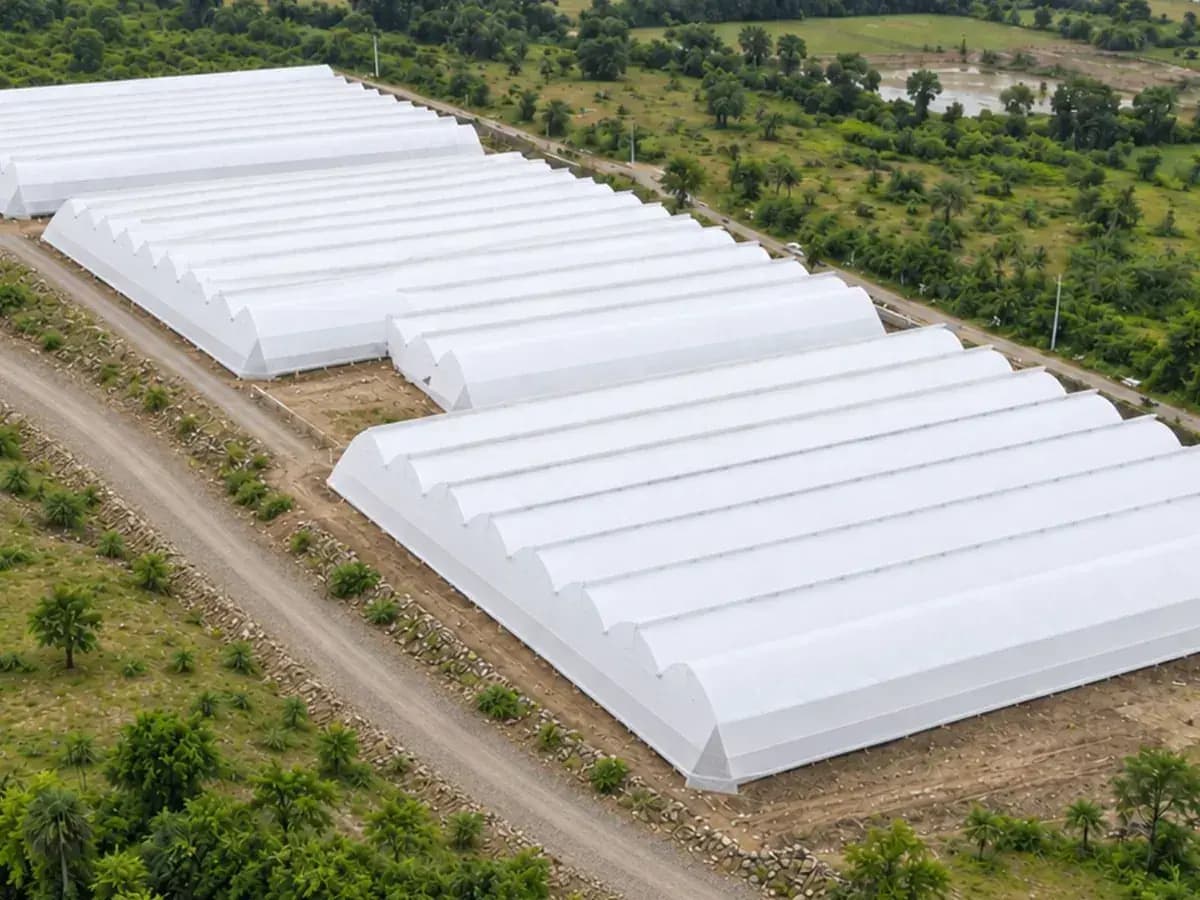
Will natural ventilation cope with Bhopal weather?
For much of the year, an NVPH is a practical option in Bhopal. Dry air in March, April and May helps warm air escape through the roof vent while cooler air enters through the side curtains. May is the limiting month: the average afternoon high is 42.3°C, humidity is 24%, and sunshine reaches 7.2 kWh/m²/day. Natural ventilation removes heat, but it does not provide the controlled cooling of a fan-and-pad house.
paragraphs
The monsoon creates a different operating condition rather than extreme heat. July receives about 418 mm rain, August 381 mm and September 155 mm. Humidity is 81% in July, 88% in August and 83% in September, so rain exclusion, open curtains whenever rain stops, crop spacing and disease hygiene become more important than trying to hold heat inside.
Winter nights also need attention. January’s average night low is 8.7°C and December’s is 9.8°C. Close side curtains in the evening to reduce cold draughts around the crop, then reopen them after the morning becomes comfortable. An NVPH is not a heated structure, so crop selection and planting timing should respect these cool nights.
| Month | Afternoon high | Night low | Humidity | Rain | Sun (kWh/m²/day) | Wind (m/s) |
|---|---|---|---|---|---|---|
| Jan | 25.6°C | 8.7°C | 42% | 11 mm | 4.3 | 1.8 |
| Feb | 29.7°C | 11.9°C | 35% | 11 mm | 5.3 | 1.9 |
| Mar | 34.8°C | 17.1°C | 27% | 12 mm | 6.3 | 2.1 |
| Apr | 40°C | 22.9°C | 20% | 6 mm | 7.1 | 2.5 |
| May | 42.3°C | 27.5°C | 24% | 13 mm | 7.2 | 3.5 |
| Jun | 37.4°C | 26.6°C | 53% | 167 mm | 5.8 | 3.6 |
| Jul | 30.7°C | 23.7°C | 81% | 418 mm | 4.1 | 3.3 |
| Aug | 28.8°C | 22.9°C | 88% | 381 mm | 3.8 | 2.8 |
| Sep | 29.5°C | 21.6°C | 83% | 155 mm | 4.9 | 2 |
| Oct | 29.5°C | 18°C | 69% | 25 mm | 5.3 | 1.5 |
| Nov | 28°C | 13.5°C | 58% | 11 mm | 4.5 | 1.4 |
| Dec | 26.1°C | 9.8°C | 49% | 6 mm | 4.2 | 1.6 |
A month-by-month ventilation and shade routine
January and February are comparatively dry, with 8.7°C and 11.9°C average night lows. Use the curtains to protect the crop after late afternoon and through the cold night, then open them progressively in the morning. March turns warmer quickly, with a 34.8°C average high. Start opening roof vents and side curtains early enough to avoid storing midday heat under the film.
April and May need the most active heat routine. In April the average high is 40°C and in May it reaches 42.3°C. Roll side curtains fully up, keep the roof vent clear, and use shade over the crop during the strongest sun. Irrigate early in the day as specified in the seasonal steps; do not depend on a closed house to conserve humidity in this dry period.
June is the transition month, with 167 mm rain and 53% humidity. Inspect the cover, gutters, funnels and GI springs before sustained rain begins. From July to September, open side curtains whenever it is not raining so that humid air can leave. Close or lower them during rain to protect the crop, but avoid keeping the house shut for long after rain. October remains relatively humid at 69%, though rain falls to 25 mm; retain airflow and watch crop canopy density. November and December return to dry, cooler conditions, when evening curtain management again matters.
- Before July: clear gutters and funnels, check film tears and tighten GI springs.
- July–September: keep curtains open whenever rain permits; humidity remains above 75%.
- May: use the shade arrangement, fully raise curtains and keep roof ventilation unobstructed.
| Month | Jan | Feb | Mar | Apr | May | Jun | Jul | Aug | Sep | Oct | Nov | Dec | Detail |
|---|---|---|---|---|---|---|---|---|---|---|---|---|---|
| Peak heat | ~42°C highs | ||||||||||||
| Strongest sun | 7.2 kWh/m²/day | ||||||||||||
| Wettest month | ~418 mm | ||||||||||||
| Humid (75%+) | July–September |
- 1
Before July
Clear gutters and funnels, check the film for tears and tighten the GI springs. July brings about 418 mm, the heaviest rain of the year.
- 2
July to September
Humidity stays at 75% or more. Keep side curtains open whenever it is not raining; space plants a little wider to cut fungal disease.
- 3
May
Peak heat, about 42°C. Roll the curtains fully up, close the shade net or second layer over the crop, and irrigate early in the day.
Material changes worth making for this site
The standard 250-micron white diffused polyfilm remains suitable for Bhopal. It spreads the intense May sunlight more evenly, while the roof vent and side curtains provide the basic airflow path. Side insect net is important because ventilation should not mean leaving the crop unprotected from insect entry.
For the hottest period, choose an aluminium shade net rather than relying only on the standard white 50% shade net. Its reflective surface is intended to send heat back out at around 42°C. Add a second net layer that can be opened or closed seasonally with ropes and pulleys; this gives the grower a practical way to increase shade in peak heat and remove unnecessary obstruction when light is lower.
Keep the GI gutter sheet and funnels, but make gutter cleaning a pre-monsoon job. Heavy rain is the reason to specify an aluminium door rather than an FRP door: the recommended choice does not warp or swell. An entry cabin is also worth including where insect exclusion is important, since its double-door arrangement limits whitefly and thrips entry when people move in and out.
- Keep: 250-micron white diffused roof film, roof vent, side curtains and GI gutters.
- Add: aluminium shade net and a seasonally operated second net layer.
- Choose: aluminium door and an entry cabin for a more protected entry.
| Part | Standard kit | For Bhopal | Why |
|---|---|---|---|
| Roof film | 250-micron white diffused polyfilm | Keep | Spreads May's 7.2 kWh/m²/day of sunlight evenly |
| Shade net | White 50% | Aluminium Shade Net (4 m) | Reflects heat back out at 42°C |
| Second net layer | None | Add (double layer) | Open or close it by the season with ropes and pulleys |
| Air circulation | Roof vent + curtains | Keep | Natural airflow is enough |
| Doors | FRP (fibre) doors | Aluminium Door | Heavy rain: aluminium does not warp or swell |
| Gutters | GI gutter sheet + funnels | Keep | July brings ~418 mm; clean before June |
| Entry cabin | Optional | Include | A double door keeps whitefly and thrips out when people walk in |
What a complete NVPH material kit contains
Polyhouse Constructions supplies complete kits from its factory at Degaon, on the Pune–Bangalore Highway at Tal. Wai, Satara, Maharashtra. This is material supply, not a Bhopal office. Delivery to Bhopal is listed as 4 days after dispatch, and erection is carried out by Kryzen Biotech’s construction team.
The table below shows the largest line items in a 28 × 36 m kit. It includes GI members, gutter sheet, white diffused polyfilm, side insect net, skirting apron, shade net and fixing accessories. That reference kit has 67 items in all and about 4.8 tonnes of steel and fittings; the online kit builder provides the individual quantities, weights and rates for the exact span and bay selected.
GI pipes are ISI-marked branded steel from Tata, Jindal and JSW. The supplied material carries a 15-year warranty on the GI structure, 2.5 years on polyfilm and 3 years on nets. In-house engineering and manufacturing, a 32-point QA process, lab test certificates with dispatch and a technical data sheet for every product support the kit.
- A kit covers GI structure, film, nets and fittings rather than only the cover material.
- Order booking is with 5% advance; 95% is payable before dispatch.
- Rates follow weekly GI and plastic rates and are updated every Friday.
| Group | Item | Quantity | Weight |
|---|---|---|---|
| GI structure | Small Column (76X2.0X4500) | 36 nos | 609 kg |
| GI structure | Side Hockey (60X2.0X5500) | 32 nos | 549 kg |
| GI structure | Big Bottom (60X2.0X8000) | 21 nos | 524 kg |
| GI structure | Big Arc (42X2.0X5200) | 27 nos | 292 kg |
| GI structure | GI Gutter Sheet | 70 mtr | — |
| Film & nets | Polyfilm White Diffused 250 Micron (4.5 m) | 255 mtr | — |
| Film & nets | Polyfilm White Diffused 250 Micron (5.5 m) | 138 mtr | — |
| Film & nets | Side Insect Net (5.2 m) | 130 mtr | — |
| Film & nets | Side Skirting Apron (1.5 m) | 130 mtr | — |
| Film & nets | White Shade Net 50% | 192 mtr | — |
| Fittings & accessories | Aluminium Profile | 836 mtr | — |
| Fittings & accessories | GI Spring | 1,425 mtr | — |
| Fittings & accessories | F Bracket | 54 nos | — |
| Fittings & accessories | Clamps 60 mm Half | 358 nos | — |
| Fittings & accessories | Self Drilling Screw | 1,881 nos | — |
This week’s material price and how to read it
The current material-only prices, including GST and ex-factory, are shown below. A 20 × 24 m small house of 480 m² is ₹4,68,814. A 28 × 36 m medium house of 1,008 m² is ₹8,59,963. A 52 × 76 m house of 3,952 m², described as about 1 acre, is ₹28,99,897.
These figures exclude freight to Bhopal and erection. The per-square-metre material rate falls with larger structures because gutters, end frames and doors are shared: it is ₹977/m² for the small size, ₹853/m² for medium, and ₹734/m² for the 3,952 m² size. A grower should compare the full item list for the selected size, not only the per-m² figure, especially when adding aluminium shade net, a second layer, aluminium doors or an entry cabin.
For projects within the relevant size limits, subsidy rules may be relevant, but norms can change. MIDH/NHM gives 50% of the cost norm up to 4,000 m² per beneficiary. For commercial projects above 2,500 m², NHB guidelines state a credit-linked back-ended subsidy of 50% of project cost at admissible norms, capped at ₹56 lakh per project; In-Principle Approval is required before starting. Confirm the current position with the state horticulture department.
| Size | Span × bay | Area | Material incl. GST | Per m² |
|---|---|---|---|---|
| Small | 20 × 24 m | 480 m² | ₹4,68,814 | ₹977 |
| Medium | 28 × 36 m | 1,008 m² | ₹8,59,963 | ₹853 |
| About 1 acre | 52 × 76 m | 3,952 m² | ₹28,99,897 | ₹734 |
Price your own size for Bhopal
Choose span and bay and get the full list with quantities, weights and rates in a minute.
Crops that fit an NVPH and Bhopal price timing
Coloured capsicum, parthenocarpic cucumber and tomato are the most direct protected-cultivation choices to evaluate. Capsicum needs careful heat management in May, which is why the reflective shade and fully open ventilation routine matter. In Bhopal district markets, capsicum’s average modal price is ₹2,326/q; its recorded high month is July at ₹3,200/q and low month is April at ₹1,600/q.
Cucumber is a shorter 3–4 month crop and can suit planned cycles around the climate. Its average modal price is ₹1,054/q, with a recorded high of ₹1,188/q in September and low of ₹888/q in July. Tomato has an average modal price of ₹1,559/q; its high is ₹2,181/q in August and low is ₹933/q in April. These are historic district-market observations, not a price promise.
For a more diversified plan, green chilli averaged ₹2,264/q and capsicum ₹2,326/q, while coriander leaves averaged ₹2,103/q across four markets. Coriander had the highest recorded month at ₹4,306/q in October but the lowest at ₹1,262/q in May. Study the table against your own planting, harvest and marketing plan rather than selecting a crop only because one month showed a high price.
- Bhopal district markets listed include Bhopal(F&V) APMC, Bhopal(F&V), Bhopal APMC and Bhopal.
- Tomato: high in August; cucumber: high in September; capsicum: high in July in the available data.
- Price data are Agmarknet daily prices via data.gov.in for the last two years, expressed per quintal.
| Crop | Markets | Average modal price | Highest month | Lowest month |
|---|---|---|---|---|
| Tomato | 2 | ₹1,559/q | Aug (₹2,181) | Apr (₹933) |
| Cucumber | 2 | ₹1,054/q | Sep (₹1,188) | Jul (₹888) |
| Green chilli | 2 | ₹2,264/q | Jul (₹3,365) | Jun (₹1,636) |
| Cauliflower | 2 | ₹1,572/q | Sep (₹1,924) | Apr (₹1,000) |
| Coriander (leaves) | 4 | ₹2,103/q | Oct (₹4,306) | May (₹1,262) |
| Brinjal | 2 | ₹956/q | Nov (₹1,167) | Jun (₹836) |
| Cabbage | 2 | ₹889/q | Aug (₹1,035) | Nov (₹713) |
| Capsicum | 2 | ₹2,326/q | Jul (₹3,200) | Apr (₹1,600) |
| Okra (bhindi) | 2 | ₹1,924/q | Oct (₹2,130) | Aug (₹1,712) |
| Bottle gourd | 2 | ₹2,074/q | Oct (₹2,458) | May (₹1,622) |
NVPH or fan and pad for Bhopal?
Choose an NVPH when the crop can be managed with roof-vent and side-curtain airflow, and when you want no electricity cost for cooling. It is listed as suitable in Bhopal for capsicum, cucumber, tomato and flowers. The dry May air helps ventilation, but the house will still experience the outside heat more closely than a mechanically cooled system.
Choose fan and pad where tighter summer temperature control is essential. In Bhopal, the fan-and-pad option is stated to achieve about 30°C inside in May using exhaust fans and wet pads. It suits leafy greens and crops needing tighter control in summer, but requires electricity for the fans and a pump.
For the about-one-acre comparison shown, NVPH material is ₹28,99,897, or ₹734/m², while fan-and-pad material is ₹32,48,775, or ₹822/m². The difference is not only initial material price: it is also the ongoing power and water-management requirement of pads and fans. For a first protected-cultivation project focused on cucumber, tomato or capsicum, a correctly shaded and well-operated NVPH is the simpler system to assess first.
| Naturally ventilated | Fan & pad | |
|---|---|---|
| Cooling | Roof vent and side curtains (no power) | Exhaust fans and wet pads, ~30°C inside in May |
| Running cost | None for cooling | Electricity for fans and a pump |
| Material price, 1 acre | ₹28,99,897 (₹734/m²) | ₹32,48,775 (₹822/m²) |
| Suits in Bhopal | Capsicum, cucumber, tomato, flowers | Leafy greens and crops needing tight control in summer |
Planning supply and construction from Bhopal
Build the kit online at polyhouseconstructions.com to see every component, quantity and the current week’s rate before booking. Polyhouse Constructions is a venture of Kryzen Biotech Pvt Ltd and manufactures protected-cultivation structures and material in India. Individual items are also available if an existing structure needs a specific replacement or upgrade.
For a new project, finalise crop, size and shade specification before ordering so the material list reflects the Bhopal heat and monsoon choices. Construction is done by Kryzen Biotech’s construction team. Nearby locations such as Mandideep, Sehore, Sihora, Raisen and Vidisha may have similar regional planning considerations, but every site should be checked for its own drainage, water and crop requirements.
| What you get | Polyhouse Construction | Typical local fabricator |
|---|---|---|
| Experience | 30 years of collective experience in greenhouse engineering | Often a small crew learning on the job |
| Technical know-how | Strong technical understanding: structure planned for your climate and crop | Usually repeats one standard design |
| Warranty | 15-year manufacturing warranty | Rarely a written warranty |
| Engineering | In-house engineering team | No design or load checks |
| Manufacturing | In-house manufacturing, cut and drilled to drawing | Buys pipes from traders, cuts on site |
| Quality checks | 32-point QA checklist for every part | Visual check at best |
| Lab certificate | Lab test certificate with every dispatch | Not provided |
| Technical sheet | Technical data sheet for every product | Not available |
| Material match | Zero material mismatch: every part counted per design | Short or excess material is common |
| Raw material | Branded steel from Tata, Jindal and JSW | Unbranded or mixed sources |
| Price | Lowest cost across India, with real-time price benefits from weekly rates | Fixed quote; rate drops are not passed on |
| Backing | Backed by industry leader Kryzen Biotech | Single-owner workshop |
Buy from India's biggest CEA manufacturing company
Choose your structure and size and get the complete material list, priced this week.
FAQs
Can a naturally ventilated polyhouse handle Bhopal’s May heat?
It can be used, but May needs active management because the average high is 42.3°C and sunshine is 7.2 kWh/m²/day. Fully open side curtains, keep roof vents clear, and use aluminium shade net plus a second adjustable layer if specified for the kit.
How should I operate curtains during the Bhopal monsoon?
July to September are humid, with humidity of 81%, 88% and 83% respectively. Keep side curtains open whenever it is not raining to release humid air; close or lower them during rain, then reopen as conditions allow.
What is the price of NVPH material for Bhopal?
This week’s ex-factory, GST-inclusive material price is ₹4,68,814 for 480 m², ₹8,59,963 for 1,008 m² and ₹28,99,897 for 3,952 m². Freight to Bhopal and erection are extra, and rates change with weekly GI and plastic rates.
Which crops should I consider in a Bhopal NVPH?
Capsicum, parthenocarpic cucumber and tomato are suitable crops to evaluate. In available Bhopal district mandi data, capsicum averaged ₹2,326/q, tomato ₹1,559/q and cucumber ₹1,054/q, but crop choice should also account for planting time, heat tolerance and your market plan.
Should I choose fan and pad instead of an NVPH in Bhopal?
Fan and pad is the better fit for crops requiring tighter summer control; it is listed at about 30°C inside in May. An NVPH has no cooling power cost and suits capsicum, cucumber, tomato and flowers, but it will not control May heat as tightly as fan and pad.
NVPH materials near Bhopal
Neighbouring towns on the same delivery route, and how their summers compare.
| Town | From Bhopal | Hottest month | Humid months | Suits |
|---|---|---|---|---|
| NVPH materials in Mandideep | ~30 km | May, 43°C | 3 | NVPH + fan & pad |
| NVPH materials in Sehore | ~40 km | May, 43°C | 3 | NVPH + fan & pad |
| NVPH materials in Sihora | ~40 km | May, 43°C | 3 | NVPH + fan & pad |
| NVPH materials in Raisen | ~50 km | May, 42°C | 3 | NVPH + fan & pad |
| NVPH materials in Vidisha | ~70 km | May, 42°C | 3 | NVPH + fan & pad |
| NVPH materials in Narsinghgarh | ~80 km | May, 43°C | 3 | NVPH + fan & pad |