
Subsidy guide · Bhopal district, Madhya Pradesh
NHB subsidy polyhouse project in Bhopal
By Editorial Team, Kryzen Biotech · Updated 13 November 2026
A Bhopal farmer planning a commercial protected-cultivation unit should decide the scheme route before ordering material or starting civil work. MIDH/NHM is the district horticulture office route for up to 4,000 m² per beneficiary, while an NHB commercial project is credit-linked, requires bank finance and needs In-Principle Approval (IPA) before work begins.
- NHB route
- Projects above 2,500 m²
- MIDH / NHM route
- Up to 4,000 m² per farmer
- Cost norms here
- General area
- Structure for this climate
- NVPH or fan & pad
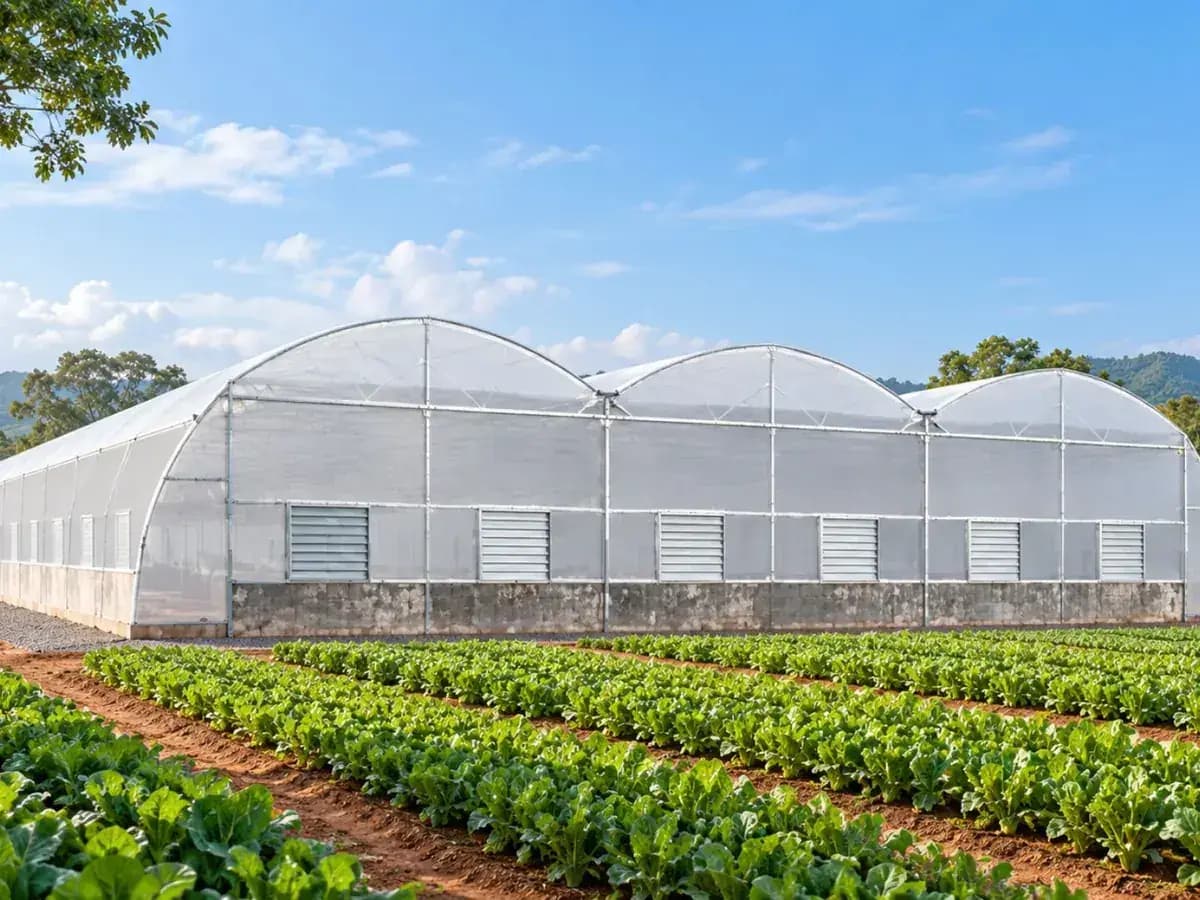
Choose MIDH or NHB before finalising the project size
The choice is not simply about subsidy percentage: both schemes use assistance of 50% at the applicable cost norms, but their project route and funding process differ. MIDH/NHM can suit an individual farmer, group or FPO planning an area up to 4,000 m² per beneficiary. Apply through the Bhopal district horticulture office and confirm the current state process and norms before applying.
NHB is intended for commercial projects above 2,500 m². It is available to farmers, companies, FPOs and entrepreneurs, but it is credit-linked and back-ended: a term loan is needed, and the subsidy is credited to that loan account after project completion and inspection. The NHB guideline ceiling is ₹56 lakh per project, subject to current guidelines.
For a one-acre protected-cultivation plan of 3,952 m², the area falls below the 4,000 m² MIDH limit and above the 2,500 m² NHB commercial-project threshold. Do not assume that this overlap means either route will be sanctioned automatically. Take the proposed area, crop plan and ownership or lease papers to the district horticulture office, and discuss the bank route if pursuing NHB.
- MIDH/NHM: up to 4,000 m² per beneficiary; apply at the Bhopal district horticulture office.
- NHB: above 2,500 m²; apply online for IPA and arrange a term loan through a bank.
- NHB assistance is back-ended, so it is not a payment to rely on before construction is completed.
- Norms and limits can change; obtain confirmation from the state horticulture department before committing funds.
| MIDH / NHM (state mission) | NHB commercial project | |
|---|---|---|
| Who it is for | Individual farmers, groups, FPOs | Commercial projects: farmers, companies, FPOs, entrepreneurs |
| Project size | Up to 4,000 m² per beneficiary | Above 2,500 m² (1,000 m² in the North-East) |
| Assistance | 50% of cost, up to the cost norm | 50% of project cost at admissible norms, credit-linked and back-ended |
| Ceiling | Area limit per beneficiary | ₹56 lakh per project in the NHB scheme guidelines; check the current limit |
| Bank loan | Not always needed | Needed: subsidy is credited to the term loan |
| Apply at | the Bhopal district horticulture office | NHB online portal (In-Principle Approval) and your bank |
A structure that can handle Bhopal’s heat and monsoon
Bhopal’s design brief has two distinct seasons. May averages a 42.3°C afternoon high with strong sunshine of 7.2 kWh/m²/day. From July to September, humidity averages 81% to 88%, with 418 mm rain in July and 381 mm in August. A structure must therefore give crop protection from monsoon rain while allowing adequate ventilation through the humid months.
For most vegetable projects, a naturally ventilated polyhouse is the usual first choice here. Its film roof keeps rain off the crop, while roof vents and roll-up curtains move air without power. It is a practical starting structure for protected cucumber or coloured capsicum, subject to the approved design and crop plan.
A fan-and-pad polyhouse is a useful option where tighter summer cooling is central to the crop plan. In May, it can reduce a 42°C afternoon to about 30°C inside, which can suit leafy greens. A square or curved nethouse can also provide shade and insect protection; however, crop and rain exposure should be assessed carefully rather than treating a nethouse as a substitute for a rain-protected polyhouse.
- Naturally ventilated polyhouse: best fit for a rain-protected vegetable unit.
- Fan & pad polyhouse: good fit where controlled cooling is needed in May.
- Square or curved nethouse: good fit for shade and insect-net use, with the crop plan matched to its protection level.
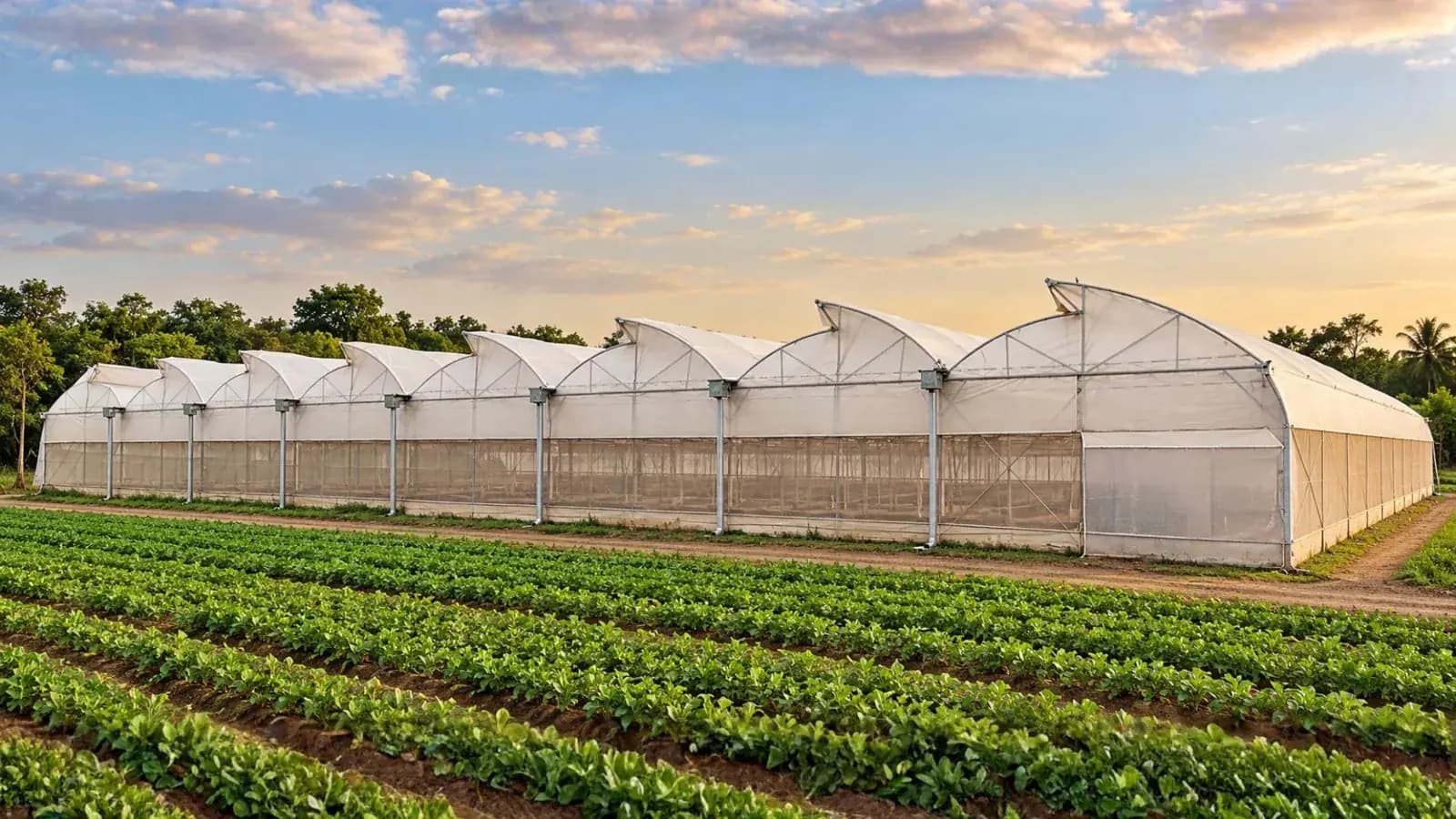
Naturally ventilated polyhouse
Best fitFilm roof keeps monsoon rain off the crop; roof vents and roll-up curtains move air without power. The usual first choice in Bhopal.
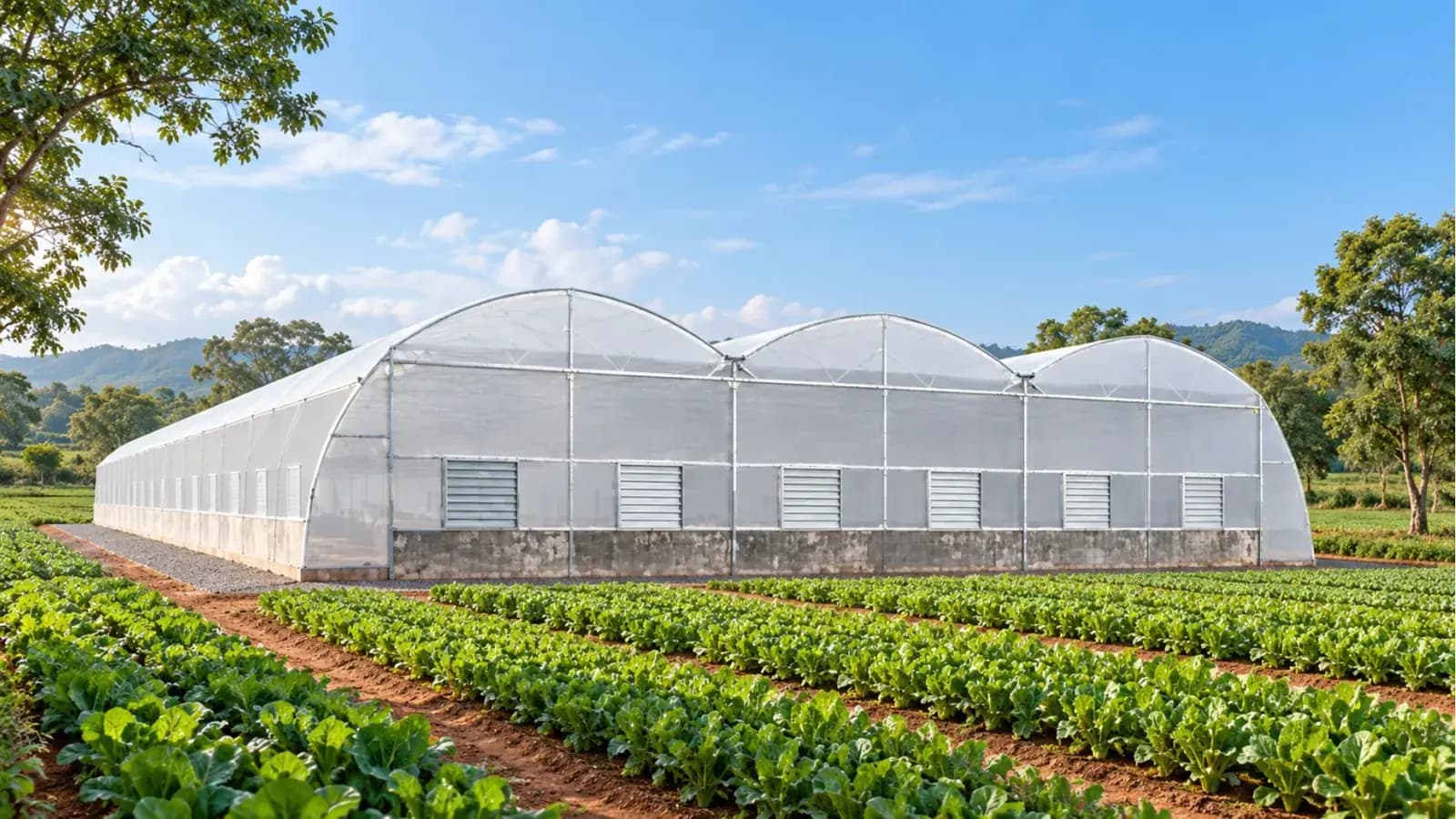
Fan & pad polyhouse
Good fitExhaust fans pull air through wet pads. In May that can take a 42°C afternoon down to about 30°C inside, cool enough for leafy greens.
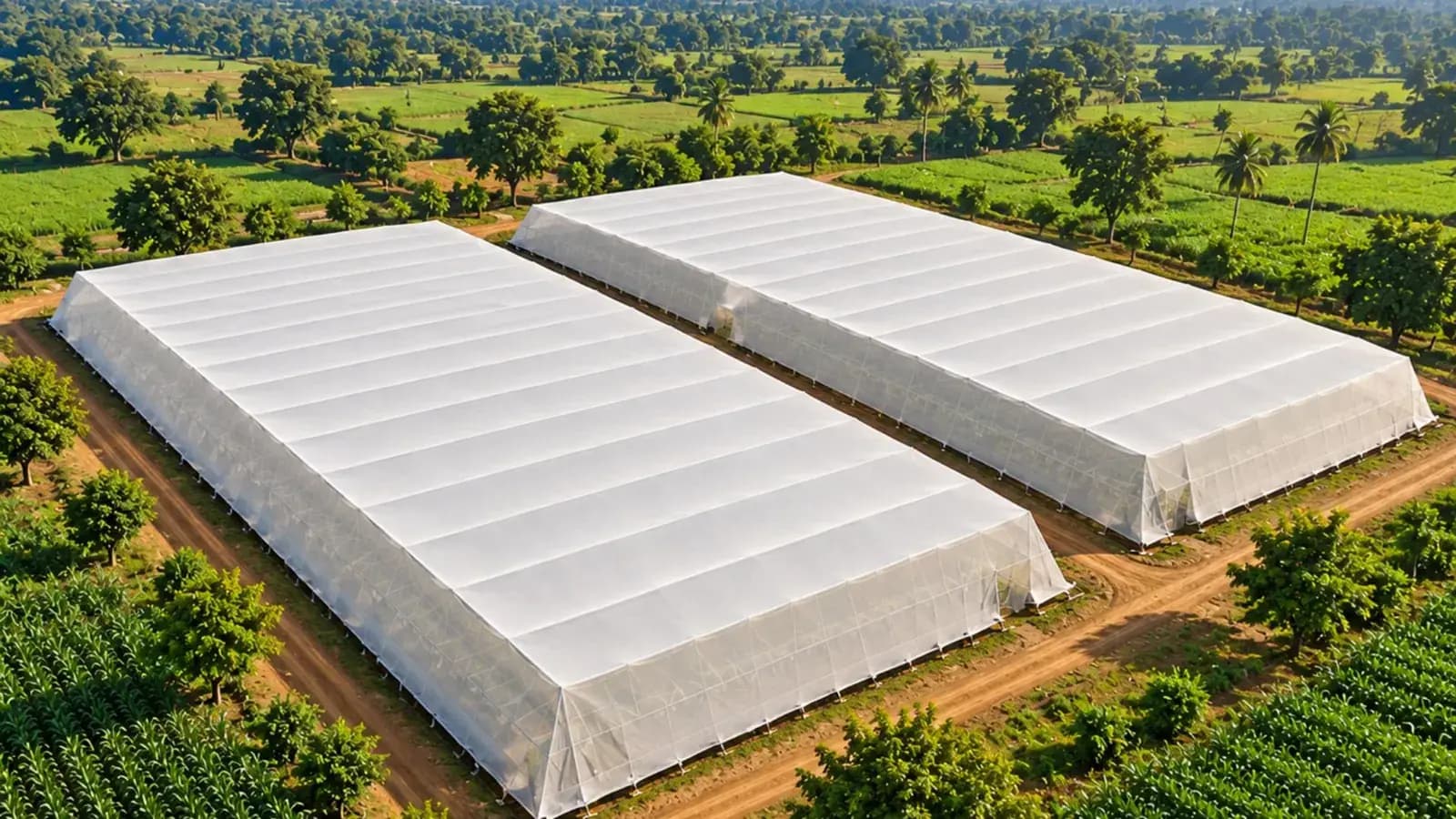
Square nethouse
Good fitFlat-roof 4 × 4 m grid with shade and insect net, the NHB nursery design. Low rain here keeps it useful most of the year.
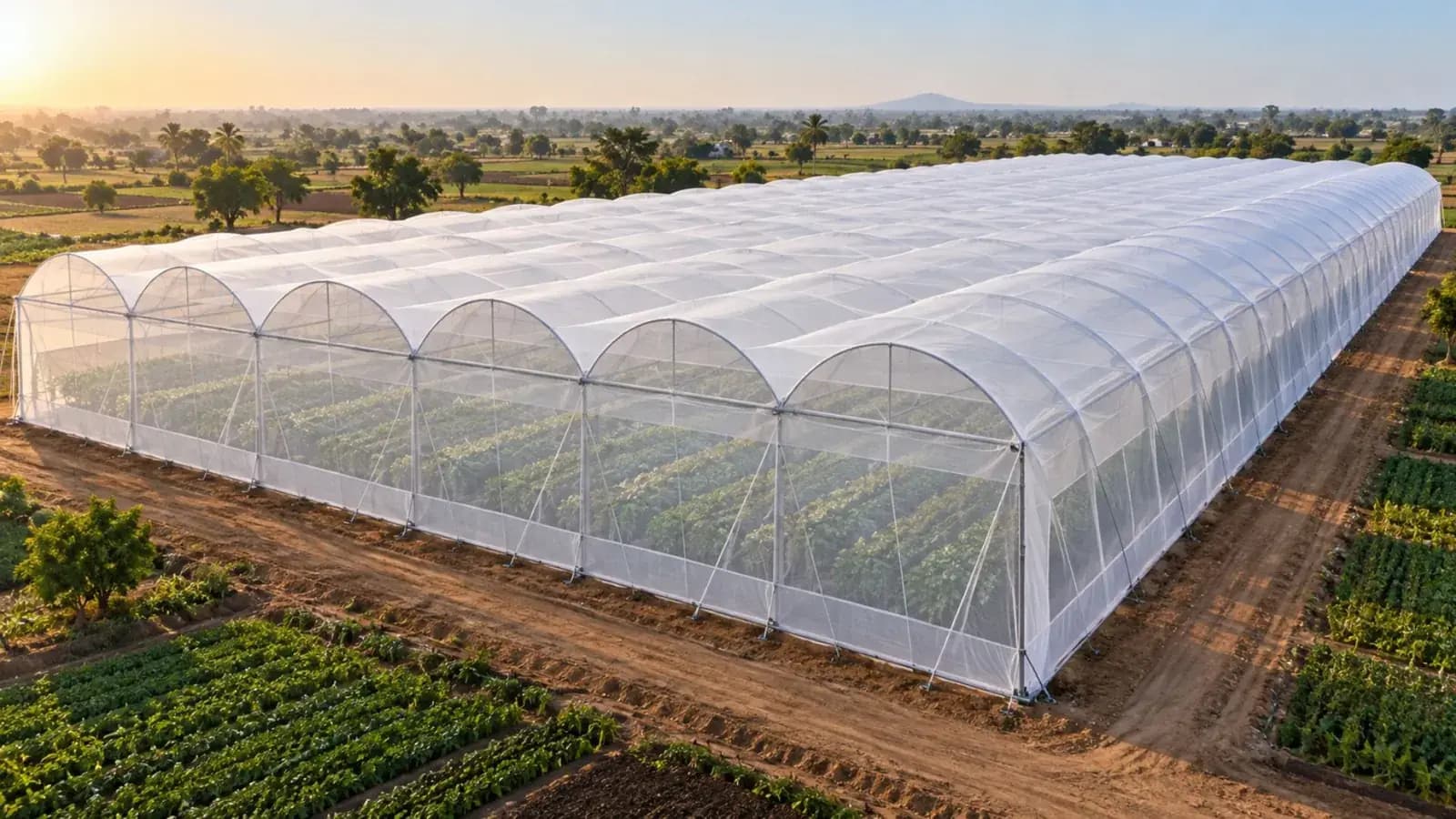
Curved nethouse
Good fitArched GI frame covered in shade net: taller crops, more air and a lower cost than a polyhouse. Shading pays off when sunlight peaks in May.
What the one-acre fan-and-pad example means
The worked example below is for 3,952 m², about one acre, using a fan-and-pad polyhouse. At the structure cost norm of ₹1,400 per m², the eligible structure cost is ₹55,32,800. For high-value vegetables, the planting-material norm in this example is ₹140 per m², or ₹5,53,280.
That makes the eligible project cost ₹60,86,080 and the maximum subsidy at 50% of the norm ₹30,43,040 (₹30.43 lakh). This is an indicative calculation, not a sanction letter: the approved project, current norms and inspection determine the final sanctioned amount.
The table also lists our material price this week, including GST, as ₹32,48,775 (₹822/m²). It is an ex-factory material figure without freight or erection, and it should not be confused with either the eligible project cost or subsidy amount. Prices follow weekly GI and plastic rates and are updated every Friday.
- Example structure: fan and pad polyhouse.
- Example area: 3,952 m².
- Maximum example subsidy: ₹30,43,040 at 50% of the applicable norm.
- Confirm the norm and project approval before treating this calculation as a budget.
| Item | Amount |
|---|---|
| Structure | Fan and pad polyhouse |
| Area | 3,952 m² (about one acre) |
| Structure cost norm | ₹1,400 per m² |
| Eligible structure cost | ₹55,32,800 |
| Planting material norm (high-value vegetables) | ₹140 per m² → ₹5,53,280 |
| Eligible project cost | ₹60,86,080 |
| Maximum subsidy at 50% of the norm | ₹30,43,040 (₹30.43 lakh) |
| Our material price this week (incl. GST) | ₹32,48,775 (₹822/m²) |
Crop groups, planting-material norms and Bhopal mandi timing
For NHB project planning, high-value vegetables have a planting-material norm of ₹140 per m². This group suits Bhopal for coloured capsicum, parthenocarpic cucumber, lettuce and leafy greens. The flower norms shown in the planting-material table are ₹610 per m² for carnation and gerbera, and ₹426 per m² for rose and lilium; gerbera and rose are identified as suitable choices for Bhopal. Orchid and anthurium, at ₹700 per m², are less suited.
Build the crop calendar around market reality, not just the protected structure. In Bhopal district’s markets, capsicum had an average modal price of ₹2,326 per quintal, with the highest month in July at ₹3,200 and the lowest in April at ₹1,600. Cucumber averaged ₹1,054 per quintal, peaking in September at ₹1,188 and reaching its low in July at ₹888.
There are useful additional signals for a diversified plan. Tomato’s highest recorded month was August at ₹2,181 per quintal, while green chilli peaked in July at ₹3,365. Coriander leaves peaked in October at ₹4,306. These are historic modal-price observations from Bhopal district markets, not future price promises; use them to discuss planting and harvest windows with your crop adviser.
- High-value vegetable planting-material norm: ₹140 per m².
- Capsicum: highest observed month July; cucumber: highest observed month September.
- Coriander leaves: highest observed month October.
- Use the Bhopal(F&V) APMC, Bhopal(F&V), Bhopal APMC and Bhopal market data as a local selling reference.
| Crop | Markets | Average modal price | Highest month | Lowest month |
|---|---|---|---|---|
| Tomato | 2 | ₹1,559/q | Aug (₹2,181) | Apr (₹933) |
| Cucumber | 2 | ₹1,054/q | Sep (₹1,188) | Jul (₹888) |
| Green chilli | 2 | ₹2,264/q | Jul (₹3,365) | Jun (₹1,636) |
| Cauliflower | 2 | ₹1,572/q | Sep (₹1,924) | Apr (₹1,000) |
| Coriander (leaves) | 4 | ₹2,103/q | Oct (₹4,306) | May (₹1,262) |
| Brinjal | 2 | ₹956/q | Nov (₹1,167) | Jun (₹836) |
| Cabbage | 2 | ₹889/q | Aug (₹1,035) | Nov (₹713) |
| Capsicum | 2 | ₹2,326/q | Jul (₹3,200) | Apr (₹1,600) |
| Okra (bhindi) | 2 | ₹1,924/q | Oct (₹2,130) | Aug (₹1,712) |
| Bottle gourd | 2 | ₹2,074/q | Oct (₹2,458) | May (₹1,622) |
Prepare the file for the Bhopal district office and bank
For MIDH/NHM, begin at the Bhopal district horticulture office with land and project information, before any installation begins. For NHB, prepare the online IPA application and take a detailed project report to the bank for a term-loan proposal. The DPR should set out project costs, crop plan and cash flow.
Keep land records in the applicant’s name—Khasra and B-1 in Madhya Pradesh—or a registered lease, along with a site map. Aadhaar, PAN and bank details are needed. Companies and FPOs should add their registration papers. Soil and water test reports, an itemised supplier quotation with HSN codes and specifications, and, for NHB, the DPR and bank sanction letter belong in the project file.
After purchase and construction, preserve every invoice and material test certificate. Inspectors check the installed structure against the approved design. Polyhouse Constructions can provide an itemised quotation, technical data sheets and lab test certificates with dispatch; these are useful supporting records, but they do not replace scheme approval.
- Land papers or registered lease with site map.
- Aadhaar, PAN and bank details; entity registration documents where applicable.
- Soil and water test report.
- Itemised quotation with HSN codes and specifications.
- DPR and bank sanction letter for an NHB application.
- Invoices and test certificates after purchase.
- Land records in your name (in Madhya Pradesh: Khasra and B-1), or a registered lease, with a site map
- Aadhaar, PAN and bank details; for companies and FPOs, registration papers
- Soil and water test report
- Supplier quotation with HSN codes and specifications
- Detailed project report and bank sanction letter (NHB)
- Test certificates and invoices for the material, after purchase
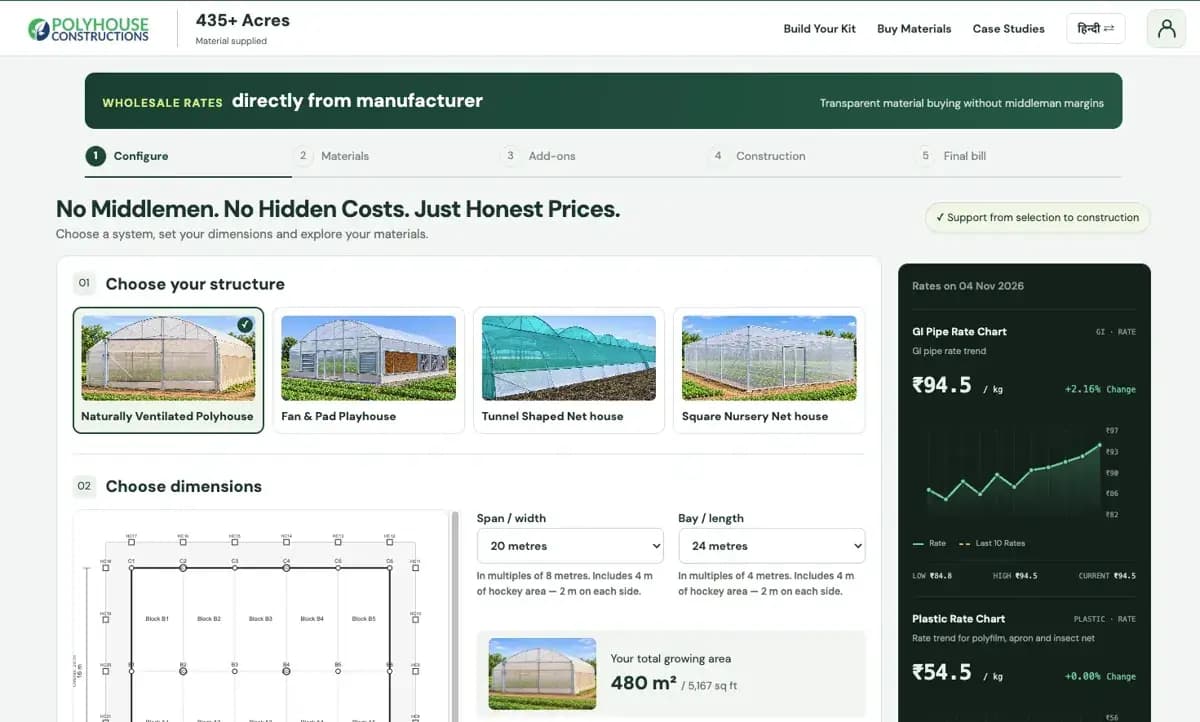
Itemised quotation
Every item with size, quantity, HSN code and GST, ready to attach to the application.

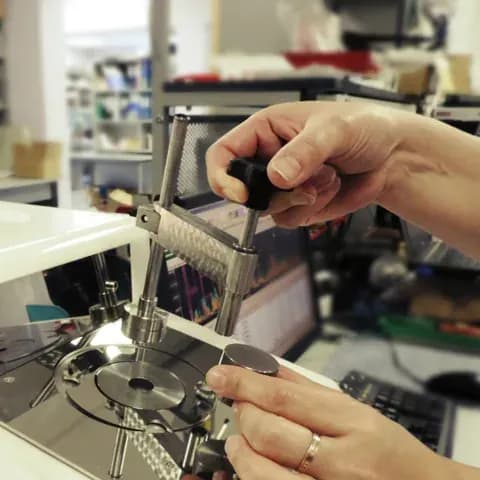
Lab test certificates
Tensile, chemical, salt spray and other tests on the steel, by third-party labs.
ISI-marked GI
GI pipes from Tata, Jindal or JSW steel, with a 15-year warranty.
Apply first; do not build first
This sequence is critical for subsidy eligibility. First select the structure and area, obtain an itemised quotation and prepare the project report. Next, submit the scheme application before starting site work or structure erection. For an NHB project, IPA is required before work starts; NHB has required IPA before work starts since 2017.
After NHB IPA and bank processing, build to the approved design using BIS-standard material and retain the certificates and invoices. Following completion, a joint inspection is carried out. NHB subsidy is released to the bank loan account after the project is complete; MIDH release follows the state process.
Polyhouse Constructions manufactures complete material kits at Degaon on the Pune–Bangalore Highway, Tal. Wai, Satara, Maharashtra. Material includes the GI structure, polyfilm, nets and fittings. Construction or erection is done by Kryzen Biotech’s construction team, not by a Bhopal office.
- Do not start construction before the relevant application and approval stage.
- For NHB: IPA, term loan, construction, inspection, then back-ended subsidy to the loan account.
- Retain the approved design, quotation, invoices and certificates together.
- 1
Pick the structure and size
Match it to Bhopal's climate (see above) and your market. Keep under 4,000 m² for MIDH, or above 2,500 m² for an NHB project.
- 2
Get a quotation and project report
An itemised supplier quotation with HSN codes, and for NHB a detailed project report (DPR) with costs, crop plan and cash flow.
- 3
Apply before you build
MIDH: apply at the Bhopal district horticulture office. NHB: file for In-Principle Approval on the NHB portal; NHB has required IPA before work starts since 2017.
- 4
Bank loan (NHB)
Get the term loan sanctioned. The subsidy is back-ended: it is paid into the loan account after the project is complete.
- 5
Build to standard
Build with BIS-standard material and keep every test certificate and invoice: inspectors check the structure against the approved design.
- 6
Inspection and release
After a joint inspection, the subsidy is released to your bank (NHB) or to you (MIDH, as per the state process).
Avoid the errors that delay a subsidy claim
The most serious mistake is beginning foundations, erection or purchase-led construction activity before NHB IPA. Another is selecting a size without checking the scheme route: a project at or below 4,000 m² may be considered through MIDH, while NHB commercial projects are above 2,500 m². The district horticulture office should confirm which current route applies to your application.
Do not budget only on a supplier’s material quote. In the worked example, the material price, eligible project cost and subsidy are separate figures. Freight and erection are not included in the stated ex-factory material price. Also, do not treat a high-price month in mandi records as an assured selling price.
Finally, avoid deviations from the approved structure or missing papers at inspection. Use an itemised specification rather than an informal verbal scope. Our GI structure uses ISI-marked pipes from Tata, Jindal and JSW; we provide a 15-year manufacturing warranty on the GI structure, while polyfilm has a 2.5-year warranty and nets have a 3-year warranty.
- Starting work before NHB IPA.
- Confusing material cost with eligible cost or subsidy.
- Using an unapproved area or structure specification.
- Missing HSN-coded quotation, invoices, test certificates or bank papers.
- Planning sales on a single historic mandi-price peak.
| What you get | Polyhouse Construction | Typical local fabricator |
|---|---|---|
| Experience | 30 years of collective experience in greenhouse engineering | Often a small crew learning on the job |
| Technical know-how | Strong technical understanding: structure planned for your climate and crop | Usually repeats one standard design |
| Warranty | 15-year manufacturing warranty | Rarely a written warranty |
| Engineering | In-house engineering team | No design or load checks |
| Manufacturing | In-house manufacturing, cut and drilled to drawing | Buys pipes from traders, cuts on site |
| Quality checks | 32-point QA checklist for every part | Visual check at best |
| Lab certificate | Lab test certificate with every dispatch | Not provided |
| Technical sheet | Technical data sheet for every product | Not available |
| Material match | Zero material mismatch: every part counted per design | Short or excess material is common |
| Raw material | Branded steel from Tata, Jindal and JSW | Unbranded or mixed sources |
| Price | Lowest cost across India, with real-time price benefits from weekly rates | Fixed quote; rate drops are not passed on |
| Backing | Backed by industry leader Kryzen Biotech | Single-owner workshop |
Material planning after the scheme route is clear
Once the project route and approved design are settled, a complete kit can be planned online with every item, quantity and the current week’s rate visible. The kit may include GI structure, 250-micron white diffused UV-stabilised polyfilm, shade nets, side insect net and fittings. Polyhouse Constructions carries out in-house engineering and manufacturing, with a 32-point QA process and lab test certificates with dispatch.
For a Bhopal project, send the final approved area and structure type to the construction team before dispatch planning. Material is supplied from the Satara factory; the stated delivery time is 4 days after dispatch. Booking is with 5% advance and 95% before dispatch.
- Complete kits are available for naturally ventilated and fan-and-pad polyhouses, plus square and curved nethouses.
- Weekly rates are updated every Friday.
- A 5% bulk discount applies on 10+ units of an item.
Buy from India's biggest CEA manufacturing company
Choose your structure and size and get the complete material list, priced this week.
FAQs
Can I use MIDH instead of NHB for a one-acre polyhouse in Bhopal?
One acre in the worked example is 3,952 m², which is within the MIDH limit of up to 4,000 m² per beneficiary. It is also above the NHB commercial-project threshold of 2,500 m², so confirm the applicable route and current norms with the Bhopal district horticulture office before applying.
Is NHB subsidy paid before I construct the polyhouse?
No. NHB assistance is credit-linked and back-ended, with a term loan required. After completion and inspection, the subsidy is credited to the loan account.
Do I need NHB IPA before placing the order or starting erection?
NHB requires In-Principle Approval before work starts. Apply through the NHB portal and do not begin construction activity before the required approval stage.
Which protected structure is most practical for Bhopal vegetables?
A naturally ventilated polyhouse is the usual first choice because it keeps monsoon rain off the crop and uses roof vents and roll-up curtains for airflow. A fan-and-pad polyhouse is also a good fit when May cooling is important, as it can bring a 42°C afternoon down to about 30°C inside.
What subsidy figure should I use for a 3,952 m² fan-and-pad project?
The indicative worked example has an eligible project cost of ₹60,86,080 and a maximum subsidy of ₹30,43,040 at 50% of the norm. It is only an illustration; the sanctioned amount depends on the approved project, current norms and inspection.
Subsidy projects near Bhopal
The same guide for nearby towns, with the structure that suits each.
| Town | From Bhopal | District | Cost norms | Suits |
|---|---|---|---|---|
| Subsidy project in Mandideep | ~30 km | Raisen | General | NVPH or fan & pad |
| Subsidy project in Sehore | ~40 km | Sehore | General | NVPH or fan & pad |
| Subsidy project in Sihora | ~40 km | — | General | NVPH or fan & pad |
| Subsidy project in Raisen | ~50 km | Raisen | General | NVPH or fan & pad |
| Subsidy project in Vidisha | ~70 km | Vidisha | General | NVPH or fan & pad |
| Subsidy project in Narsinghgarh | ~80 km | Rajgarh | General | NVPH or fan & pad |