
NVPH materials · Kolkata district, West Bengal
Naturally Ventilated Polyhouse Material for Kolkata
By Editorial Team, Kryzen Biotech · Updated 13 November 2026
A naturally ventilated polyhouse can work in Kolkata, but it must be operated primarily for airflow and rain protection rather than for major temperature reduction. April needs full vent opening and careful shade use; June to November needs strict humidity management, sound gutters and insect exclusion during frequent rain.
- Hottest month
- April, ~38°C
- Humid (75%+)
- 6 months
- NVPH material, 1 acre
- ₹734/m²
- Delivery
- ~7 days
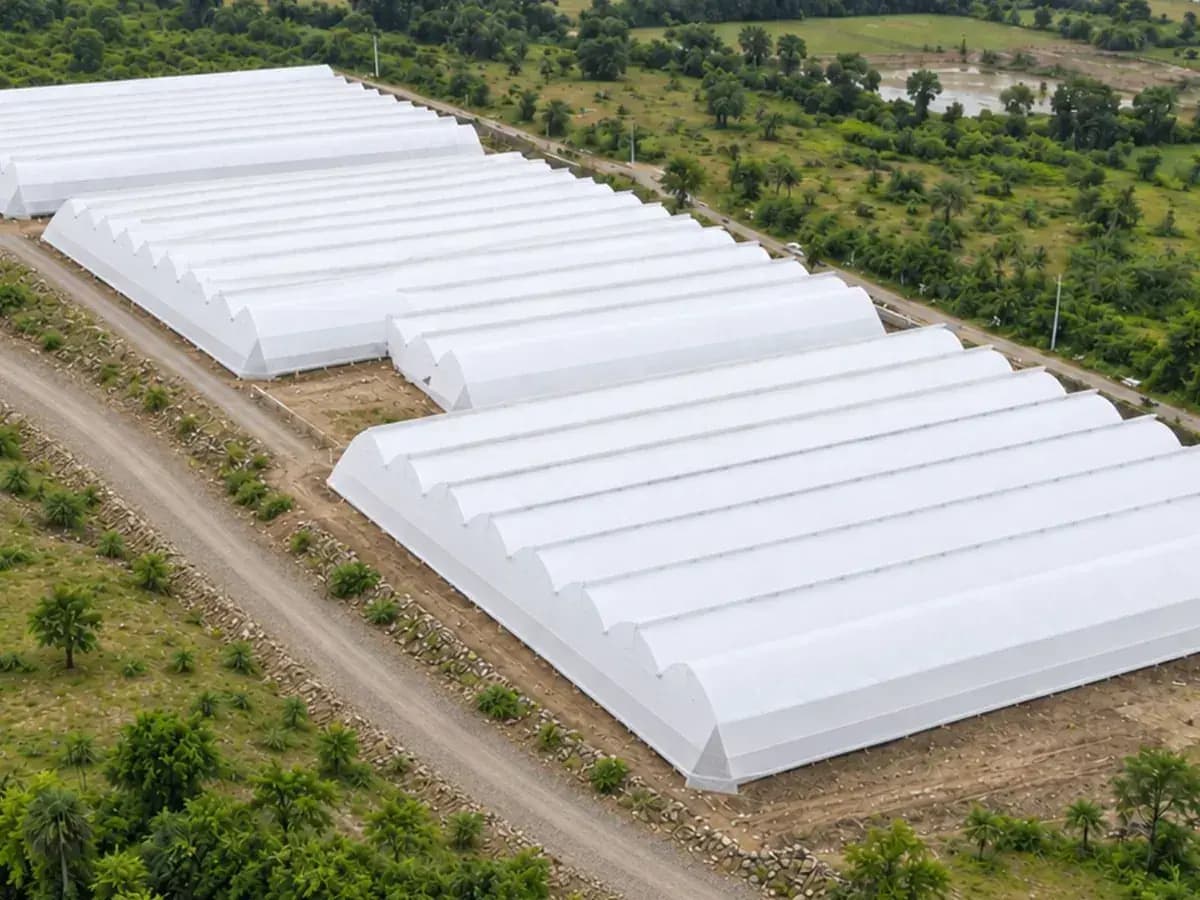
Will natural ventilation cope with Kolkata weather?
Yes, with realistic expectations. A roof vent and roll-up side curtains remove warm air without using power, but an NVPH will not create a cool, dry climate in Kolkata’s monsoon. April is the critical heat month, with an average afternoon high of 38.1°C and the strongest sun at 5.9 kWh/m²/day. Keep both side curtains fully raised in daytime, use the roof vent, irrigate early, and use the 50% white shade net only where the crop is heat-sensitive.
From June through November, humidity is the bigger limitation. It is 80% in June, 87% in July and reaches 89% in August and September. The house should stay as open as rain permits: shut curtains only enough to stop rain blowing onto the crop, then reopen promptly. July is the wettest month at about 333 mm, so water must leave the roof and site quickly.
The mild period is December to February. January nights average 10.2°C, while daytime highs are 24.4°C; December has just 9 mm rain. This is the best window to maximise natural light, maintain airflow and plan main crop cycles. The month-by-month table below is useful for matching planting, curtain operation and crop protection to actual conditions.
- January–February: mild days and cool nights; avoid keeping the house unnecessarily closed.
- March–May: heat rises quickly; April calls for full ventilation and crop-specific shade.
- June–September: heavy rain and very high humidity; prioritise dry foliage and drainage.
- October–November: rain reduces but humidity remains high; continue frequent venting.
| Month | Afternoon high | Night low | Humidity | Rain | Sun (kWh/m²/day) | Wind (m/s) |
|---|---|---|---|---|---|---|
| Jan | 24.4°C | 10.2°C | 65% | 13 mm | 3.8 | 1.7 |
| Feb | 29.6°C | 14.5°C | 57% | 20 mm | 4.7 | 1.7 |
| Mar | 34.9°C | 19.8°C | 55% | 31 mm | 5.4 | 2 |
| Apr | 38.1°C | 24.3°C | 60% | 50 mm | 5.9 | 2.9 |
| May | 36.9°C | 26.2°C | 67% | 144 mm | 5.8 | 3 |
| Jun | 33.1°C | 26.7°C | 80% | 231 mm | 4.6 | 3.1 |
| Jul | 31.2°C | 26.1°C | 87% | 333 mm | 4.2 | 3.1 |
| Aug | 30.7°C | 25.8°C | 89% | 308 mm | 4.2 | 2.5 |
| Sep | 30.2°C | 25.2°C | 89% | 259 mm | 4.4 | 2 |
| Oct | 29.7°C | 22.4°C | 84% | 146 mm | 4.4 | 1.5 |
| Nov | 27.2°C | 16.6°C | 78% | 23 mm | 4.1 | 1.4 |
| Dec | 24.1°C | 11.4°C | 74% | 9 mm | 3.6 | 1.6 |
Curtains, roof vents and shade: a practical yearly routine
Run the side curtains as an active crop-management tool. In April and May, open them fully through the hot part of the day so hot air can escape through the roof vent. During the monsoon, do not leave a curtain down for the whole day after a shower; reopen it whenever rain direction allows. In the humid months, morning airflow is especially important because leaf wetness can persist after the night.
The standard 250-micron white diffused roof film is appropriate here. It spreads the intense April sunlight more evenly, while the white 50% shade net is retained for protection where needed. Do not treat shade as a substitute for ventilation: excess shade in a humid house can keep foliage wet for longer. From November to February, open the structure for maximum available light and use the dry, mild stretch for maintenance and main planting.
- Before July, clear gutters and funnels, inspect film for tears and tighten GI springs.
- In June–November, run circulation fans in the morning and maintain wider plant spacing to help foliage dry.
- In April, irrigate early in the day rather than adding late moisture to the house.
- Use shade selectively for sensitive crops, not automatically for every crop and season.
| Month | Jan | Feb | Mar | Apr | May | Jun | Jul | Aug | Sep | Oct | Nov | Dec | Detail |
|---|---|---|---|---|---|---|---|---|---|---|---|---|---|
| Peak heat | ~38°C highs | ||||||||||||
| Strongest sun | 5.9 kWh/m²/day | ||||||||||||
| Wettest month | ~333 mm | ||||||||||||
| Humid (75%+) | June–November | ||||||||||||
| Nethouse season | November–February |
- 1
Before July
Clear gutters and funnels, check the film for tears and tighten the GI springs. July brings about 333 mm, the heaviest rain of the year.
- 2
June to November
Humidity stays at 75% or more. Keep side curtains open whenever it is not raining and run air circulation fans in the mornings; space plants a little wider to cut fungal disease.
- 3
April
Peak heat, about 38°C. Roll the curtains fully up, add shade only for sensitive crops, and irrigate early in the day.
- 4
November to February
The dry, mild stretch. Open the house for maximum light, plan the main planting and do structural maintenance.
Material choices that suit Kolkata rain and humidity
The core NVPH should retain the 250-micron white diffused, UV-stabilised polyfilm, 50% white shade net, roof vent, side insect net and roll-up curtains. Kolkata receives 1,567 mm rain annually, close to the West Bengal average of 1,531 mm, but July’s rainfall makes gutters and funnels a working part of the design, not an optional detail. Clean them before the monsoon and keep the outlet area clear.
For this climate, add air-circulation fans. They do not replace natural ventilation; they move air around the crop in the six humid months, helping leaves dry. Aluminium doors are preferable to FRP fibre doors in heavy-rain conditions because they do not warp or swell. A double-door entry cabin is also worth including to reduce whitefly and thrips entry when people enter the house.
Use side insect net along with curtains, and keep the lower skirting apron properly fixed. The aim is to admit air through the designed openings while limiting pest entry. If the crop is shade-loving, a second net layer is optional; it is not a standard requirement for Kolkata sunlight.
- Keep: roof film, white 50% shade net, GI gutter sheet and funnels.
- Add: air-circulation fans and aluminium doors.
- Consider: a double-door entry cabin and a second net layer only for shade-loving crops.
| Part | Standard kit | For Kolkata | Why |
|---|---|---|---|
| Roof film | 250-micron white diffused polyfilm | Keep | Spreads April's 5.9 kWh/m²/day of sunlight evenly |
| Shade net | White 50% | Keep white 50% | Sunlight here does not call for a reflective net |
| Second net layer | None | Optional | Only for shade-loving crops |
| Air circulation | Roof vent + curtains | Air Circulation Fan | 6 humid months: moving air keeps leaves dry |
| Doors | FRP (fibre) doors | Aluminium Door | Heavy rain: aluminium does not warp or swell |
| Gutters | GI gutter sheet + funnels | Keep | July brings ~333 mm; clean before June |
| Entry cabin | Optional | Include | A double door keeps whitefly and thrips out when people walk in |
What the Kolkata NVPH kit includes
Polyhouse Constructions supplies complete material kits from its factory at Degaon, on the Pune–Bangalore Highway at Wai, Satara; it does not have an office in Kolkata. Dispatch delivery to Kolkata is listed at 7 days after dispatch. Kryzen Biotech’s construction team carries out erection where construction is required.
A kit includes the GI structure, roof film, nets, fittings and operating hardware. For example, the 20 × 24 m kit has structural members such as side hockey pipes, columns, runners and arcs; 250-micron white diffused polyfilm; side insect net; side skirting apron; 50% white shade net; aluminium profile; GI springs; four manual gear roll-up curtain units; two fibre doors; and F brackets. The largest listed items are shown in the table below; the full kit has 67 items and about 2.5 tonnes of steel and fittings.
The GI structure uses ISI-marked branded steel from Tata, Jindal and JSW. Warranty is 15 years on the GI structure, 2.5 years on polyfilm and 3 years on nets. Every dispatch has a lab test certificate and each product has a technical data sheet.
- Build the exact span and bay online to view every item, quantity, weight and current rate.
- A 5% advance is required for booking; 95% is due before dispatch.
- For 10 or more units of an item, a 5% bulk discount applies.
| Group | Item | Quantity | Weight |
|---|---|---|---|
| GI structure | Side Hockey (60X2.0X5500) | 22 nos | 378 kg |
| GI structure | Small Column (76X2.0X4500) | 18 nos | 305 kg |
| GI structure | Big Bottom (60X2.0X8000) | 8 nos | 200 kg |
| GI structure | Hockey Runner (42X2.0X4000) | 18 nos | 150 kg |
| GI structure | Big Arc (42X2.0X5200) | 12 nos | 130 kg |
| Film & nets | Polyfilm White Diffused 250 Micron (4.5 m) | 158 mtr | — |
| Film & nets | Polyfilm White Diffused 250 Micron (5.5 m) | 73 mtr | — |
| Film & nets | Side Insect Net (5.2 m) | 90 mtr | — |
| Film & nets | Side Skirting Apron (1.5 m) | 90 mtr | — |
| Film & nets | White Shade Net 50% | 80 mtr | — |
| Fittings & accessories | Aluminium Profile | 500 mtr | — |
| Fittings & accessories | GI Spring | 900 mtr | — |
| Fittings & accessories | Manual Gear Roll Up Curtain Unit | 4 nos | — |
| Fittings & accessories | Fibre Door | 2 nos | — |
| Fittings & accessories | F Bracket | 24 nos | — |
Live material price and what it covers
The current material-only, ex-factory price for a small 20 × 24 m NVPH is ₹4,68,814 for 480 m², or ₹977/m². A 28 × 36 m, 1,008 m² kit is ₹8,59,963 at ₹853/m². An approximately one-acre 52 × 76 m kit, covering 3,952 m², is ₹28,99,897 at ₹734/m².
These are this week’s GI and plastic rates and include GST, but freight to Kolkata and erection are extra. The lower per-square-metre material cost at larger sizes comes from sharing gutters, end frames and doors over more area. Rates follow weekly GI and plastic movements and are updated every Friday, so use the kit builder for the exact current material list and rate before booking.
- Small: 20 × 24 m, 480 m² — ₹4,68,814.
- Medium: 28 × 36 m, 1,008 m² — ₹8,59,963.
- About 1 acre: 52 × 76 m, 3,952 m² — ₹28,99,897.
| Size | Span × bay | Area | Material incl. GST | Per m² |
|---|---|---|---|---|
| Small | 20 × 24 m | 480 m² | ₹4,68,814 | ₹977 |
| Medium | 28 × 36 m | 1,008 m² | ₹8,59,963 | ₹853 |
| About 1 acre | 52 × 76 m | 3,952 m² | ₹28,99,897 | ₹734 |
Price your own size for Kolkata
Choose span and bay and get the full list with quantities, weights and rates in a minute.
Crop choices: use Sealdah Koley price seasons, not only averages
For a Kolkata NVPH, cucumber, capsicum and tomato are practical starting crops to evaluate alongside your crop skill and disease-management ability. In the district’s Sealdah Koley Market APMC and Sealdah Koley Market data, cucumber averages ₹4,629/q and reaches ₹5,993 in January. That fits the mild, lower-rain period, although crop timing should be planned for harvest rather than merely sowing in January.
Capsicum averages ₹5,957/q and its recorded high is ₹8,525 in July, but July is also the wettest month and humidity is 87%. Therefore, a July price peak is not by itself a reason to grow a monsoon crop: it demands disciplined airflow, rain management and pest monitoring. Tomato averages ₹3,159/q, with a high of ₹4,507 in December and a low of ₹1,324 in March; its December price season aligns better with Kolkata’s cooler, drier conditions.
For diversification, bitter gourd peaks at ₹5,593 in February, ridge gourd at ₹5,298 in January, and bhindi at ₹8,333 in February. Brinjal and green chilli each show July highs, but monsoon humidity must be factored in before selecting them. These are district market observations in ₹ per quintal, not assured farm-gate returns.
- Cucumber: average ₹4,629/q; high ₹5,993 in January.
- Capsicum: average ₹5,957/q; high ₹8,525 in July.
- Tomato: average ₹3,159/q; high ₹4,507 in December.
- Bitter gourd: high ₹5,593 in February; ridge gourd: high ₹5,298 in January.
| Crop | Markets | Average modal price | Highest month | Lowest month |
|---|---|---|---|---|
| Tomato | 2 | ₹3,159/q | Dec (₹4,507) | Mar (₹1,324) |
| Capsicum | 2 | ₹5,957/q | Jul (₹8,525) | Feb (₹3,077) |
| Cucumber | 2 | ₹4,629/q | Jan (₹5,993) | May (₹3,684) |
| Bitter gourd | 2 | ₹4,304/q | Feb (₹5,593) | Apr (₹3,663) |
| Brinjal | 2 | ₹4,902/q | Jul (₹6,725) | Feb (₹2,256) |
| Cabbage | 2 | ₹2,495/q | Nov (₹3,555) | Feb (₹1,248) |
| Green chilli | 2 | ₹5,253/q | Jul (₹6,667) | Apr (₹3,981) |
| Okra (bhindi) | 2 | ₹4,386/q | Feb (₹8,333) | Jun (₹1,917) |
| Ridge gourd | 2 | ₹4,614/q | Jan (₹5,298) | Jun (₹3,521) |
| Cauliflower | 1 | ₹2,081/q | Jul (₹2,746) | Feb (₹1,422) |
NVPH or fan and pad for a Kolkata project?
Choose a naturally ventilated house when the objective is protected cropping with low cooling running cost and the crop can be managed through vents, curtains, shade and circulation fans. It has no power cost for cooling. In Kolkata, fan-and-pad cooling is rarely worth choosing because humidity is high from June to November; evaporative pad cooling is less useful in humid conditions.
For an approximately one-acre structure, the listed NVPH material price is ₹28,99,897 or ₹734/m², compared with ₹32,48,775 or ₹822/m² for fan and pad. Fan and pad also requires electricity for exhaust fans and a pump. For capsicum, cucumber, tomato and flowers, the naturally ventilated option is the more suitable starting point here, provided the humid-season operating discipline is in place.
- NVPH cooling: roof vent and side curtains, with no power for cooling.
- Fan and pad: exhaust fans and wet pads, with electricity for fans and pump.
- Kolkata decision: invest in airflow, drainage and insect exclusion before considering evaporative cooling.
| Naturally ventilated | Fan & pad | |
|---|---|---|
| Cooling | Roof vent and side curtains (no power) | Exhaust fans and wet pads |
| Running cost | None for cooling | Electricity for fans and a pump |
| Material price, 1 acre | ₹28,99,897 (₹734/m²) | ₹32,48,775 (₹822/m²) |
| Suits in Kolkata | Capsicum, cucumber, tomato, flowers | Rarely worth it at this humidity |
Buy from India's biggest CEA manufacturing company
Choose your structure and size and get the complete material list, priced this week.
FAQs
Can I use an NVPH in Kolkata through the monsoon?
Yes, but it must be managed for humidity and rain. From June to November, keep curtains open whenever rain permits, use circulation fans in the morning, and maintain gutters before July, when rainfall averages about 333 mm.
Does Kolkata need 50% shade net in a naturally ventilated polyhouse?
The standard white 50% shade net is suitable, particularly for heat-sensitive crops in April when average highs reach 38.1°C. Use it selectively; in humid weather, excessive shade can reduce drying of the crop canopy.
What is the current NVPH material price for Kolkata?
The 20 × 24 m, 480 m² material kit is ₹4,68,814 including GST, ex-factory. Freight to Kolkata and erection are extra, and weekly GI and plastic rates can change.
Which crops should I assess first for a Kolkata NVPH?
Cucumber, capsicum and tomato are sensible crops to assess against your market plan and crop-management capability. Kolkata district data shows cucumber’s highest recorded month in January, tomato’s in December, and capsicum’s in July, though monsoon humidity raises production risk for the latter.
Is fan and pad better than natural ventilation in Kolkata?
Usually not for this location because Kolkata is humid from June to November and evaporative pad cooling is less useful in high humidity. An NVPH has lower material cost in the listed one-acre comparison and no cooling power cost, while circulation fans can support humid-season crop management.
NVPH materials near Kolkata
Neighbouring towns on the same delivery route, and how their summers compare.
| Town | From Kolkata | Hottest month | Humid months | Suits |
|---|---|---|---|---|
| NVPH materials in Bally | ~10 km | Apr, 38°C | 6 | NVPH |
| NVPH materials in Baranagar | ~10 km | Apr, 38°C | 6 | NVPH |
| NVPH materials in Howrah | ~10 km | Apr, 38°C | 6 | NVPH |
| NVPH materials in Kamarhati | ~20 km | Apr, 38°C | 6 | NVPH |
| NVPH materials in Madhyamgram | ~20 km | Apr, 38°C | 6 | NVPH |
| NVPH materials in Maheshtala | ~20 km | Apr, 38°C | 6 | NVPH |