
Polyhouse material · Satna district, Madhya Pradesh
Polyhouse Material Supplier in Satna
By Editorial Team, Kryzen Biotech · Updated 12 November 2026
Kryzen supplies complete polyhouse material kits to growers in Satna straight from our factory near Satara: ISI-marked GI pipes, 250-micron diffused polyfilm, insect and shade nets, gutters and every clamp and bolt. Satna is about 1,330 km away by road, so a kit dispatched from the factory usually reaches you in about 5 days.
- Distance from factory
- ~1,330 km by road
- Delivery after dispatch
- ~5 days
- Hottest month
- May, ~43°C
- Climate pick
- NVPH + fan & pad
Four structures, one supplier for Satna
Each kit comes with the full GI structure, covering and fittings. Here is how each one suits Satna's climate.

Naturally ventilated polyhouse
Best fitFilm roof keeps monsoon rain off the crop; roof vents and roll-up curtains move air without power. The usual first choice in Satna.
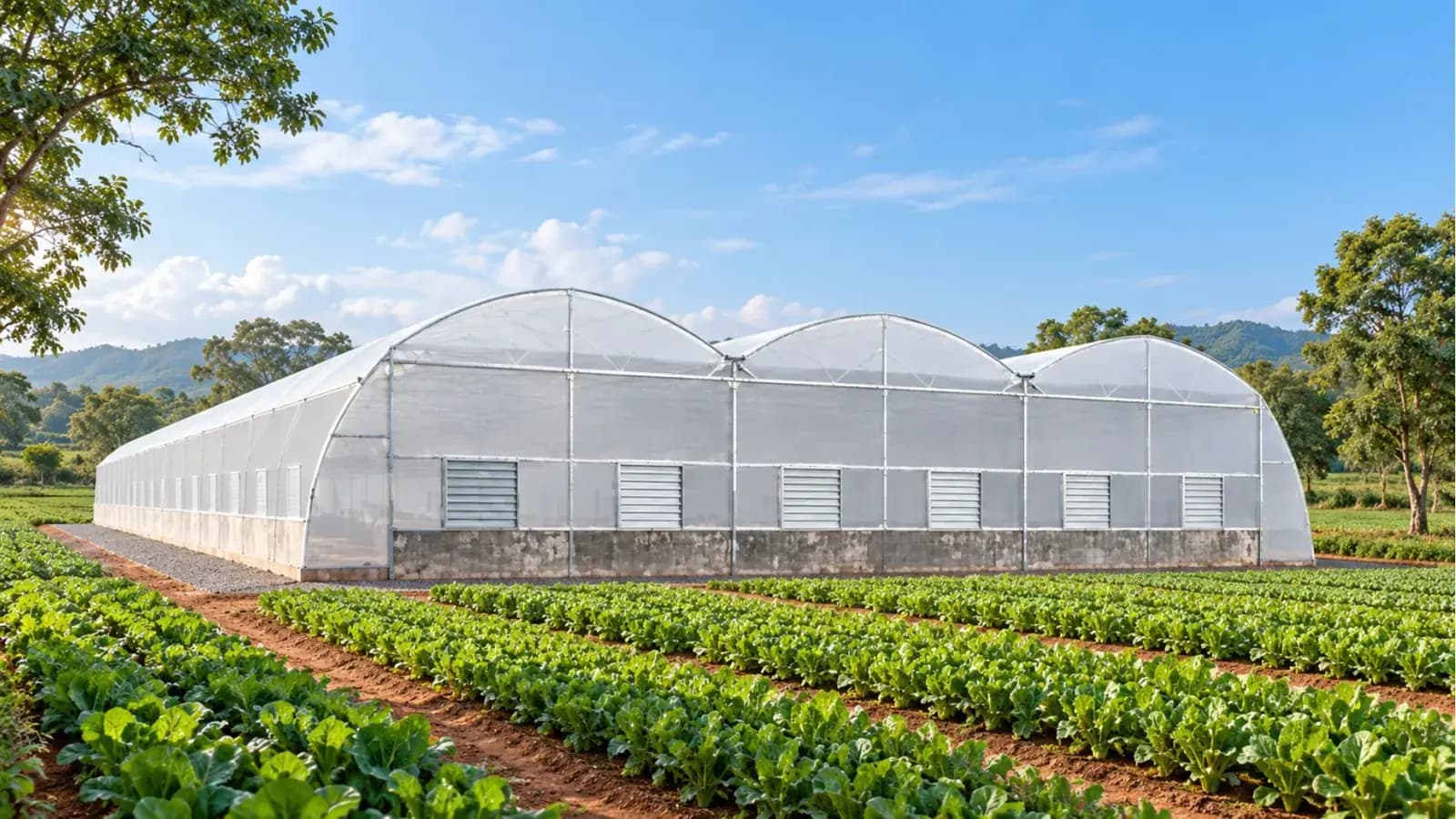
Fan & pad polyhouse
Good fitExhaust fans pull air through wet pads. In May that can take a 43°C afternoon down to about 31°C inside, cool enough for leafy greens.

Square nethouse
Good fitFlat-roof 4 × 4 m grid with shade and insect net, the NHB nursery design. Low rain here keeps it useful most of the year.

Curved nethouse
Good fitArched GI frame covered in shade net: taller crops, more air and a lower cost than a polyhouse. Shading pays off when sunlight peaks in May.
Plants you can grow in Satna
Crops that suit protected cultivation in Satna, with the structure we would grow each one in.

Coloured capsicum
NVPH
Grow under shade net through May, when highs reach 43°C.

Cucumber (parthenocarpic)
NVPH
Fast 3–4 month crop; drip irrigation keeps it going in dry spells.

Lettuce and leafy greens
Fan & pad polyhouse
Pads bring May afternoons down to about 31°C, so greens can grow through summer.

Gerbera and rose
NVPH
Cut flowers with year-round demand from city florists and events.
🌱 Vegetable seedlings
Square nethouse
Raise healthy nursery seedlings for local farmers all year.
Why choose Polyhouse Construction over a local fabricator in Satna
| What you get | Polyhouse Construction | Typical local fabricator |
|---|---|---|
| Experience | ✓30 years of collective experience in greenhouse engineering | Often a small crew learning on the job |
| Technical know-how | ✓Strong technical understanding: structure planned for your climate and crop | Usually repeats one standard design |
| Warranty | ✓15-year manufacturing warranty | Rarely a written warranty |
| Engineering | ✓In-house engineering team | No design or load checks |
| Manufacturing | ✓In-house manufacturing, cut and drilled to drawing | Buys pipes from traders, cuts on site |
| Quality checks | ✓32-point QA checklist for every part | Visual check at best |
| Lab certificate | ✓Lab test certificate with every dispatch | Not provided |
| Technical sheet | ✓Technical data sheet for every product | Not available |
| Material match | ✓Zero material mismatch: every part counted per design | Short or excess material is common |
| Raw material | ✓Branded steel from Tata, Jindal and JSW | Unbranded or mixed sources |
| Price | ✓Lowest cost across India, with real-time price benefits from weekly rates | Fixed quote; rate drops are not passed on |
| Backing | ✓Backed by industry leader Kryzen Biotech | Single-owner workshop |
A year of weather in Satna, month by month
Plan film, shading and planting around these months. keep curtains and vents ready for the humid stretch from July to September.
| Month | Jan | Feb | Mar | Apr | May | Jun | Jul | Aug | Sep | Oct | Nov | Dec | Detail |
|---|---|---|---|---|---|---|---|---|---|---|---|---|---|
| Peak heat | ~43°C highs | ||||||||||||
| Strongest sun | 7 kWh/m²/day | ||||||||||||
| Wettest month | ~331 mm | ||||||||||||
| Humid (75%+) | July–September |
From NASA POWER monthly averages for Satna.
Which materials suit Satna's climate
Summer peaks in May, when Satna averages about 43°C in the afternoon at 23% humidity. Yearly rainfall is around 1,066 mm. This is how we match the material list to that weather.
| Part | What we supply | Why in Satna |
|---|---|---|
| Roof film | 250-micron white diffused polyfilm | Sunlight peaks in May at about 7 kWh per m² a day; diffused film spreads it and cuts leaf scorch. |
| Shading | Aluminium (reflective) shade net | 43°C highs and strong sun: a reflective net sends heat back out instead of holding it inside. |
| Gutters | GI gutter sheet with funnels | About 1,066 mm of rain a year; keep gutters clear before the monsoon. |
| Ventilation | Roll-up side curtains, side insect net | Humid spell from July to September; open the curtains fully in those months. |
Local market prices for polyhouse crops near Satna
Across 12 mandis in Satna district, 8 polyhouse and nethouse crops trade regularly. Green peas has the most arrivals; Green chilli has the widest price swing (321%), peaking in June.
| Crop | Markets | Average | Highest month | Lowest month | Swing |
|---|---|---|---|---|---|
| Green peas | 25 | ₹3,520/q | May · ₹3,677 | Dec · ₹3,337 | 10% |
| Tomato | 4 | ₹1,086/q | Jun · ₹1,640 | Apr · ₹523 | 214% |
| Brinjal | 4 | ₹1,059/q | Nov · ₹1,369 | May · ₹830 | 65% |
| Bottle gourd | 4 | ₹1,102/q | Sep · ₹1,344 | Apr · ₹896 | 50% |
| Cucumber | 4 | ₹1,162/q | Jun · ₹1,400 | Apr · ₹838 | 67% |
| Okra (bhindi) | 4 | ₹1,692/q | Mar · ₹2,625 | Jul · ₹1,027 | 156% |
| Green chilli | 4 | ₹3,429/q | Jun · ₹6,250 | Nov · ₹1,485 | 321% |
| Papaya | 5 | ₹1,393/q | Jul · ₹1,540 | Sep · ₹1,169 | 32% |
A planting calendar built on local prices
Working back from the month each crop sells highest locally, with typical days from transplanting to first harvest under cover. For example, green peas peaks in May; at about 60 days to first harvest, transplant in March.
| Crop | Sells best | Days to first harvest | Transplant / sow in | Avoid harvesting in |
|---|---|---|---|---|
| Green peas | Jan, Feb, Mar, Apr, May, Jun, Jul, Aug, Sep, Oct, Nov, Dec | ~60 | March | Dec |
| Tomato | Jun | ~75 | March | Apr |
| Brinjal | Nov | ~60 | September | May |
| Bottle gourd | Jun, Sep | ~55 | July | Apr |
| Cucumber | Jun, Sep, Oct | ~40 | April | Apr |
| Okra (bhindi) | Feb, Mar | ~45 | January | Jul |
| Green chilli | Jun | ~75 | March | Nov |
Satna's weather, month by month
May is the hottest month, with afternoons around 42.9°C; January nights drop to about 8.2°C. July is the wettest (331 mm of 1,066 mm a year), and humidity stays at 75% or more for 3 months. The mildest growing months, with afternoons of 20–32°C and little rain, are Jan, Feb, Oct, Nov, Dec.
| Month | Afternoon high | Night low | Humidity | Rain | Sun (kWh/m²/day) | Wind (m/s) |
|---|---|---|---|---|---|---|
| Jan | 23.6°C | 8.2°C | 49% | 17 mm | 4.1 | 1.5 |
| Feb | 28.3°C | 11.7°C | 41% | 22 mm | 5.1 | 1.7 |
| Mar | 34.2°C | 17.2°C | 30% | 15 mm | 6.2 | 1.9 |
| Apr | 40.1°C | 23.4°C | 21% | 10 mm | 7 | 2.2 |
| May | 42.9°C | 28°C | 23% | 20 mm | 7 | 2.6 |
| Jun | 39.2°C | 28.2°C | 47% | 134 mm | 5.7 | 3 |
| Jul | 32.2°C | 24.9°C | 79% | 331 mm | 4.5 | 2.7 |
| Aug | 30.4°C | 24.1°C | 86% | 297 mm | 4.4 | 2.3 |
| Sep | 29.9°C | 22.6°C | 84% | 172 mm | 4.9 | 1.9 |
| Oct | 29.6°C | 18.5°C | 71% | 36 mm | 5 | 1.4 |
| Nov | 26.9°C | 13.4°C | 60% | 6 mm | 4.3 | 1.3 |
| Dec | 24°C | 9.2°C | 54% | 6 mm | 3.9 | 1.4 |
Getting the material to Satna
Satna is about 1,330 km by road from our factory at Degaon, Satara, on the Pune–Bangalore highway. Once your order is packed, the truck usually reaches Satna in about 5 days, with the invoice and test reports.
Each vehicle is insured for the full invoice value. Share the farm PIN code and access road details so we send a truck that can reach the site.
Subsidy on polyhouse material in Madhya Pradesh
Under the Mission for Integrated Development of Horticulture (MIDH), farmers in Madhya Pradesh can get 50% of the government cost norm for naturally ventilated polyhouses (₹1,000–1,200 per m²), fan and pad polyhouses (₹1,500–1,800 per m²) and nethouses (₹710 per m²), on up to 2,500 m² per farmer. The subsidy is worked out on the government cost norm for your structure and size, not on your bill.
Commercial projects above 2,500 m² can apply to the National Horticulture Board for a credit-linked subsidy of 50% of the eligible project cost, up to ₹100 lakh per project. Both schemes want materials that meet BIS standards: our GI pipes carry the ISI mark and test reports ship with every order. Apply through the Madhya Pradesh horticulture department or your district horticulture officer before you buy.
Get polyhouse material from India's biggest CEA manufacturing company
Choose your structure and size, and get the complete material list in a minute.
FAQs
Do you deliver polyhouse material to Satna?
Yes. We dispatch from our factory at Degaon, Satara, about 1,330 km from Satna by road, and the truck usually arrives in about 5 days. Every load is insured for the invoice value.
Which polyhouse suits Satna?
A naturally ventilated polyhouse for vine crops, and fan and pad cooling if you grow greens through May: the air is dry enough for pads to bring 43°C down to about 31°C.
Can I buy only a few items, like film or nets?
Yes. Use Buy individual items to order film, nets, fittings or pipes on their own, for repairs or an extension.
Can you also build the polyhouse in Satna?
Yes. Kryzen Biotech's construction team builds polyhouses and nethouses across India, including Madhya Pradesh. See the link to polyhouse construction in Satna below.
What can I grow in a polyhouse in Satna?
coloured capsicum, cucumber (parthenocarpic), lettuce and leafy greens, gerbera and rose, among others. The right crop depends on your market, water and the season you plant.
Is there a subsidy for polyhouse material in Madhya Pradesh?
Yes. NHM / MIDH pays 50% of the cost norm on up to 2,500 m² per farmer, and NHB gives a 50% credit-linked subsidy for projects above 2,500 m². Apply before buying; we provide the quotation, ISI-marked material and test reports the claim needs.
Polyhouse material near Satna
Neighbouring towns we deliver to from the same route, and how their climate compares with Satna.
| Town | From Satna | Hottest month | Rain a year | Suits |
|---|---|---|---|---|
| Polyhouse material in Maihar | ~50 km | May, 43°C | 1,066 mm | NVPH + fan & pad |
| Polyhouse material in Rewa | ~60 km | May, 43°C | 987 mm | NVPH + fan & pad |
| Polyhouse material in Panna | ~90 km | May, 43°C | 1,083 mm | NVPH + fan & pad |
| Polyhouse material in Katni | ~120 km | May, 43°C | 1,151 mm | NVPH + fan & pad |
| Polyhouse material in Mauganj | ~140 km | May, 43°C | 1,000 mm | NVPH + fan & pad |
| Polyhouse material in Sidhi | ~140 km | May, 43°C | 1,000 mm | NVPH + fan & pad |
Want it built as well? Read about polyhouse construction in Satna on the Kryzen blog.