
Subsidy guide · Zunheboto district, Nagaland
NHB Subsidy Eligible Protected Cultivation Project in Zunheboto
By Editorial Team, Kryzen Biotech · Updated 12 November 2026
A subsidy-ready protected cultivation project in Zunheboto needs three things: the right scheme for its size, a structure the scheme recognises, and paperwork that matches. Here is how the National Horticulture Board (NHB) and the Mission for Integrated Development of Horticulture (MIDH) apply in Nagaland, and what a 3,952 m² project would look like.
- NHB route
- Projects above 1,000 m²
- MIDH / NHM route
- Up to 4,000 m² per farmer
- Cost norms here
- Hilly (+15%)
- Structure for this climate
- NVPH / nethouse
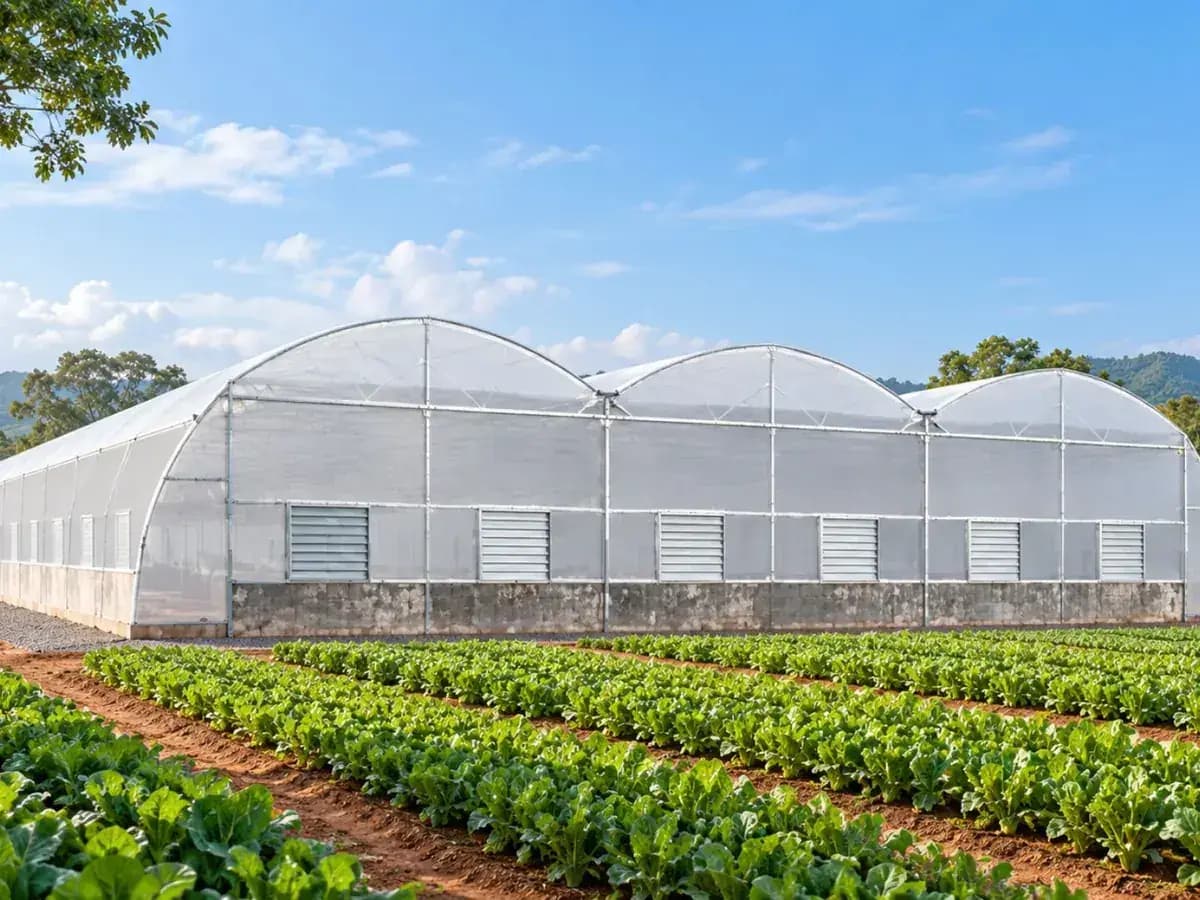
NHB or MIDH: which scheme fits a project in Zunheboto
For a project in Zunheboto the first question is size. Up to 4,000 m², the MIDH route through the Nagaland horticulture department is usually simpler. Above 1,000 m², an NHB project with a bank loan becomes possible.
| MIDH / NHM (state mission) | NHB commercial project | |
|---|---|---|
| Who it is for | Individual farmers, groups, FPOs | Commercial projects: farmers, companies, FPOs, entrepreneurs |
| Project size | Up to 4,000 m² per beneficiary | Above 1,000 m² (the lower North-East limit) |
| Assistance | 50% of cost, up to the cost norm | 50% of project cost at admissible norms, credit-linked and back-ended |
| Ceiling | Area limit per beneficiary | ₹56 lakh per project in the NHB scheme guidelines; check the current limit |
| Bank loan | Not always needed | Needed: subsidy is credited to the term loan |
| Apply at | the Zunheboto district horticulture office | NHB online portal (In-Principle Approval) and your bank |
Worked example: a 3,952 m² project in Zunheboto
Take a naturally ventilated polyhouse of 3,952 m² in Zunheboto, growing high-value vegetables. At that size it can go to NHB as a commercial project, or to MIDH since it is under 4,000 m². The most it can receive at NHB's hilly-area norms:
| Item | Amount |
|---|---|
| Structure | Naturally ventilated polyhouse |
| Area | 3,952 m² (about one acre) |
| Structure cost norm (hilly) | ₹970 per m² |
| Eligible structure cost | ₹38,33,440 |
| Planting material norm (high-value vegetables) | ₹140 per m² → ₹5,53,280 |
| Eligible project cost | ₹43,86,720 |
| Maximum subsidy at 50% of the norm | ₹21,93,360 (₹21.93 lakh) |
| Our material price this week (incl. GST) | ₹28,99,897 (₹734/m²) |
Assistance is usually 50% of your actual eligible cost or of the cost norm, whichever is lower, so put every eligible cost in the project report: material, freight, erection, drip and planting material. Our material alone comes to ₹734 per m² this week against a structure norm of ₹970; freight and erection come on top.
Local market prices for polyhouse crops near Zunheboto
Across 4 mandis in Zunheboto district, 4 polyhouse and nethouse crops trade regularly. Cucumber has the most arrivals; Tomato has the widest price swing (146%), peaking in June.
| Crop | Markets | Average | Highest month | Lowest month | Swing |
|---|---|---|---|---|---|
| Cucumber | 2 | ₹2,182/q | Jun · ₹3,000 | Sep · ₹1,550 | 94% |
| Papaya | 1 | ₹3,696/q | Jan · ₹3,950 | Oct · ₹3,400 | 16% |
| Tomato | 2 | ₹3,089/q | Jun · ₹4,100 | May · ₹1,667 | 146% |
| Green chilli | 3 | ₹3,626/q | Jan · ₹5,200 | May · ₹2,475 | 110% |
A planting calendar built on local prices
Working back from the month each crop sells highest locally, with typical days from transplanting to first harvest under cover. For example, cucumber peaks in June; at about 40 days to first harvest, transplant in April.
| Crop | Sells best | Days to first harvest | Transplant / sow in | Avoid harvesting in |
|---|---|---|---|---|
| Cucumber | Jun, Oct | ~40 | April | Sep |
| Tomato | Jun, Sep, Oct | ~75 | March | May |
| Green chilli | Jan | ~75 | October | May |
Zunheboto's weather, month by month
June is the hottest month, with afternoons around 29.4°C; January nights drop to about 6.6°C. July is the wettest (272 mm of 1,453 mm a year), and humidity stays at 75% or more for 6 months. The mildest growing months, with afternoons of 20–32°C and little rain, are Feb, Mar, Oct, Nov, Dec.
| Month | Afternoon high | Night low | Humidity | Rain | Sun (kWh/m²/day) | Wind (m/s) |
|---|---|---|---|---|---|---|
| Jan | 19.2°C | 6.6°C | 68% | 11 mm | 4 | 0.4 |
| Feb | 21.9°C | 8.5°C | 64% | 22 mm | 4.5 | 0.4 |
| Mar | 25.7°C | 12°C | 61% | 51 mm | 4.9 | 0.4 |
| Apr | 28.1°C | 15.6°C | 66% | 124 mm | 4.9 | 0.3 |
| May | 29.3°C | 18.1°C | 72% | 188 mm | 4.7 | 0.2 |
| Jun | 29.4°C | 20.1°C | 79% | 241 mm | 4.2 | 0.1 |
| Jul | 29°C | 20.5°C | 83% | 272 mm | 3.9 | 0.1 |
| Aug | 29°C | 20.5°C | 83% | 235 mm | 4.2 | 0.1 |
| Sep | 27.9°C | 19.5°C | 83% | 185 mm | 4.2 | 0.1 |
| Oct | 25.8°C | 16.6°C | 81% | 95 mm | 4.2 | 0.2 |
| Nov | 22.8°C | 11.8°C | 76% | 19 mm | 4.2 | 0.4 |
| Dec | 20°C | 8°C | 73% | 10 mm | 3.8 | 0.4 |
Steps to apply
- 1
Pick the structure and size
Match it to Zunheboto's climate (see above) and your market. Keep under 4,000 m² for MIDH, or above 1,000 m² for an NHB project.
- 2
Get a quotation and project report
An itemised supplier quotation with HSN codes, and for NHB a detailed project report (DPR) with costs, crop plan and cash flow.
- 3
Apply before you build
MIDH: apply at the Zunheboto district horticulture office. NHB: file for In-Principle Approval on the NHB portal; NHB has required IPA before work starts since 2017.
- 4
Bank loan (NHB)
Get the term loan sanctioned. The subsidy is back-ended: it is paid into the loan account after the project is complete.
- 5
Build to standard
Build with BIS-standard material and keep every test certificate and invoice: inspectors check the structure against the approved design and hilly-area specification.
- 6
Inspection and release
After a joint inspection, the subsidy is released to your bank (NHB) or to you (MIDH, as per the state process).
Eligible structures and how they suit Zunheboto
All four structures we supply are covered by the schemes. What matters for the project's success is the fit with Zunheboto's weather.
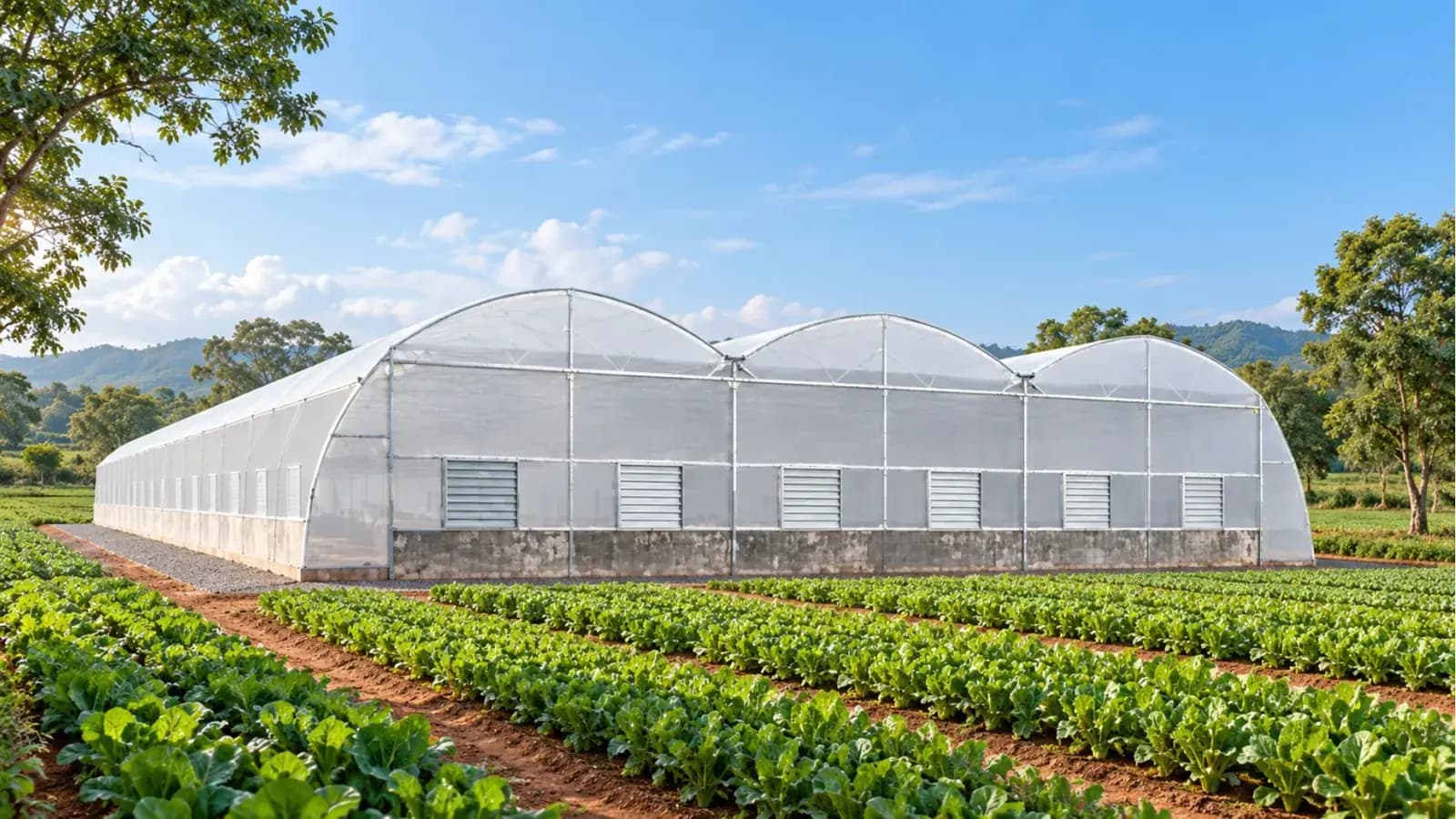
Naturally ventilated polyhouse
Best fitFilm roof keeps June–November rain off the crop; roof vents and roll-up curtains move air without power. The usual first choice in Zunheboto.
Fan & pad polyhouse
LimitedPads cool by evaporation, which works poorly at 79% humidity in June. Consider it only for crops that need tight control.
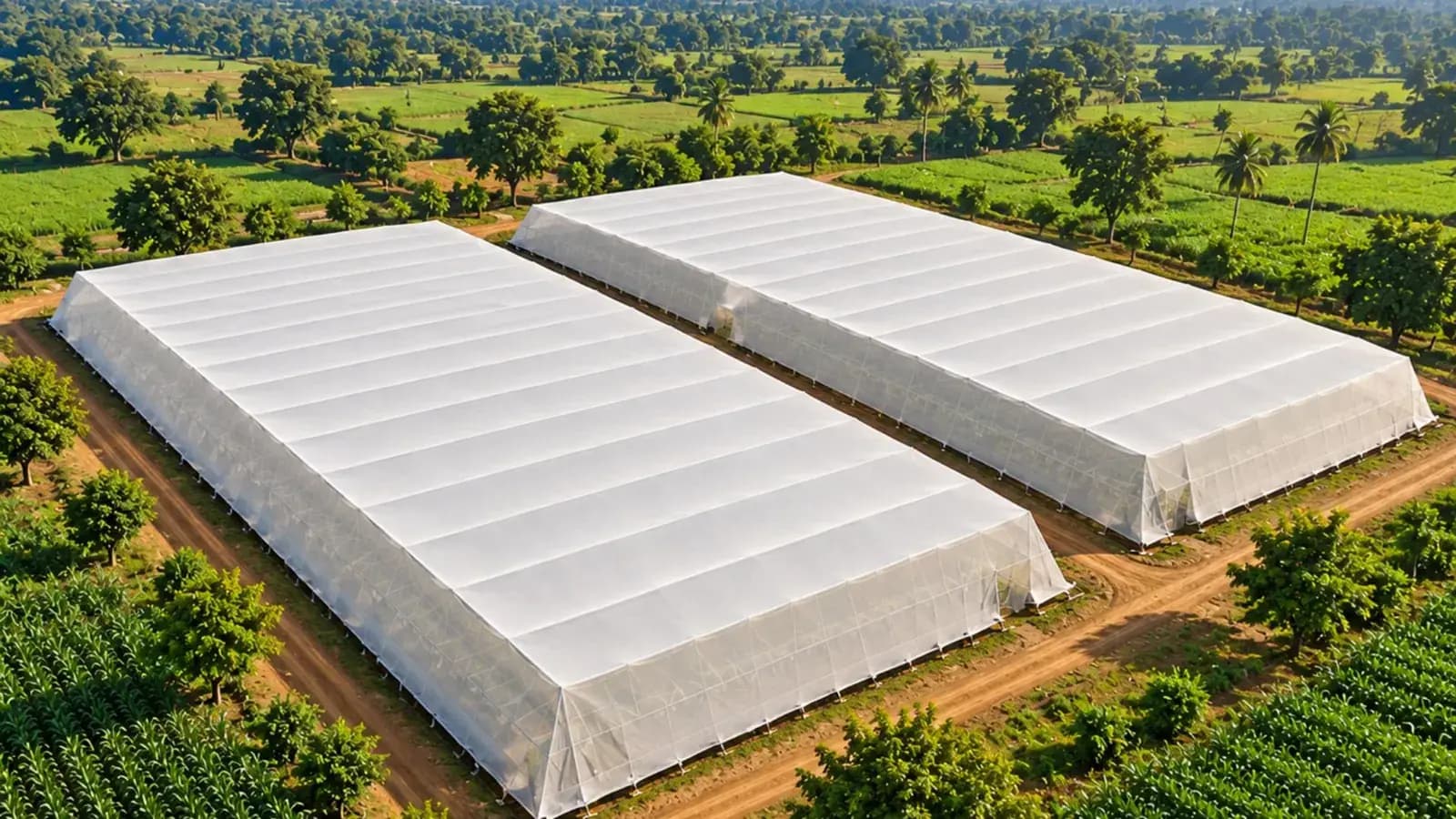
Square nethouse
Good fitFlat-roof 4 × 4 m grid with shade and insect net, the NHB nursery design. Low rain here keeps it useful most of the year.
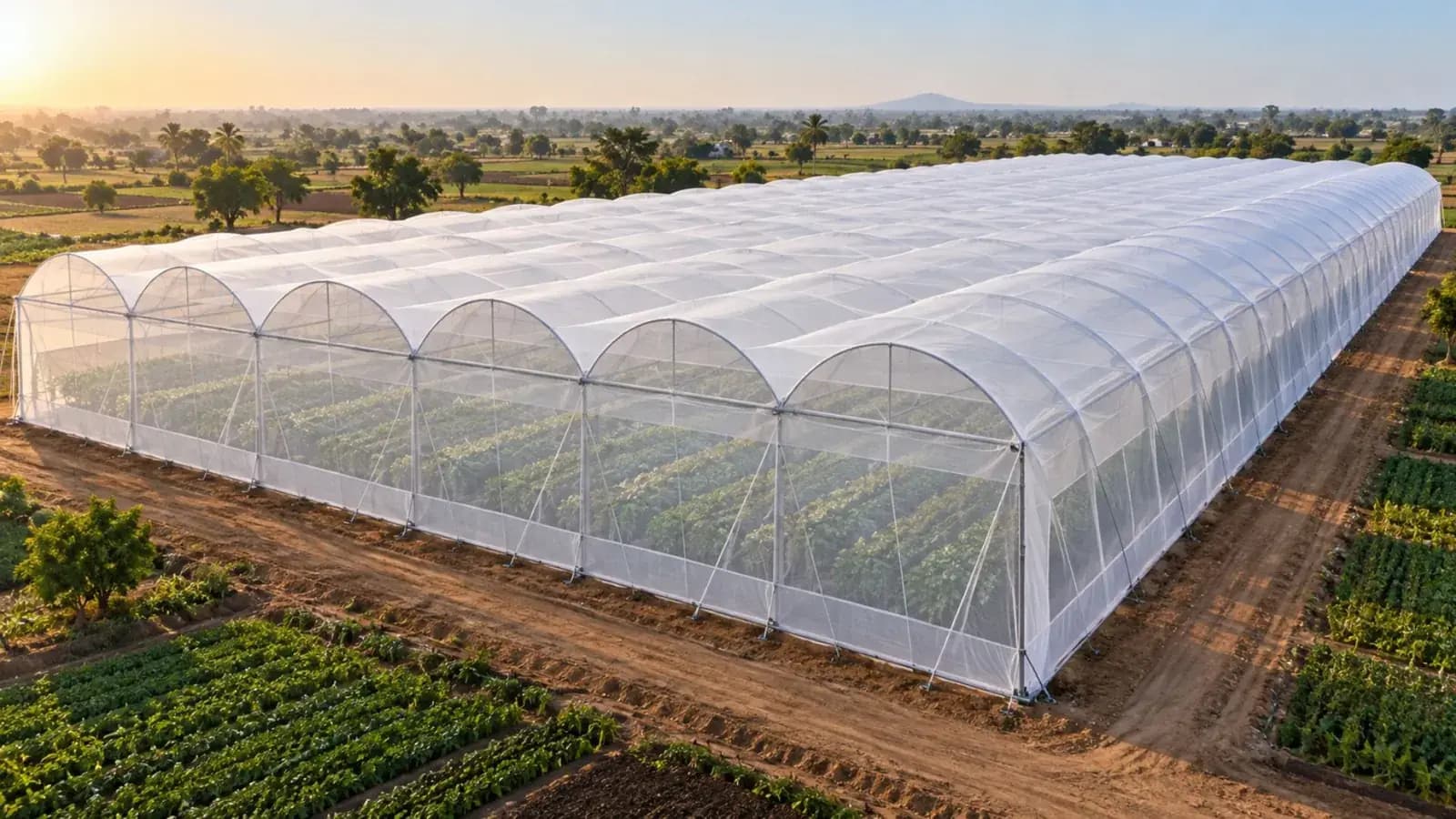
Curved nethouse
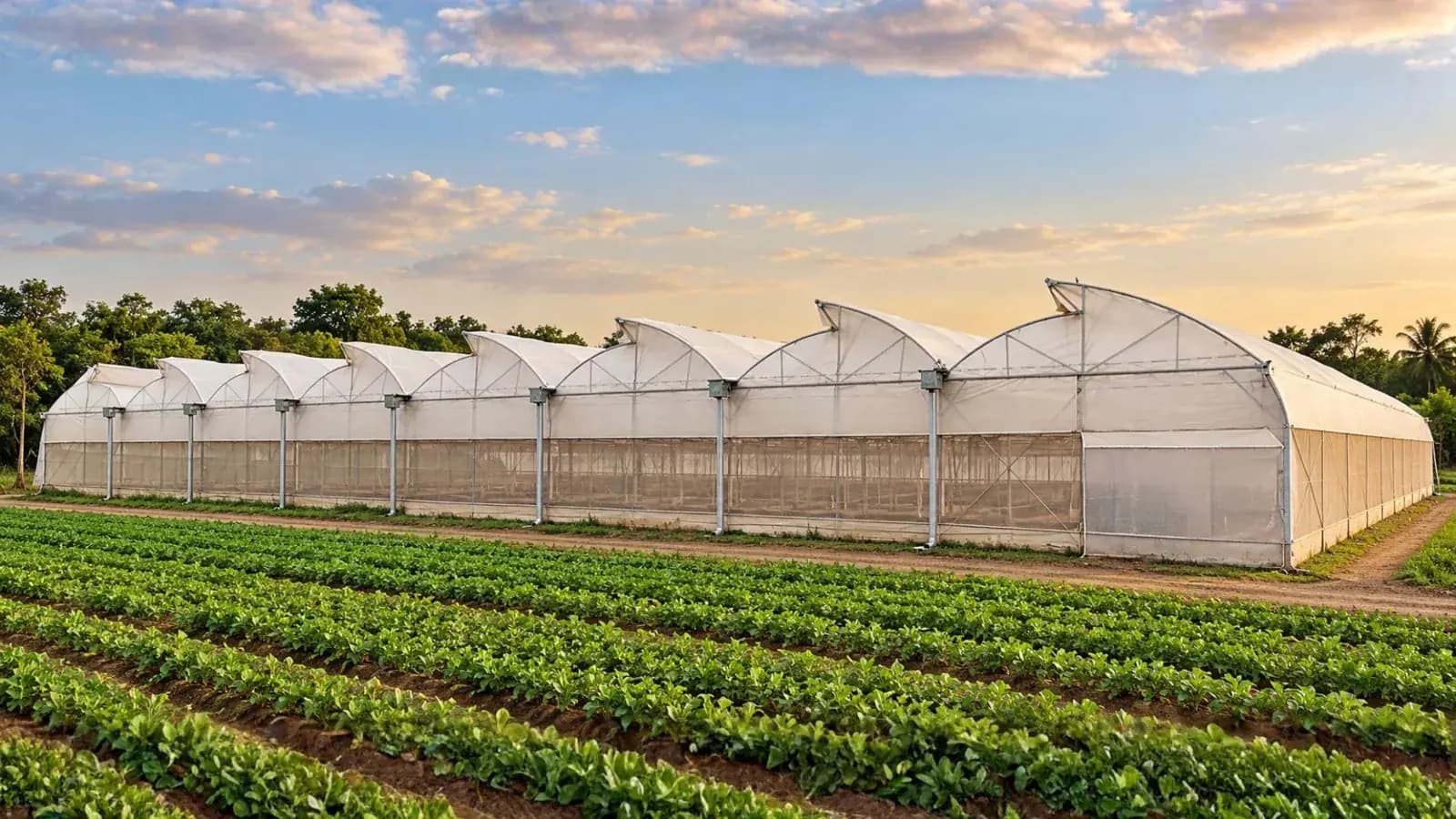
Good fitArched GI frame covered in shade net: taller crops, more air and a lower cost than a polyhouse. Rain passes through, so pick crops that tolerate it.
Planting material norms and crops that suit
NHB also counts planting material and cultivation in the project cost, at these norms. The right column shows which groups suit this climate.
| Crop group | NHB norm | Suits Zunheboto? |
|---|---|---|
| High-value vegetables | ₹140 per m² | Yes: Broccoli and zucchini, Coloured capsicum, Cucumber (parthenocarpic) |
| Orchid and anthurium | ₹700 per m² | Less suited |
| Carnation and gerbera | ₹610 per m² | Yes: Carnation |
| Rose and lilium | ₹426 per m² | Yes: Lilium |
Documents you will usually need
- Land records in your name (in Nagaland: the record of rights), or a registered lease, with a site map
- Aadhaar, PAN and bank details; for companies and FPOs, registration papers
- Soil and water test report
- Supplier quotation with HSN codes and specifications
- Detailed project report and bank sanction letter (NHB)
- Test certificates and invoices for the material, after purchase
What we provide for your file:
Itemised quotation
Every item with size, quantity, HSN code and GST, ready to attach to the application.

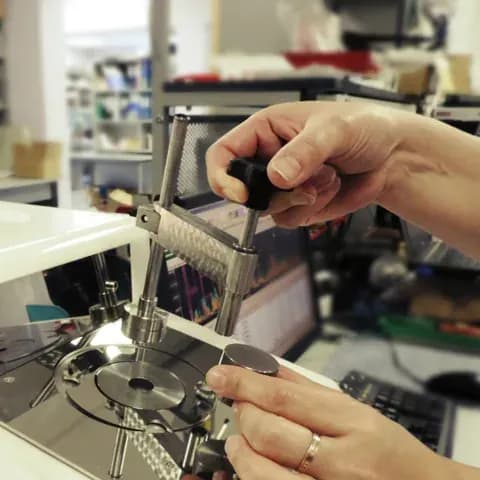
Lab test certificates
Tensile, chemical, salt spray and other tests on the steel, by third-party labs.
ISI-marked GI
GI pipes from Tata, Jindal or JSW steel, with a 15-year warranty.
Material for your Zunheboto project
We supply the complete material for subsidy projects in Nagaland from our Satara factory, about 2,980 km from Zunheboto. See the kit and live price for your structure:
Zunheboto within Nagaland
Among the 6 towns we supply in Nagaland, Zunheboto ranks 6th for summer heat and 4th for yearly rain. Other Nagaland towns on our list:
Buy from India's biggest CEA manufacturing company
Choose your structure and size and get the complete material list, priced this week.
FAQs
Is a polyhouse in Zunheboto eligible for NHB subsidy?
Yes, if the project is above 1,000 m² and set up as a commercial project with a bank loan. NHB gives a credit-linked, back-ended subsidy of 50% of project cost at its norms. Smaller projects can apply under MIDH through the Zunheboto district horticulture office.
How much subsidy can I get on 1 acre in Zunheboto?
For a 3,952 m² naturally ventilated polyhouse with high-value vegetables, up to about ₹21.93 lakh at NHB's hilly norms (50% of ₹43,86,720). The sanctioned figure depends on the approved project.
Is the subsidy paid on my bill or on the cost norm?
Usually on whichever is lower: your actual eligible cost or the admissible cost norm. Include every eligible cost (material, freight, erection, irrigation, planting material) in the project report.
Can I build first and apply later?
No. NHB requires In-Principle Approval before work starts, and MIDH applications are approved before the structure is built. Apply first.
Are hilly-area norms used in Nagaland?
Yes, Nagaland is treated as a hilly state, so cost norms are about 15% higher, which raises the subsidy.
Does the material need to be ISI-marked?
The schemes expect structures that conform to technical standards. Our GI pipes carry the ISI mark and every order ships with lab test certificates.
Subsidy projects near Zunheboto
The same guide for nearby towns, with the structure that suits each.
| Town | From Zunheboto | District | Cost norms | Suits |
|---|---|---|---|---|
| Subsidy project in Wokha | ~40 km | Wokha | Hilly | NVPH / nethouse |
| Subsidy project in Mokokchung | ~50 km | Mokokchung | Hilly | NVPH / nethouse |
| Subsidy project in Tuensang | ~60 km | Tuensang | Hilly | NVPH / nethouse |
| Subsidy project in Kohima | ~70 km | Kohima | Hilly | NVPH / nethouse |
| Subsidy project in Mariani | ~100 km | Jorhat | Hilly | NVPH / nethouse |
| Subsidy project in Dimapur | ~100 km | Dimapur | Hilly | NVPH / nethouse |