
NVPH materials · Jaipur district, Rajasthan
Naturally Ventilated Polyhouse Material for Jaipur
By Editorial Team, Kryzen Biotech · Updated 13 November 2026
A naturally ventilated polyhouse can suit Jaipur for much of the year, but it must be operated actively through the dry April–June heat, the wetter July–September period and cool January nights. For a crop that needs close summer temperature control, fan and pad cooling is the stronger option; for crops that can work with shade, open vents and seasonal management, an NVPH keeps cooling power costs out of the system.
- Hottest month
- May, ~42°C
- Humid (75%+)
- Rarely
- NVPH material, 1 acre
- ₹734/m²
- Delivery
- ~5 days
Can natural ventilation handle Jaipur’s weather?
Jaipur’s main NVPH challenge is heat rather than year-round humidity. May is the hottest month, with an average afternoon high of 41.6°C, 23% humidity and the strongest sun at 7.2 kWh/m²/day. June remains very hot at 40.5°C, while nights are also warm at 28.7°C. Opening the roof vent and side curtains maximises the natural movement of air: cooler air enters through the sides and warm air leaves through the roof. But ventilation cannot bring the inside temperature down to a precise target in these peak-heat months.
The rainy period changes the operating priority. Rain rises to 158 mm in July and 172 mm in August, while humidity reaches 62% and 73% respectively. Day highs ease to 35.8°C in July and 33.1°C in August, but the curtains and crop need more observation so that rain does not enter while humid air is not unnecessarily trapped. September is still humid at 64%, with 63 mm rain. From October, conditions become drier and cooler. January has a 22.3°C average high but a 6.8°C average night low, so night-side opening should not be treated the same way as summer.
The month-by-month table below is the practical reference for deciding when heat rejection, rain protection or night protection should be the priority.
- April–June: dry, high-sun period; heat management is critical.
- July–September: lower daytime heat but higher humidity and rain; manage openings around rainfall.
- November–February: cooler days and notably cool nights; avoid leaving curtains fully open after daytime ventilation.
| Month | Afternoon high | Night low | Humidity | Rain | Sun (kWh/m²/day) | Wind (m/s) |
|---|---|---|---|---|---|---|
| Jan | 22.3°C | 6.8°C | 36% | 5 mm | 4 | 1.6 |
| Feb | 26.3°C | 9.8°C | 32% | 10 mm | 5.1 | 1.8 |
| Mar | 32.3°C | 15.5°C | 27% | 10 mm | 6.2 | 2 |
| Apr | 38.3°C | 21.9°C | 21% | 10 mm | 7 | 2.3 |
| May | 41.6°C | 26.8°C | 23% | 18 mm | 7.2 | 3.1 |
| Jun | 40.5°C | 28.7°C | 38% | 61 mm | 6.5 | 3.2 |
| Jul | 35.8°C | 26.5°C | 62% | 158 mm | 5.3 | 2.8 |
| Aug | 33.1°C | 24.5°C | 73% | 172 mm | 5 | 2.3 |
| Sep | 33.7°C | 22.5°C | 64% | 63 mm | 5.5 | 2 |
| Oct | 33.1°C | 18.5°C | 43% | 10 mm | 5.3 | 1.6 |
| Nov | 28.5°C | 13.7°C | 35% | 4 mm | 4.2 | 1.5 |
| Dec | 23.9°C | 8.7°C | 35% | 3 mm | 3.8 | 1.5 |
A working calendar for vents, curtains and shade
In January and February, use daytime opening when the house warms up, then reduce the side opening as the evening cools. January’s average night low is 6.8°C and February’s is 9.8°C. March begins the rapid rise in heat, reaching 32.3°C by afternoon, and April reaches 38.3°C. Start opening the side curtains early enough to clear built-up heat rather than waiting for the crop to show stress.
May needs the most deliberate routine: roll the curtains fully up, close the shade net or second layer over the crop, and irrigate early in the day. June needs the same heat response, with an average high of 40.5°C. Keep the roof vent available as the top outlet for hot air. In July and August, operate side curtains with the rain event in mind; do not use a fixed summer setting when rainfall is 158 mm and 172 mm. September is a transition month, then October’s 33.1°C days and 18.5°C nights allow more comfortable daytime ventilation.
In November and December, sunlight falls to 4.2 and 3.8 kWh/m²/day and night lows reach 13.7°C and 8.7°C. Use the available daylight and avoid unnecessary late-day opening. This is an operating plan, not an automatic climate-control system: check crop condition and weather on the day before changing the curtain position.
- Open the roof vent and side curtains for maximum natural airflow during peak heat.
- Use shade over the crop in May and manage irrigation early in the day.
- Adjust rather than permanently close curtains during the July–September rain period.
- Reduce side opening after daytime ventilation in the cool-night season.
| Month | Jan | Feb | Mar | Apr | May | Jun | Jul | Aug | Sep | Oct | Nov | Dec | Detail |
|---|---|---|---|---|---|---|---|---|---|---|---|---|---|
| Peak heat | ~42°C highs | ||||||||||||
| Strongest sun | 7.2 kWh/m²/day |
- 1
May
Peak heat, about 42°C. Roll the curtains fully up, close the shade net or second layer over the crop, and irrigate early in the day.
Material changes worth specifying for Jaipur
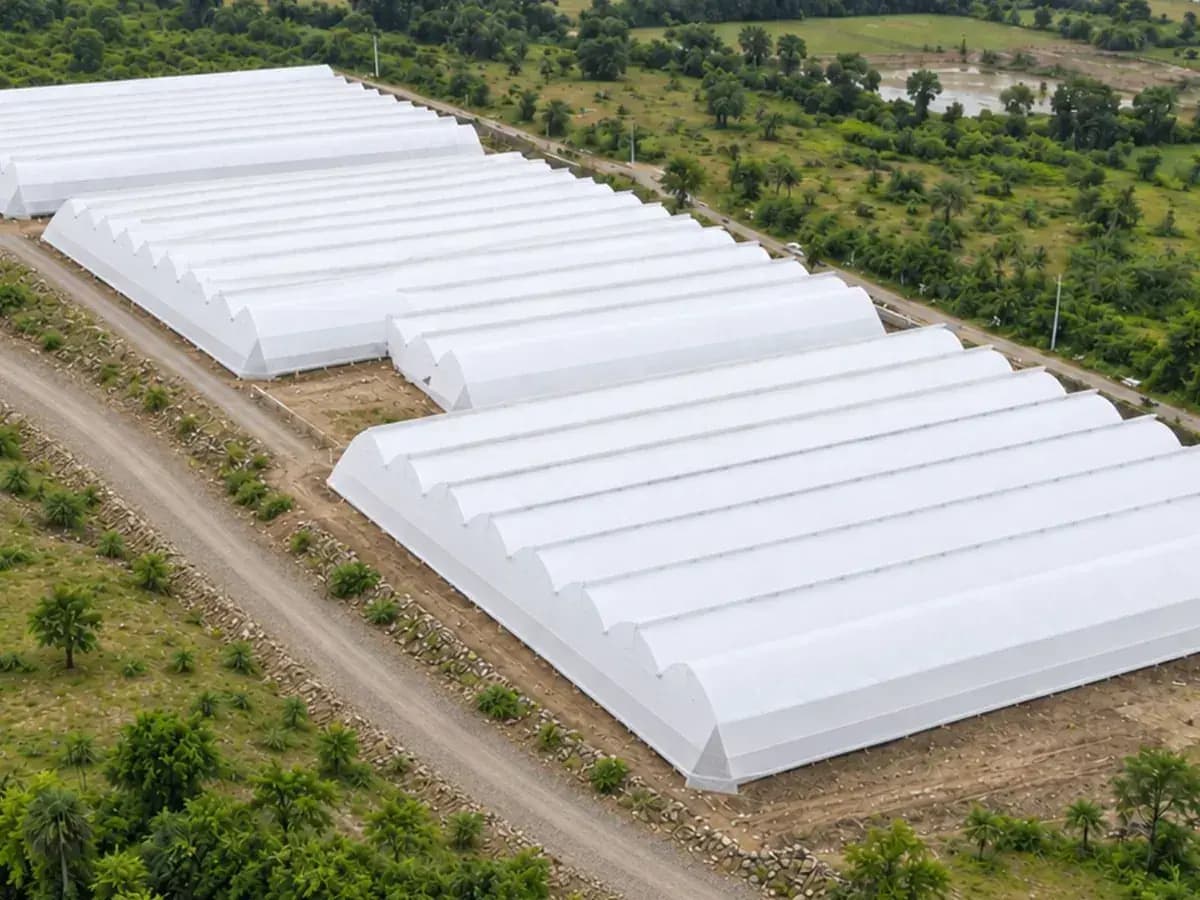
The standard NVPH material set already addresses the basic climatic needs: a roof vent with side curtains for airflow, 250-micron white diffused polyfilm, side insect net, FRP doors and GI gutters with funnels. The white diffused roof film should be retained because it spreads Jaipur’s intense May sunlight evenly. The annual rainfall is 524 mm, close to the Rajasthan average of 514 mm, so gutters remain part of the required rainwater-management arrangement rather than an optional add-on.
For Jaipur’s hottest period, select aluminium shade net instead of the standard white 50% shade net. Its stated purpose is to reflect heat back out at 42°C. Add a second net layer, operated with ropes and pulleys, so it can be opened or closed by season. This allows stronger shading in the May heat without carrying the same shade arrangement unchanged into the lower-sun winter months.
Keep side insect net and consider the optional entry cabin where people enter frequently. The cabin uses a double-door arrangement to help keep whitefly and thrips out. FRP doors are the recommended door choice for this climate. These selections improve how the NVPH is managed; they do not convert it into a fan-and-pad cooled house.
- Keep: 250-micron white diffused roof film, roof vent, curtains, FRP doors and GI gutters.
- Change: specify aluminium reflective shade net for peak heat.
- Add: a seasonally operated second net layer.
- Optional: entry cabin for a double-door entry arrangement.
| Part | Standard kit | For Jaipur | Why |
|---|---|---|---|
| Roof film | 250-micron white diffused polyfilm | Keep | Spreads May's 7.2 kWh/m²/day of sunlight evenly |
| Shade net | White 50% | Aluminium Shade Net (4 m) | Reflects heat back out at 42°C |
| Second net layer | None | Add (double layer) | Open or close it by the season with ropes and pulleys |
| Air circulation | Roof vent + curtains | Keep | Natural airflow is enough |
| Doors | FRP (fibre) doors | Keep FRP | FRP lasts well in this climate |
| Gutters | GI gutter sheet + funnels | Keep | About 524 mm a year |
| Entry cabin | Optional | Optional | A double door keeps whitefly and thrips out when people walk in |
What comes in a Jaipur NVPH material kit
Polyhouse Constructions supplies complete material kits from its Degaon, Pune–Bangalore Highway factory at Tal. Wai, Satara, Maharashtra. A kit combines GI structure, polyfilm, nets and fittings; it is not a generic pipe-only supply. Jaipur is 1,320 km from the factory, and delivery is stated as 5 days after dispatch. Construction or erection, where required, is done by Kryzen Biotech’s construction team rather than by a Jaipur office.
For the 20 × 24 m example, the kit has 67 items in all and about 2.5 tonnes of steel and fittings. The largest listed GI members include 22 Side Hockey pieces, 18 Small Columns, 8 Big Bottom members, 18 Hockey Runners and 12 Big Arcs. It also includes 158 m of 4.5 m polyfilm, 73 m of 5.5 m polyfilm, 90 m of side insect net, 80 m of white 50% shade net, four manual gear roll-up curtain units and two fibre doors. For Jaipur, the shade-net choice can be changed as described above.
The structure uses ISI-marked branded steel from Tata, Jindal and JSW. The stated warranties are 15 years on the GI structure, 2.5 years on polyfilm and 3 years on nets. Every dispatch has a lab test certificate and each product has a technical data sheet.
- Build the exact kit online to see every item, quantity, weight and current rate.
- Material is manufactured and supplied from Satara; Polyhouse Constructions does not claim a Jaipur office.
- Booking is with 5% advance and 95% before dispatch.
| Group | Item | Quantity | Weight |
|---|---|---|---|
| GI structure | Side Hockey (60X2.0X5500) | 22 nos | 378 kg |
| GI structure | Small Column (76X2.0X4500) | 18 nos | 305 kg |
| GI structure | Big Bottom (60X2.0X8000) | 8 nos | 200 kg |
| GI structure | Hockey Runner (42X2.0X4000) | 18 nos | 150 kg |
| GI structure | Big Arc (42X2.0X5200) | 12 nos | 130 kg |
| Film & nets | Polyfilm White Diffused 250 Micron (4.5 m) | 158 mtr | — |
| Film & nets | Polyfilm White Diffused 250 Micron (5.5 m) | 73 mtr | — |
| Film & nets | Side Insect Net (5.2 m) | 90 mtr | — |
| Film & nets | Side Skirting Apron (1.5 m) | 90 mtr | — |
| Film & nets | White Shade Net 50% | 80 mtr | — |
| Fittings & accessories | Aluminium Profile | 500 mtr | — |
| Fittings & accessories | GI Spring | 900 mtr | — |
| Fittings & accessories | Manual Gear Roll Up Curtain Unit | 4 nos | — |
| Fittings & accessories | Fibre Door | 2 nos | — |
| Fittings & accessories | F Bracket | 24 nos | — |
This week’s material price and what it excludes
The current NVPH prices below are material-only, including GST and ex-factory. Freight to Jaipur and erection are extra, so keep them separate when comparing a project estimate. Weekly GI and plastic rates are updated every Friday; the online kit builder is the right place to check the live line-item rate for the chosen span and bay.
At 480 m², the 20 × 24 m small kit is ₹4,68,814, or ₹977/m². The 28 × 36 m, 1,008 m² medium kit is ₹8,59,963, or ₹853/m². The 52 × 76 m option, described as about 1 acre and measuring 3,952 m², is ₹28,99,897, or ₹734/m². The lower material rate per m² on larger houses reflects shared gutters, end frames and doors.
If buying individual items, there is a 5% bulk discount on 10 or more units of an item. A complete online build is still useful for a Jaipur project because it identifies the exact material quantities before freight and erection are considered.
- Small: 20 × 24 m, 480 m² — ₹4,68,814.
- Medium: 28 × 36 m, 1,008 m² — ₹8,59,963.
- About 1 acre: 52 × 76 m, 3,952 m² — ₹28,99,897.
| Size | Span × bay | Area | Material incl. GST | Per m² |
|---|---|---|---|---|
| Small | 20 × 24 m | 480 m² | ₹4,68,814 | ₹977 |
| Medium | 28 × 36 m | 1,008 m² | ₹8,59,963 | ₹853 |
| About 1 acre | 52 × 76 m | 3,952 m² | ₹28,99,897 | ₹734 |
Price your own size for Jaipur
Choose span and bay and get the full list with quantities, weights and rates in a minute.
Crop planning around Jaipur mandi price seasons
Choose the NVPH crop and planting schedule with price season in view, not only the structure’s climate. Jaipur district market data covers Udaipur (F&V) APMC, Chomu FV APMC, Jaipur (F&V) APMC and Bassi APMC among the listed markets. The table below gives modal-price observations from the last two years, in ₹ per quintal; it is a price reference, not a promise of the price at harvest.
Cucumber is a natural crop to study for an NVPH plan because it has an average modal price of ₹2,082/q across seven markets and its highest listed month is July at ₹2,480/q; April is its low month at ₹1,388/q. Tomato averages ₹2,046/q across nine markets, peaking in August at ₹3,425/q and reaching its low in February at ₹967/q. Both need a crop calendar that considers Jaipur’s severe April–June heat before targeting a market month.
For other choices, green chilli has its highest listed month in February at ₹3,665/q, bitter gourd in February at ₹4,176/q, brinjal in November at ₹2,253/q and bhindi in December at ₹5,251/q. Cauliflower peaks in July at ₹3,417/q. These peak months can help compare cropping windows, but crop suitability must also be judged against the heat, rain and level of climate control available in an NVPH.
- Do not base crop choice on the average price alone; note both the high and low months.
- April and May are low-price months in the listed data for cucumber, bottle gourd, chilli, brinjal, bhindi and bitter gourd.
- Match the expected harvest period with market season and the house’s ability to manage Jaipur heat.
| Crop | Markets | Average modal price | Highest month | Lowest month |
|---|---|---|---|---|
| Tomato | 9 | ₹2,046/q | Aug (₹3,425) | Feb (₹967) |
| Cucumber | 7 | ₹2,082/q | Jul (₹2,480) | Apr (₹1,388) |
| Bottle gourd | 7 | ₹1,469/q | Sep (₹1,845) | Apr (₹1,030) |
| Green chilli | 7 | ₹2,680/q | Feb (₹3,665) | May (₹1,580) |
| Cauliflower | 7 | ₹2,369/q | Jul (₹3,417) | Jan (₹1,214) |
| Brinjal | 7 | ₹1,731/q | Nov (₹2,253) | May (₹1,304) |
| Cabbage | 7 | ₹1,299/q | Nov (₹2,201) | Mar (₹657) |
| Okra (bhindi) | 7 | ₹3,425/q | Dec (₹5,251) | May (₹2,025) |
| Bitter gourd | 6 | ₹2,936/q | Feb (₹4,176) | May (₹1,739) |
| Spinach | 5 | ₹1,556/q | Sep (₹2,438) | Feb (₹937) |
When fan and pad is the better Jaipur choice
An NVPH cools through roof vents and side curtains without cooling electricity consumption. It is listed as suitable in Jaipur for capsicum, cucumber, tomato and flowers. Its one-acre material price is ₹28,99,897, or ₹734/m². For farmers seeking lower initial material cost and no power use for cooling, this is the practical comparison point.
Fan and pad uses exhaust fans and wet pads. In Jaipur’s May conditions it is stated to achieve about 30°C inside, compared with the NVPH relying on airflow and shading while outside average highs reach 41.6°C. Its listed one-acre material price is ₹32,48,775, or ₹822/m², and it adds electricity use for fans and a pump. It is identified for leafy greens and crops needing tight control in summer.
Therefore, select an NVPH when the crop plan can work with seasonal vent, curtain and shade management. Move to fan and pad when the summer production plan depends on tighter temperature control rather than accepting the limitations of natural ventilation during May and June.
- NVPH: no power for cooling; roof vent and side curtains.
- Fan and pad: approximately 30°C inside in May, with fan and pump electricity use.
- The decision is primarily about the required level of summer control.
| Naturally ventilated | Fan & pad | |
|---|---|---|
| Cooling | Roof vent and side curtains (no power) | Exhaust fans and wet pads, ~30°C inside in May |
| Running cost | None for cooling | Electricity for fans and a pump |
| Material price, 1 acre | ₹28,99,897 (₹734/m²) | ₹32,48,775 (₹822/m²) |
| Suits in Jaipur | Capsicum, cucumber, tomato, flowers | Leafy greens and crops needing tight control in summer |
Buy from India's biggest CEA manufacturing company
Choose your structure and size and get the complete material list, priced this week.
FAQs
Will an NVPH be too hot in Jaipur during May?
May has an average high of 41.6°C and the strongest sun at 7.2 kWh/m²/day, so it is the limiting month for a naturally ventilated house. Use fully raised curtains, roof ventilation, aluminium shade net and the second seasonal net layer; choose fan and pad if the crop requires close summer temperature control.
What is the material price for a naturally ventilated polyhouse in Jaipur?
This week’s ex-factory material price including GST is ₹4,68,814 for a 20 × 24 m kit, ₹8,59,963 for 28 × 36 m, and ₹28,99,897 for a 52 × 76 m kit. Freight to Jaipur and erection are extra, and rates update every Friday.
Which curtain setting is suitable during Jaipur’s monsoon?
July and August have 158 mm and 172 mm average rain, with humidity of 62% and 73%. Manage side curtains around rain rather than leaving them at a fixed peak-summer setting, while retaining roof ventilation and avoiding unnecessary trapping of humid air.
Which crops should I compare for a Jaipur NVPH?
Compare cucumber, tomato, green chilli, bitter gourd, brinjal, bhindi and cauliflower against their expected harvest months. In the district data, cucumber peaks in July at ₹2,480/q, tomato in August at ₹3,425/q, green chilli in February at ₹3,665/q and bhindi in December at ₹5,251/q.
Does Polyhouse Constructions have a Jaipur office or provide construction?
Polyhouse Constructions manufactures and supplies material from its Satara factory and does not state that it has a Jaipur office. Construction or erection is done by Kryzen Biotech’s construction team, and delivery to Jaipur is stated as 5 days after dispatch.
NVPH materials near Jaipur
Neighbouring towns on the same delivery route, and how their summers compare.
| Town | From Jaipur | Hottest month | Humid months | Suits |
|---|---|---|---|---|
| NVPH materials in Phulera | ~70 km | May, 41°C | 0 | NVPH + fan & pad |
| NVPH materials in Reengus | ~70 km | May, 41°C | 0 | NVPH + fan & pad |
| NVPH materials in Shahpura (Bhilwara area) | ~70 km | May, 43°C | 0 | NVPH + fan & pad |
| NVPH materials in Shahpura (Jaipur area) | ~70 km | May, 42°C | 0 | NVPH + fan & pad |
| NVPH materials in Sambhar | ~80 km | May, 41°C | 0 | NVPH + fan & pad |
| NVPH materials in Sri Madhopur | ~80 km | May, 41°C | 0 | NVPH + fan & pad |